 Sudden Valley Siding
 Sehome's Exterior Challenge: Salt Air, Driving Rain, and a Long Moss Season
Homes in and around Sehome sit in one of the wettest corners of Washington State, and the exterior of a house here works harder than it does almost anywhere else in the country. Whatcom County gets a steady diet of driving, wind-blown rain for much of the year, and proximity to Bellingham Bay adds a layer of salt-laden air that most siding, trim, and fastener systems were never engineered to handle long-term. Add in the shade from mature tree cover common in established neighborhoods, and you get a fourth factor: a moss and algae season that can run eight months or more.
None of this means a home in Sehome is doomed to constant repairs. It means the exterior materials and installation details matter more here than they would in a dry climate, and that a contractor who doesn't understand Pacific Northwest moisture behavior is going to leave gaps that show up as problems two, five, or ten years down the road.
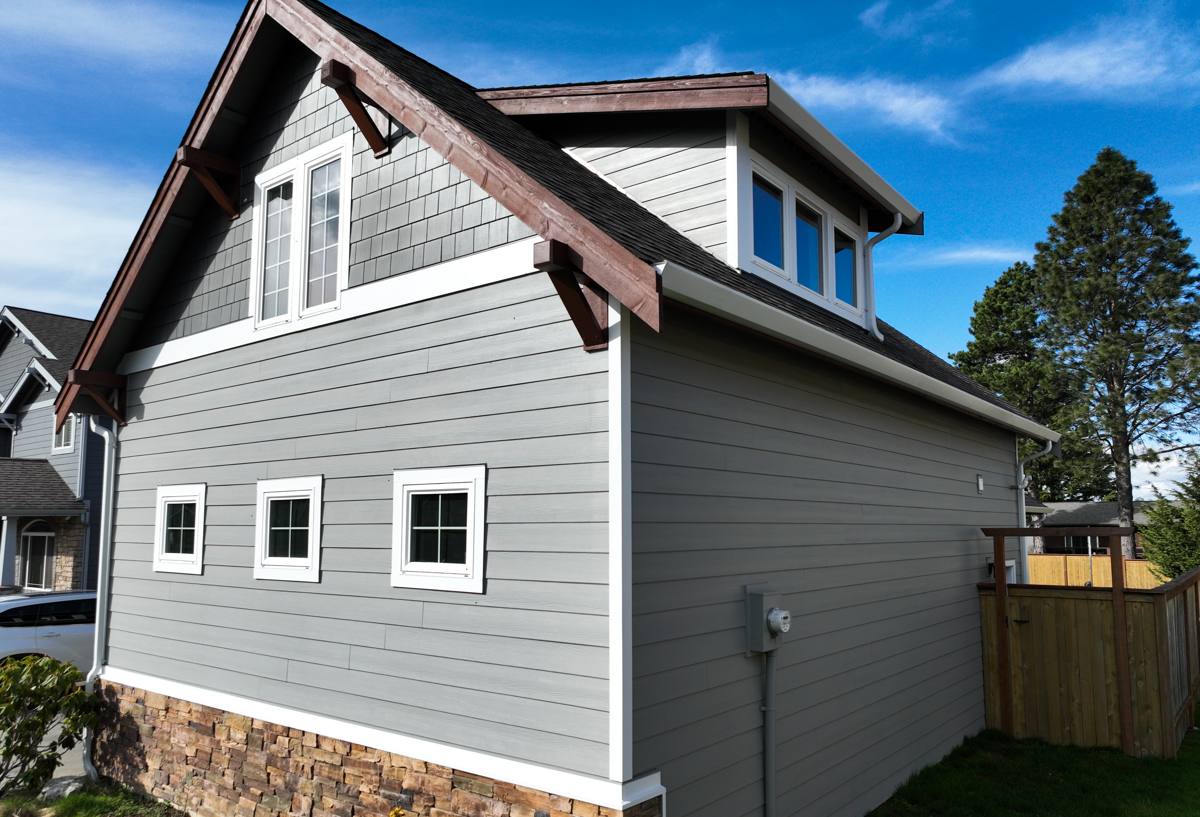
How Whatcom County Weather Actually Attacks a House
Wind-Driven Rain
Rain that falls straight down is manageable. Rain that gets pushed sideways by wind — which is the normal pattern off the Salish Sea — finds every seam, lap joint, and fastener penetration in a wall system. Over years, water that gets behind siding rather than running off it is what causes rot in sheathing and framing, not the rain itself.
Salt Air Corrosion
Airborne salt accelerates corrosion in metal flashing, fasteners, and hardware, and it can degrade certain paint and coating systems faster than inland exposure would. This is a slow, cumulative effect, which is exactly why it gets overlooked until a homeowner is dealing with rust streaks or failed caulk lines at year eight or ten instead of year twenty.
Moss, Algae, and Shade
Tree-shaded lots hold moisture longer after a storm passes, and that constant dampness is what moss and algae need to take hold on roofing, siding, and decking. Beyond the cosmetic issue, moss holds water against a surface and can work into seams and fastener heads, which shortens the life of whatever it's growing on.
Why We Install Only James Hardie Fiber Cement Siding
We made a deliberate decision to standardize on James Hardie fiber cement siding for every home we side, including in Sehome. That's not a marketing preference — it's a response to exactly the conditions described above.
Non-Combustible Material
Fiber cement is manufactured from cement, sand, and cellulose fiber, and it does not burn. In a region where wildfire smoke and dry-season fire risk are an increasing part of the conversation even in traditionally wet counties, that's a real advantage over wood-based or polymer siding products.
Climate-Engineered HZ Product Lines
James Hardie manufactures regional HZ formulations specifically calibrated for different moisture and freeze-thaw conditions across the country. For the Pacific Northwest, that means a product engineered around sustained damp exposure rather than a one-size-fits-all formulation.
Factory-Applied ColorPlus Finish
Hardie's ColorPlus finish is baked on at the factory under controlled conditions, which gives more consistent, durable color and adhesion than field-applied paint. It also comes backed by its own finish warranty, separate from the substrate warranty on the siding itself.
A Strong, Transferable Warranty
James Hardie backs its siding with a long, transferable limited warranty. That transferability matters to homeowners who may sell within the warranty period — it's a real asset that shows up in a home inspection, not just paperwork.
What We Don't Install, and Why That's on Purpose
Part of being straightforward with homeowners means explaining what we've chosen not to offer.
Vinyl Siding
Vinyl is inexpensive and easy to install, but it's a thin plastic product that can warp in temperature swings, fade over time, and offers little in the way of impact resistance. In a climate defined by wind and moisture rather than heat, its main selling points don't line up with what actually matters here.
LP SmartSide and Similar Engineered Wood Products
Engineered wood siding has improved over the decades, but it is still a wood-based product, and wood-based products are inherently more vulnerable to sustained moisture exposure than cement-based ones. In a county with our rainfall totals and humidity, that's a meaningful long-term maintenance and moisture-risk difference.
Cedar and Primed Spruce
Real wood siding can look excellent, and we understand its appeal. But it demands a disciplined recoating and caulking schedule to hold up against constant damp exposure, and skipping even one cycle can let moisture in behind the finish. That's a maintenance commitment many homeowners underestimate when they choose it.
Cemplank and Allura
These are other fiber cement manufacturers, and fiber cement as a category is sound. We standardized specifically on James Hardie's HZ engineering, ColorPlus finish process, and warranty structure rather than installing multiple competing fiber cement lines, so our crews stay deeply practiced on one system rather than moderately familiar with several.
Comparing Siding Options for a Whatcom County Home
| Material | Moisture Resilience Here | Maintenance Burden | Typical Lifespan |
|---|---|---|---|
| James Hardie Fiber Cement | High — cement-based, HZ regional engineering | Low — factory finish, occasional wash | Multiple decades with proper install |
| Vinyl | Moderate — doesn't rot but can warp/crack | Low, but fades and is hard to repair invisibly | 15–25 years typical |
| LP SmartSide / Engineered Wood | Moderate — vulnerable at cut edges and seams | Moderate — coating maintenance matters | Varies widely with maintenance |
| Cedar / Primed Spruce | Lower without diligent upkeep | High — recoating and caulk cycles required | Depends heavily on maintenance discipline |
This isn't a claim that any of these alternatives are defective products — they all have a place in the market. It's an honest look at which one asks the least of a homeowner in this specific climate, which is why fiber cement is what we put on houses.
How We Approach a Siding Project in Sehome
Every property is different, but the sequence we follow is consistent, because it's built around the same moisture-management principles regardless of the house.
- Inspect the existing wall assembly for hidden rot, especially around windows, corners, and any area with a history of leaks.
- Confirm or install a proper water-resistive barrier and correctly lapped flashing before any siding goes up — this is the step that determines how the wall performs in wind-driven rain, and it's invisible once the job is done.
- Install James Hardie panels or lap siding to manufacturer specification, including proper fastener spacing, clearances at grade and roof lines, and caulking only where Hardie's installation guidelines call for it.
- Detail penetrations — hose bibs, vents, light fixtures, meter boxes — with the same care as the field siding, since these small spots are where most real-world leaks start.
- Final walk-through so the homeowner understands what maintenance, if any, the new siding actually requires.
Roofing, Windows, and Decks: The Rest of the Exterior Envelope
Siding doesn't work in isolation. A roof that's shedding water improperly, windows with failed flashing, or a deck holding moisture against the house band board can all undermine even a well-installed siding job. Because we handle roofing, windows, and decks as well as siding, we look at a Sehome home's exterior as one connected system rather than a series of unrelated projects.
Roofing
Moss buildup and prolonged dampness are the main long-term threats to roofing in this area. Proper ventilation, correct flashing at valleys and penetrations, and material choice all affect how well a roof sheds our rain volume and resists moss colonization in shaded areas.
Windows
Window flashing that isn't integrated correctly with the surrounding siding is one of the most common sources of hidden water intrusion we find when we open up a wall. Replacing windows and siding together lets us tie the flashing details into one continuous water-management plane.
Decks
Decks attached to the house need a properly flashed ledger board and drainage that directs water away from the siding above and below it — a detail that's easy to get wrong and expensive to fix once siding is finished over it.
Choosing a Local Contractor: What to Ask
Whatcom County's climate punishes shortcuts, so the questions that matter most here are about moisture management and installation detail, not just price.
- Ask how they detail flashing at windows, doors, and roof-to-wall intersections — vague answers here are a red flag.
- Ask which siding manufacturer's installation instructions they follow, and confirm they'll pull the required permits and inspections.
- Ask whether their crew is factory-trained on the specific siding product being installed, not just experienced with siding in general.
- Ask what warranty covers labor versus what the manufacturer covers on materials, and get it in writing.
- Ask for references from projects completed in this climate at least a few years back, so you can see how the work has actually held up, not just how it looked on installation day.
Living with Fiber Cement Siding in a Wet Climate
One of the practical advantages of James Hardie siding in this climate is how little ongoing maintenance it demands compared to wood-based alternatives. An occasional gentle wash to keep algae and grime from building up in shaded areas is typically enough. There's no recoating schedule to track and no soft spots to worry about from trapped moisture behind the panels, provided the installation was done correctly in the first place — which is why correct installation, not just material choice, is the real determinant of how a siding job performs over the following twenty or thirty years.
If you're weighing a siding, roofing, window, or deck project for your Sehome-area home and want an honest assessment of what your exterior actually needs, we're happy to take a look and provide a free, no-pressure estimate.