 Sudden Valley Siding
 Siding Built for Cordata's Weather, Not Just Its Looks
Cordata sits in the northern stretch of Whatcom County, close enough to the Salish Sea and the Nooksack lowlands that homes here take on a specific combination of weather stress: salt-tinged marine air, long stretches of driving rain off the water, and a moss season that can run from October well into spring. None of that is dramatic on any single day. It's the accumulation, year after year, that determines whether a home's exterior is still doing its job at year fifteen or already failing at year eight.
We're a local crew working out of Sudden Valley, and Cordata is regularly in our service rotation. That matters more than it sounds like it should. A siding job done right depends on someone who has actually stood on a Whatcom County roof in February rain, who knows which wall orientations grow moss first, and who isn't guessing at flashing details because they installed their last job in a dry climate three states away.
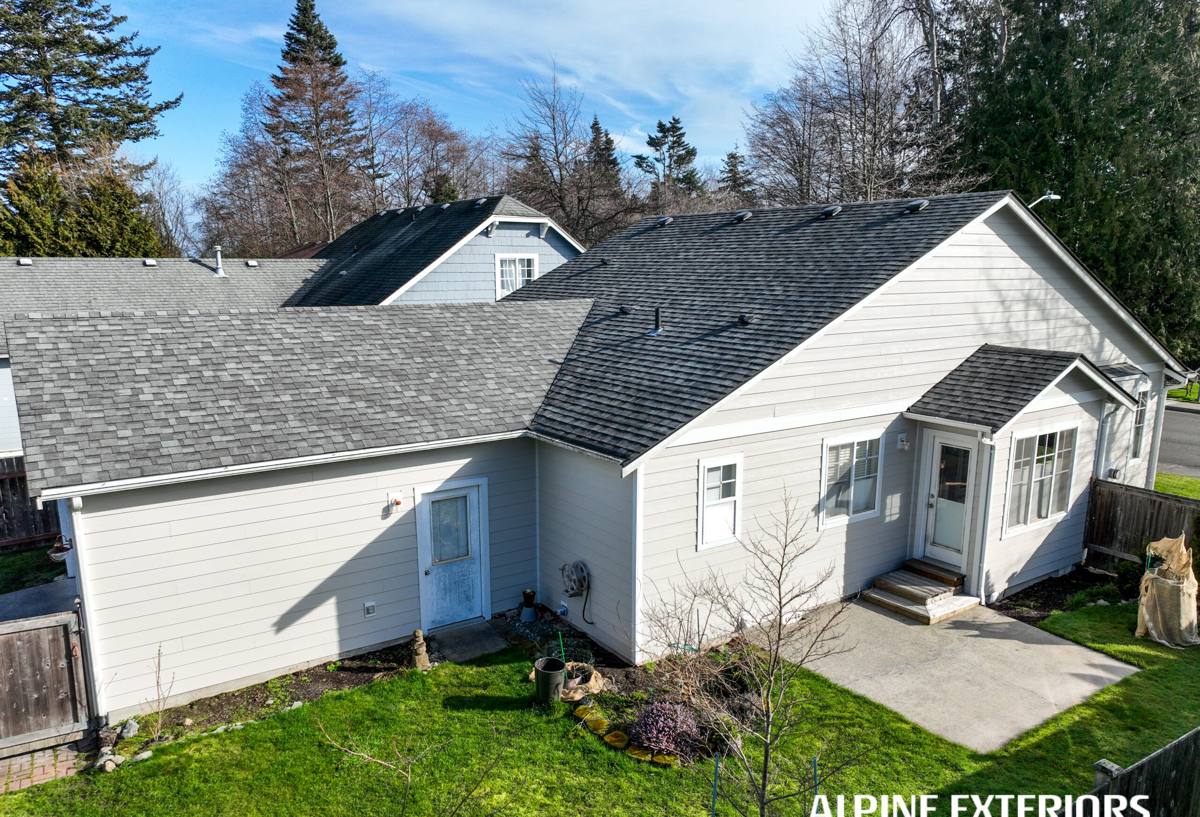
What Cordata Homes Are Up Against
Salt Air and Moisture
Cordata isn't oceanfront, but it's close enough to the Salish Sea that homes get intermittent salt-laden air, especially on windier days. Salt air accelerates corrosion on fasteners, trim metal, and any exposed hardware, and it speeds up the breakdown of finishes that aren't rated for it. Combined with near-constant regional humidity, it's a slow but steady attack on anything not built to shrug it off.
Driving Rain
Whatcom County doesn't get the heaviest rainfall totals in the state, but it gets frequent, wind-driven rain that hits siding at an angle rather than falling straight down. That matters for water management. Any siding system with weak seams, poor lap coverage, or gaps at trim and window returns will eventually let water behind the cladding — and once water is behind the siding, the sheathing and framing are what pay for it, not just the surface finish.
Moss and Prolonged Dampness
North-facing walls, shaded elevations, and anything tucked under mature trees stay damp for extended stretches through fall, winter, and early spring. That's exactly the environment moss and mildew need. Materials that absorb moisture or have porous surfaces give moss something to grip onto and feed from. Materials that shed water and don't swell keep it from getting a foothold in the first place.
Why We Only Install James Hardie Fiber Cement
We get asked fairly often why we don't offer vinyl, LP SmartSide, or other engineered wood options. The honest answer is that we made a standardization decision years ago based on what actually holds up in this climate, not based on what's cheapest to install or easiest to sell.
- Non-combustible material — fiber cement doesn't burn, which matters increasingly in a region with longer, drier summer stretches and wildfire smoke seasons even here in the wetter part of the state.
- Doesn't absorb water the way wood-based products can — fiber cement is dimensionally stable and resists the swell-shrink cycle that opens joints and cracks paint on organic materials.
- Factory-applied ColorPlus finish — baked-on, not field-applied, so it resists the fading and chalking that Pacific Northwest UV and moisture cycles cause on site-painted siding.
- Climate-engineered HZ product lines — Hardie makes region-specific formulations for wet, humid climates like ours, rather than a one-size-fits-all product.
- Strong transferable warranty — meaningful if you sell the home, which matters in a market like Cordata's where turnover happens.
We're not going to tell you vinyl or engineered wood siding is garbage — that's not honest, and it's not our call to make about a product installed correctly on millions of homes. What we will say is that after weighing the maintenance burden, moisture behavior, and long-term performance of the alternatives against what fiber cement does in this specific climate, we decided we'd rather install one product exceptionally well than several products adequately. That's the whole reason this business exists in its current form.
How We Approach a Cordata Siding Job
Assessment First
Before we talk product colors or timelines, we look at what's actually happening behind the current siding. In a lot of Whatcom County homes we open up, especially ones with older wood or vinyl siding, we find moisture staining, soft sheathing, or evidence of past moss and mildew intrusion that the homeowner never saw from the outside. That assessment changes the scope of work, and we tell you before we start, not after we've already opened a wall.
Moisture Management Details
The siding material is only part of the system. Flashing at windows, doors, and roof intersections; proper weather-resistive barrier lapping; correct fastener placement; and rainscreen or drainage gap detailing where called for — these are the details that determine whether a driving rainstorm off the Salish Sea stays outside the wall or gets behind it. We follow manufacturer installation specs closely because that's also what keeps the warranty valid.
Installed to Manufacturer Spec
James Hardie's warranty is only as good as the installation behind it. Improper nailing, wrong clearances, or skipped caulking at joints can void coverage even on a premium product. We install to spec because it's the only way the material performs the way it's engineered to.
Comparing Siding Options for This Climate
| Factor | James Hardie Fiber Cement | Vinyl | Engineered Wood (LP-type) |
|---|---|---|---|
| Moisture absorption | Very low | Doesn't absorb, but seams/panels can trap water behind them | Moderate — engineered to resist, but still wood-based |
| Salt air resistance | Strong | Generally fine, but fasteners/trim can corrode | Moderate, dependent on finish integrity |
| Moss/mildew resistance | High — dense, low-porosity surface | High on the surface itself | Moderate — depends on finish and maintenance |
| Fire rating | Non-combustible | Combustible | Combustible |
| Finish longevity | Factory-baked ColorPlus, long fade resistance | Color molded in, can fade/chalk over time | Field or factory paint, needs recoating over time |
| Typical maintenance | Occasional wash, minimal repainting | Low, but prone to cracking in impact/cold | Regular inspection for edge swelling, recoating cycles |
Beyond Siding: How the Other Trades Tie In
We also handle roofing, windows, and decks, and in Whatcom County these systems don't operate independently. A roof with poor drip-edge or flashing detailing dumps extra water onto the wall below it. Old windows with failed sealant are a direct path for the driving rain that hits Cordata homes. A deck attached to the house without proper ledger flashing is one of the more common sources of hidden rot we find. When we're on-site for a siding project, we're looking at the whole envelope, not just the wall cladding, because moisture problems rarely respect trade boundaries.
What to Expect From a Local Crew
Working with a crew based nearby in Sudden Valley rather than a regional company dispatching from out of the area has practical effects:
- We know how Whatcom County weather windows work and schedule installs around actual dry-weather stretches, not just a generic calendar.
- We're available for follow-up if something needs attention after the job — not a phone number that rings a different state.
- We've seen how different products and details perform on homes in this specific area over multiple wet seasons, not just on a spec sheet.
- Local reputation matters to us because we're still going to be working in this county next year and the year after.
Signs Your Cordata Home May Need Siding Attention
- Persistent moss or dark streaking on north-facing or shaded walls
- Soft spots, bubbling, or visible warping in the siding material
- Paint that's peeling or chalking faster than it should
- Visible gaps or separation at seams, corners, or trim boards
- Rising energy bills that might point to compromised insulation behind failing siding
- Musty smells or discoloration on interior walls near exterior corners
Any one of these on its own isn't necessarily an emergency, but they're worth having looked at before a wet Whatcom County winter turns a surface issue into a structural one.
Cost Factors Worth Understanding Up Front
We don't publish blanket pricing because every home's scope is different, but a few factors consistently drive cost on Cordata-area projects:
| Factor | Why It Affects Cost |
|---|---|
| Condition of existing sheathing | Moisture damage found during tear-off adds repair scope |
| Home size and wall complexity | More corners, dormers, and trim detail means more labor |
| Siding profile chosen | Lap width, shingle-style, or panel systems vary in material and labor cost |
| Trim and accessory scope | Full trim replacement adds cost versus reusing sound existing trim |
| Access and site conditions | Steep lots, tight setbacks, or landscaping can affect labor time |
An accurate number only comes from seeing the actual home, which is the whole point of a free estimate rather than a phone quote.
If your Cordata home is due for new siding, or you're just not sure whether what you're seeing is a real problem or a cosmetic one, we're glad to come take a look. The estimate is free, there's no pressure, and you'll get a straight answer about what your home actually needs.