 Sudden Valley Siding
 Homeowners in Sudden Valley ask us fairly often why we don't offer a menu of siding options the way some contractors do. It's a reasonable question—more choices usually sound like a good thing. But after years of tear-offs, warranty claims, and callbacks on homes around Lake Whatcom and the broader Whatcom County area, we made a deliberate decision to install only James Hardie fiber cement siding. This page explains the reasoning, not as a sales pitch, but as the honest thinking behind a standard we hold ourselves to.
The Climate We're Actually Building For
Sudden Valley sits in a microclimate that's tougher on exterior building materials than people expect. You've got moisture off Lake Whatcom, salt-tinged air rolling in from Bellingham Bay and the Strait of Georgia on windy days, driving rain that comes in sideways during fall and winter storms, and a shaded, forested landscape that keeps siding damp long after a storm passes. Add it up and you get a moss season that can stretch from October into April in the shadier lots. Siding here isn't just cladding—it's the first line of defense against a slow, steady moisture assault that never really stops.
That reality shaped our material decision more than anything else. A product that performs fine in a dry inland climate can struggle in a wet, shaded, salt-adjacent one like ours.
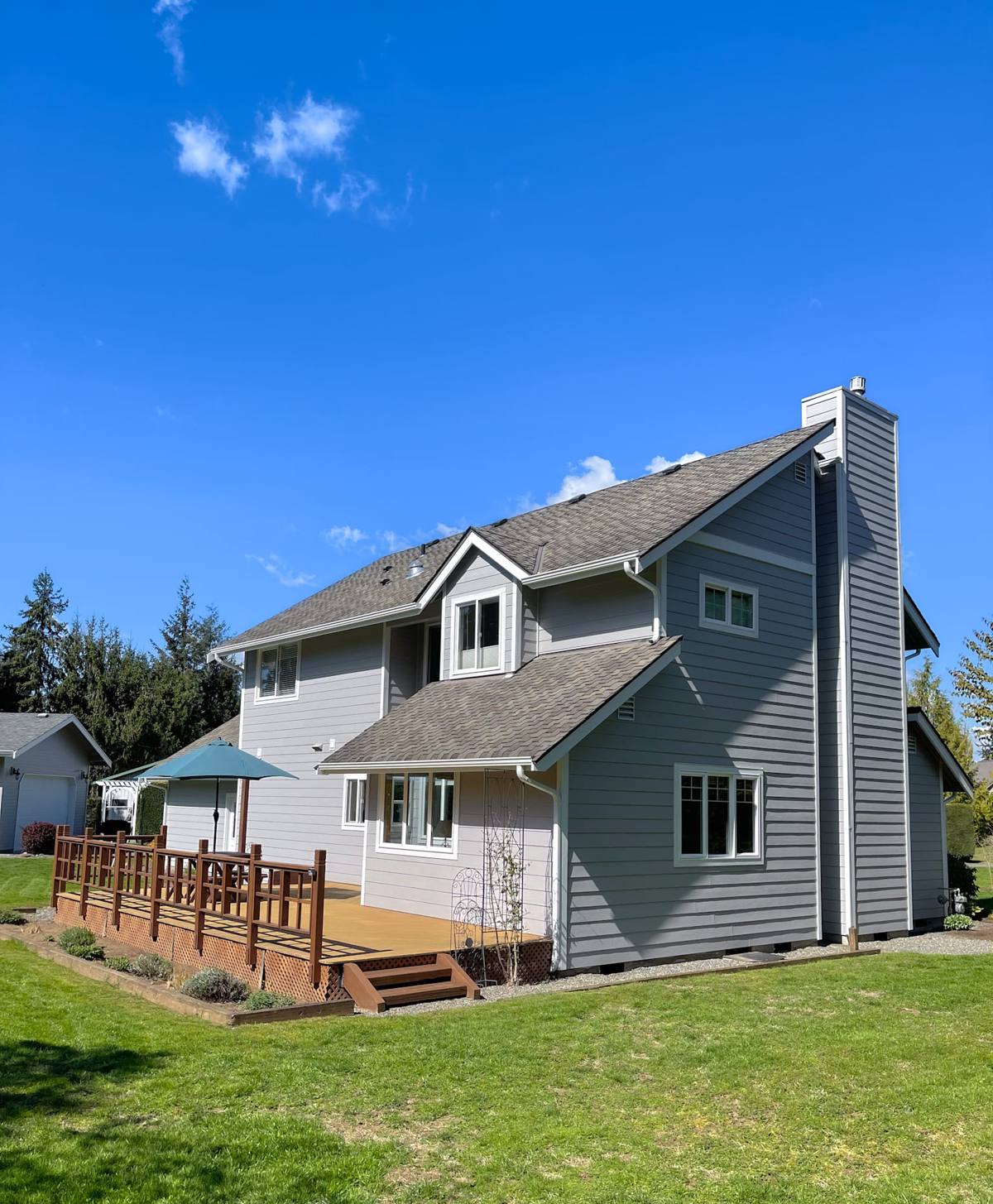
What James Hardie Fiber Cement Actually Is
James Hardie siding is made from a mixture of Portland cement, sand, cellulose fiber, and water, cured under controlled conditions into dense, dimensionally stable planks and panels. It's not plastic, and it's not wood—it's a composite engineered specifically to resist the things that destroy siding over time: moisture absorption, insect damage, UV breakdown, and fire.
A few properties matter most for our region:
- Non-combustible core — fiber cement doesn't ignite or contribute fuel to a fire, which matters as wildfire smoke and ember exposure become more common summer concerns even west of the Cascades.
- Dimensional stability — it doesn't swell, cup, or warp the way wood-based products can when they take on repeated moisture.
- Rigid, dense composition — it resists impact damage from hail, debris, and everyday wear better than vinyl.
- Won't rot or support insect activity — no cellulose-rich substrate for moisture-loving pests or fungal growth to feed on the way raw wood offers.
Why We Don't Install the Alternatives
LP SmartSide and Other Engineered Wood
Engineered wood siding has genuinely improved over the decades, and it has real fans for good reason—it's lighter, easier to handle, and often less expensive up front. But it's still a wood-strand product with a resin binder, and wood-strand products are more sensitive to sustained moisture exposure at cut edges, seams, and fastener penetrations than fiber cement. In a climate with our rainfall totals and long damp stretches, that sensitivity is exactly the failure point we've seen cause problems on other homes in the area—edge swelling, finish failure, and eventual replacement well short of what a homeowner expected from the investment.
Vinyl Siding
Vinyl is affordable and low-maintenance in the sense that it doesn't need painting. But it's a thin, flexible material that can crack in cold snaps, warp or deform near heat sources, and fade unevenly over years of UV exposure. It also doesn't offer meaningful fire resistance, and because it's designed to expand and contract with temperature, it relies on loose-hung installation that can look and perform differently than a rigid, nailed-tight fiber cement wall system. For a long-term investment in a house, we don't think it's the right call.
Cemplank, Allura, and Other Fiber Cement Brands
These are legitimate fiber cement competitors, and the base chemistry is similar to Hardie's. Our decision here is less about the raw material and more about the full system: factory finish quality, regional product engineering, warranty structure, and the depth of installer training and accessory compatibility (trim, soffit, fascia) that James Hardie has built out. Standardizing on one manufacturer's complete system, rather than mixing components across brands, reduces the seams—literally and figuratively—where problems start.
Primed Spruce and Cedar
Real wood siding has a warmth and character that's hard to argue with, and cedar in particular has a long history in this region. But solid wood siding demands a maintenance commitment—regular repainting or restaining, caulking, and vigilant moisture management—that most homeowners underestimate until they're several years in. In a climate with our wet season length, that maintenance cycle tends to compress, not stretch out.
Product Comparison: What Matters Most in a Wet, Shaded Climate
| Factor | James Hardie Fiber Cement | Vinyl | Engineered Wood (LP) | Solid Wood (Cedar) |
|---|---|---|---|---|
| Moisture/moss resistance | High — cement-based, doesn't absorb and swell | High, but seams can trap moisture | Moderate — edge/seam sensitivity | Low without diligent upkeep |
| Fire resistance | Non-combustible | Not fire-resistant, can melt/deform | Combustible, treated variants exist | Combustible |
| Factory finish life | ColorPlus: 15-year finish warranty | Color molded in, fades over time | Factory or field primed, repaint needed | Field-painted, repaint every 3-7 years |
| Impact resistance | High — dense, rigid | Low — cracks in cold, dents | Moderate | Moderate |
| Typical repaint cycle | None with ColorPlus, or 10-15 yrs primed | Never repainted, but fades/chalks | 5-8 years | 3-7 years |
HZ Product Lines: Climate-Engineered for a Reason
James Hardie manufactures regional variants of its siding—called HZ5 and HZ10 zones—engineered for the specific moisture, freeze-thaw, and humidity patterns of different parts of the country. This isn't a marketing gimmick; the cement formulation and moisture-resistance characteristics are adjusted for the climate zone the product ships to. For Whatcom County, that means we're installing a product formulated for a wet Pacific climate rather than a generic national blend built for the driest, least demanding markets. It's a small detail that most homeowners never hear about, but it's part of why we trust the material here specifically.
ColorPlus Technology: Why the Finish Matters as Much as the Board
A siding board is only as good as the finish protecting it. James Hardie's ColorPlus finish is baked on in a factory-controlled process—multiple coat layers cured under conditions no field paint job can replicate. That matters in our climate because field-applied paint has to cure in real Pacific Northwest weather, with all the humidity and temperature swings that involves, while a factory finish is applied and cured in a controlled environment before the boards ever reach a jobsite. ColorPlus finishes carry their own 15-year warranty against fading, chipping, and cracking, separate from the substrate warranty on the board itself.
Installation Is Where Good Siding Goes Wrong
Fiber cement siding fails prematurely almost exclusively because of poor installation, not poor material. A correctly installed Hardie wall system should reflect a specific set of practices:
- Proper water-resistive barrier and flashing behind every siding course, especially at windows, doors, and roof-to-wall intersections
- Correct fastener type, spacing, and penetration depth per Hardie's published installation specifications
- Minimum clearance from grade, roofing, and decks to keep board bottoms out of standing moisture and splash-back
- Properly caulked and sealed butt joints, with expansion gaps where the manufacturer specifies them
- Correct panel and trim overlap to shed water outward at every horizontal seam
- Blade and tooling practices that avoid excessive dust exposure and preserve factory-cut edge integrity
Skip any of these and you can turn a genuinely excellent product into a callback within a few years. This is a large part of why we don't spread ourselves across multiple siding systems—our crews train and install to one manufacturer's spec, repeatedly, rather than switching methods and details from job to job.
Warranty: What You're Actually Covered For
James Hardie backs its fiber cement products with a non-prorated limited warranty on the substrate (typically 30 years for HardiePlank lap siding) and a separate finish warranty on ColorPlus-coated products. These warranties are transferable to a subsequent homeowner within a defined window, which matters for resale value—a documented, transferable warranty on the exterior envelope is a tangible selling point that vinyl and engineered wood products generally can't match at the same level.
Cost Factors to Actually Weigh
| Cost Factor | What It Affects |
|---|---|
| Material cost (board + trim + accessories) | Generally higher upfront than vinyl, comparable to or less than quality cedar |
| Installation labor | More labor-intensive than vinyl due to fastening, cutting, and sealing detail |
| Long-term maintenance | Minimal with ColorPlus finish; no repainting cycle to budget for |
| Repaint/refinish cycle (if primed, not ColorPlus) | Every 10-15 years, still less frequent than wood |
| Resale/warranty value | Transferable substrate and finish warranties can support home value |
The honest picture: fiber cement usually costs more than vinyl at installation and often lands close to or below quality cedar once you account for the repainting cedar requires over the same span of years. The real savings show up over a decade or more, not on day one.
Living With Hardie Siding in Sudden Valley's Moss Season
Even a moss-resistant, non-organic material like fiber cement will collect surface growth in shaded, damp spots around Sudden Valley—moss and algae grow on almost any exterior surface here given enough shade and moisture, including roofs, decking, and fences. The difference is that Hardie siding doesn't feed that growth or degrade from it the way an organic wood substrate can. A periodic gentle rinse (never high-pressure blasting, which can damage the finish and force water behind panels) keeps the surface clean without compromising the material underneath. Keeping gutters clear and vegetation trimmed back from exterior walls also goes a long way toward slowing moss buildup in the first place.
If you're planning a siding project in Sudden Valley or elsewhere in Whatcom County and want to talk through what James Hardie siding would look like on your specific home, we're happy to walk the property with you and put together a free, no-pressure estimate—no obligation, just an honest look at what your house needs.