 Sudden Valley Siding
 Siding Built for Bellingham's Climate
Bellingham sits where the Salish Sea meets the foothills of the Cascades, and that location cuts both ways for the homes here. It's a beautiful place to live, but it's also a tough place to keep a house's exterior looking good and performing well year after year. Homes closer to the water deal with salt-laden air that works on fasteners, trim, and paint film. Homes further inland get the same relentless Pacific Northwest rain, along with the shade and moisture that make moss and algae a near-constant maintenance issue on roofs, siding, and decking. Add in the freeze-thaw swings that show up most winters, and you've got a climate that will find every weak point in an exterior over time.
We're a local crew that works this area regularly, which matters more than most homeowners realize. A contractor who mostly works drier inland markets doesn't think about moss the same way, doesn't detail flashing the same way, and doesn't always understand why a product that's fine in Spokane can struggle here. We do this work in Whatcom County conditions every week, and it shapes how we build.
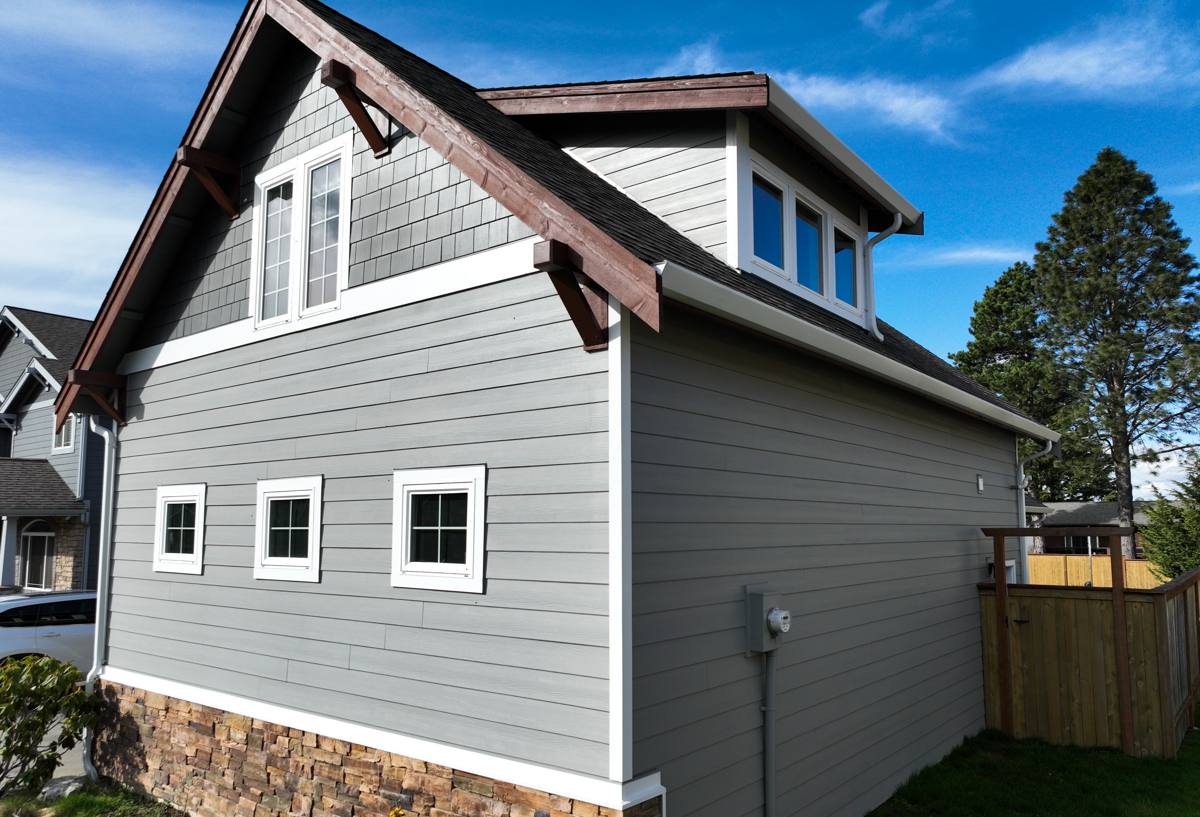
What Bellingham Homes Are Up Against
Salt Air and Corrosion
Proximity to Bellingham Bay means airborne salt is a real factor for a lot of homes in and around the city. Salt air accelerates corrosion on exposed metal — fasteners, flashing, hinges, and hardware — and it can degrade paint and caulk faster than it would inland. Materials and fastening systems that aren't rated for coastal exposure tend to show their age early: streaking, rust bleed at fastener heads, and premature caulk failure at joints and trim.
Driving Rain
Storms off the Pacific don't just drop a lot of water — they push it sideways. Wind-driven rain finds gaps that vertical rain never would: lap joints, window and door trim, penetrations for vents and fixtures, and butt joints between siding panels. A siding system is only as good as its weakest seam, and in this climate those seams get tested constantly, not just during the occasional big storm.
Moss, Algae, and a Long Wet Season
Whatcom County's wet season runs long, and shaded, north-facing, or tree-covered walls can stay damp for weeks at a stretch. That's exactly the environment moss and algae need to take hold. On the wrong siding material, sustained dampness doesn't just look bad — it can lead to swelling, softening, or paint failure underneath the growth. On siding that handles moisture the way it should, moss and algae stay a surface-level cleaning issue instead of a structural one.
Why We Only Install James Hardie Fiber Cement
We made a deliberate decision to standardize on James Hardie siding and stop installing other materials — not because every alternative is bad, but because Hardie's fiber cement holds up best against exactly the conditions Bellingham throws at a house.
- Non-combustible core. Fiber cement doesn't feed a fire the way wood-based products can, which matters for insurance conversations and long-term peace of mind.
- Moisture stability. Fiber cement doesn't absorb and swell the way engineered wood products can when a seam or joint takes on water over years of driving rain.
- Factory-applied ColorPlus finish. The finish is baked on under controlled conditions rather than field-applied, which gives more consistent coverage and better resistance to fading, chipping, and the kind of coastal-air wear that breaks down field-applied paint faster.
- Climate-engineered product lines. Hardie's HZ5 products are engineered for the freeze-thaw cycling and moisture exposure typical of the Pacific Northwest, not a generic one-size-fits-all specification.
- A strong, transferable warranty. That matters to future buyers, not just the person who orders the siding — it's a selling point when the home eventually goes on the market.
We don't install vinyl, LP SmartSide, Cemplank, Allura, or primed spruce and cedar siding. Each of those has a place in the market, but each also comes with trade-offs — moisture sensitivity, installation tolerances, maintenance burden, or warranty structure — that we're not willing to build our reputation on in this climate. When we tell a homeowner what we recommend, we want it to be the product we'd genuinely put on our own house.
How the Exterior Project Actually Works
Assessment First
Every project starts with a real look at the house — not just the siding, but the water management behind it. We check flashing at windows, doors, and roof-to-wall transitions, look at the condition of the weather-resistive barrier where it's exposed, and note any areas showing rot, staining, or past moisture intrusion. Siding failures are very often flashing and detailing failures wearing a siding-shaped disguise, so we don't skip this step.
Installation to Manufacturer Spec
James Hardie siding performs the way it's supposed to when it's installed the way Hardie specifies — correct fastener type and placement, proper clearances at grade and roof lines, correct joint treatment, and caulking only where Hardie's details call for it (not as a substitute for proper flashing). Installation quality is the difference between siding that lasts decades and siding that fails early despite being a good product.
Roofing, Windows, and Decks in the Same Conversation
Siding doesn't work in isolation. A roof that's shedding water onto a wall, a window that's not flashed correctly, or a deck ledger that's trapping moisture against the house all undermine even a well-installed siding job. Because we handle siding, roofing, windows, and decks, we look at the exterior as one connected system rather than treating each trade as someone else's problem.
Comparing Common Siding Approaches
| Factor | Vinyl | Engineered Wood (LP-type) | James Hardie Fiber Cement |
|---|---|---|---|
| Moisture behavior in driving rain | Can warp or gap over time | Vulnerable if edges/seams absorb water | Stable; resists swelling and rot |
| Coastal/salt air durability | Fasteners and trim can corrode faster | Moderate; finish and edges are the weak points | Strong; engineered HZ5 lines built for this exposure |
| Moss/algae resistance | Surface growth, generally cleanable | Growth can accelerate underlying moisture issues | Surface growth, cleanable, no structural risk |
| Fire resistance | Combustible | Combustible | Non-combustible core |
| Finish longevity | Color molded in, can fade/chalk | Field or factory paint, variable durability | Factory-baked ColorPlus finish |
What Local Actually Buys You
A crew based here understands things a traveling or out-of-area contractor often misses: which sides of a house in this area tend to hold moss longest, how far wind-driven rain typically pushes water up a wall during a real Pacific storm, and how salt exposure changes depending on how close a property sits to the water or how exposed it is to prevailing winds. That local pattern recognition shows up in the small decisions — where we add extra flashing attention, how we sequence work around the wet season, and what we flag during the initial walk-around that an unfamiliar crew might not think to check.
Being local also means we're accountable after the job is done. If a question comes up two years down the road, we're not a name from an out-of-town crew that passed through once — we're still here, working in the same neighborhoods.
Maintenance That Actually Fits This Climate
Even the right siding benefits from a bit of routine attention in a climate like this one. A simple seasonal checklist goes a long way toward protecting the investment:
- Rinse siding annually to keep moss, algae, and pollen from building up, especially on shaded or north-facing walls
- Walk the exterior after major windstorms to check for loose trim, damaged flashing, or debris caught against the wall
- Keep gutters clear so water is directed away from siding and foundation rather than sheeting down the wall face
- Trim back vegetation and tree limbs that keep siding shaded and damp longer than necessary
- Have caulking and sealant at trim and penetrations inspected every few years, since these are the first points to wear in driving rain
- Address any soft spots, staining, or paint failure promptly rather than waiting — small moisture issues are far cheaper to fix early
Planning a Project
Whether you're dealing with siding that's showing its age, planning ahead after a roof or window issue, or simply want an honest read on what your home's exterior actually needs, it helps to start with a straightforward conversation rather than a sales pitch. We'll walk the exterior with you, point out what we see — good and bad — and explain what we'd recommend and why, including where James Hardie fits and where the real priorities are for a home in this climate.
If you're in Bellingham, Sudden Valley, or elsewhere in Whatcom County and want a clear-eyed look at your siding, roofing, windows, or decks, we're happy to come take a look. Reach out for a free, no-pressure estimate using the form below.