 Sudden Valley Siding
 Two Very Different Materials, Not Just Two Price Points
Homeowners in Sudden Valley often start a siding conversation assuming vinyl and fiber cement are basically the same product in different price brackets. They're not. Vinyl siding is an extruded PVC plastic panel, formulated with color mixed all the way through and designed to flex with temperature swings. Fiber cement is a cementitious board made from sand, cement, and cellulose fibers, engineered for rigidity and dimensional stability, then finished with a factory-baked coating. One is a plastic product. The other is closer to a masonry product. That difference in chemistry is what drives almost every practical difference below.
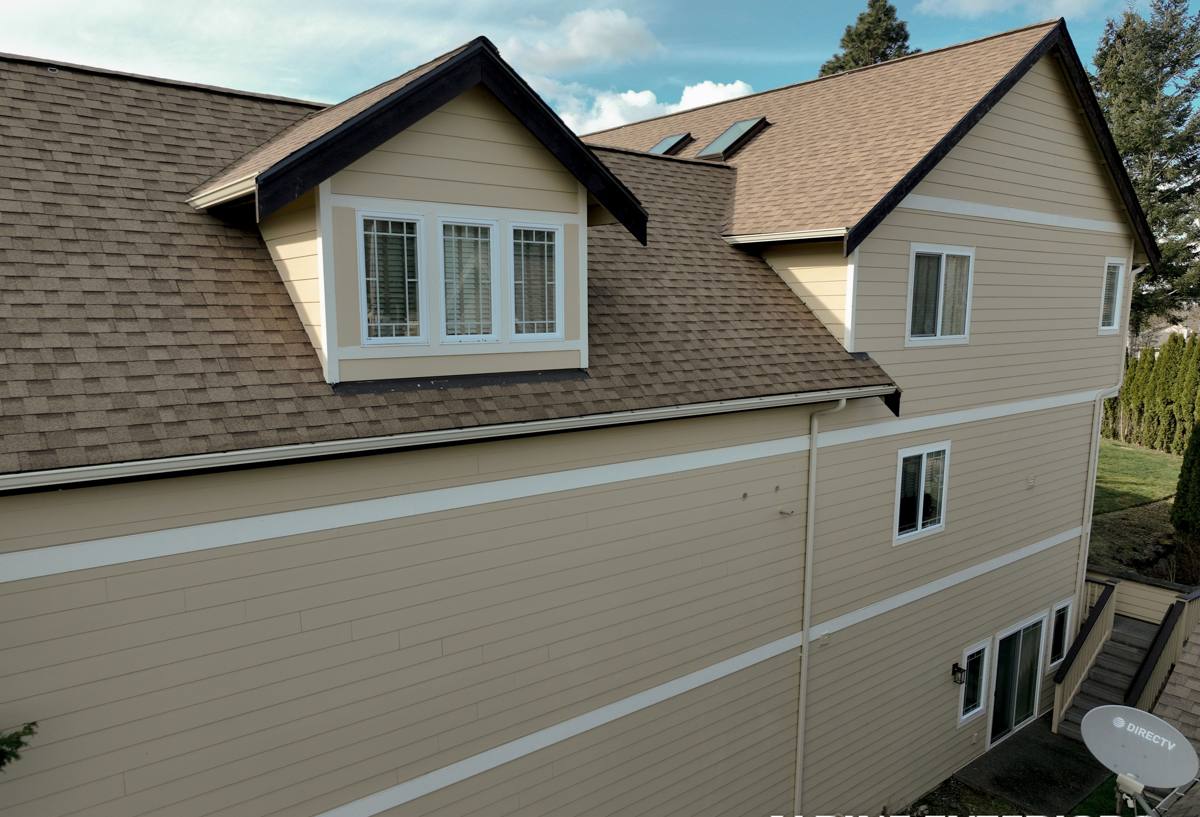
We only install James Hardie fiber cement siding on the homes we work on. This page isn't here to trash vinyl — plenty of it is on perfectly serviceable homes around Whatcom County. It's here to walk through why we made that call, and what it actually means for your house on Lake Whatcom.
How Each Material Handles Sudden Valley's Weather
Salt Air and Moisture
Sudden Valley isn't oceanfront, but the marine air moving off the Puget Sound corridor and up through the Whatcom County lowlands still carries salt and moisture that settles on every exterior surface in the area. Vinyl doesn't corrode, but it does chalk and fade under UV and salt exposure over the years, and its seams and J-channels can trap moisture behind the panel if the water-resistive barrier underneath isn't detailed correctly. Fiber cement is inert to salt — it won't corrode or leach — and James Hardie's HZ5 product line is specifically engineered for moisture-prone climates like ours, with a formulation designed to resist swelling and cracking from repeated wet-dry cycles.
Driving Rain
Lake Whatcom sits in a wind corridor, and driving rain off the water pushes moisture sideways into siding in a way that flatter, more sheltered lots don't experience. Vinyl sheds bulk water well when it's installed with proper overlap and clearance, but it's a loose-fit system by design — it's meant to move, which means it's also meant to let some air and moisture behind it. Fiber cement, installed correctly with proper flashing and a rainscreen or drainage gap, gives you a tighter, heavier barrier that doesn't flex or bow under wind-driven rain the way a thin plastic panel can.
Moss Season
Anyone who's owned a home near Lake Whatcom knows the moss season runs long — often eight or nine months of the year with enough shade and moisture to keep organic growth going on north-facing walls, under eaves, and anywhere airflow is limited. Vinyl doesn't feed moss, but its slightly textured surface and horizontal laps give spores something to grip, especially where panels have started to chalk. Hardie's ColorPlus factory finish is smoother and more resistant to this kind of buildup, and because the board itself doesn't degrade from repeated pressure washing, homeowners can actually clean it without worrying about cracking a panel or blowing water behind it.
Installation: Where the Real Differences Show Up
Both products can perform well or poorly depending entirely on the installer. That said, the two systems are forgiving of different things.
Vinyl siding installation tolerates minor wall irregularities well because the panels flex, and a less experienced crew can hang a reasonably straight wall even over an imperfect substrate. The tradeoff is that vinyl depends heavily on correct nailing (never fully driven, always in the slot to allow expansion) and correct J-channel and starter strip work. Get that wrong and you get buckling, oil-canning, or panels that pop off in a windstorm.
Fiber cement is less forgiving of shortcuts. It has to be cut with the right blade and dust control, fastened at the correct spacing with the correct fastener type, caulked and painted at cut edges, and flashed properly at every penetration and butt joint. Done right, it's an extremely stable, tight envelope. Done wrong — say, face-nailed with the wrong fastener, or butt joints left uncaulked — it can trap moisture and fail early. This is exactly why installer training and manufacturer certification matter more with fiber cement than with vinyl, and it's a big part of why we standardized on one product line we install to spec every time rather than juggling multiple systems.
Appearance and Curb Appeal Over Time
New, both products can look sharp. The difference shows up five, ten, fifteen years in. Vinyl's color is mixed through the material, so it won't peel, but it does fade unevenly over time, particularly on south- and west-facing walls, and darker colors fade faster and can warp more in direct sun. It also has a recognizable plastic sheen and a limited ability to mimic deep wood-grain texture or crisp architectural trim profiles.
Fiber cement takes paint and factory finishes the way wood or masonry does, with a flatter, more substantial look, and James Hardie's ColorPlus finish is baked on in a controlled factory environment with a 15-year finish warranty against fading and chipping. It also comes in a wider range of profiles — lap, shingle-style, board-and-batten, trim — that hold sharp lines and shadow lines vinyl typically can't replicate.
Fire and Impact Resistance
This matters more each year given the wildfire smoke and dry-summer stretches Whatcom County has seen in recent years, even in a generally wet climate. Vinyl is a petroleum-based plastic — it will soften, deform, and burn under enough heat. Fiber cement is non-combustible; James Hardie's boards carry a noncombustible rating and won't contribute fuel to a fire the way a vinyl panel can. On impact, fiber cement is also more resistant to hail damage and accidental impact (a ladder, a thrown branch in a windstorm) than vinyl, which can crack or shatter in cold weather when it becomes more brittle.
Maintenance: What You're Actually Signing Up For
- Vinyl: periodic washing to prevent chalking and grime buildup; watch for cracked or warped panels after impact or heat exposure; panels can't be spot-repaired invisibly if the color has faded, since replacement panels won't match weathered ones.
- Fiber cement: occasional washing (a garden hose and soft brush is usually enough); repaint or touch-up caulking at the manufacturer-recommended interval, generally well beyond what most paint jobs on wood siding need; check caulking at trim and butt joints every few years, especially after a hard winter.
- Both: keep gutters clean and downspouts directed away from the wall — most siding failures we see, on either product, trace back to water management, not the siding material itself.
Cost: Upfront vs. Long-Term
Vinyl has a real and legitimate cost advantage on day one — it's typically the less expensive material and it installs faster, which lowers labor cost too. Fiber cement costs more upfront, both in material and in labor, because it's heavier, requires more careful cutting and fastening, and takes longer to install correctly. The honest way to think about it is total cost of ownership, not just the number on the estimate.
| Factor | Vinyl Siding | Fiber Cement (James Hardie) |
|---|---|---|
| Upfront material + install cost | Lower | Higher |
| Typical lifespan | 20-30 years, variable | 30-50+ years when installed to spec |
| Repainting needed | No, but fades/chalks over time | Eventually, on manufacturer's longer interval |
| Fire rating | Combustible | Non-combustible |
| Performance in driving rain / salt air | Adequate with correct install | Strong, purpose-engineered (HZ5) |
| Impact/hail resistance | Can crack, especially in cold | More resistant, especially properly primed and painted |
None of this means vinyl is a bad choice for every homeowner or every budget. It means the two products are solving for different priorities, and we've chosen to build our business around the one that holds up best, longest, under the specific weather Whatcom County throws at a house.
Warranty: Read What's Actually Covered
Vinyl warranties are usually prorated, meaning the coverage value declines every year you own the home, and many exclude fading and color change outright — which is often the exact failure mode homeowners experience. James Hardie's warranty structure includes a non-prorated product warranty and a separate 15-year ColorPlus finish warranty against fading, chipping, and cracking, and is transferable to a new owner if you sell, which matters for resale on a lake-community home. Always ask a contractor, on either product, to show you the actual warranty document rather than just describe it — the fine print is where the real coverage lives.
Questions Worth Asking Before You Decide
- Is the installer certified by the manufacturer for the specific product they're proposing?
- What fastening schedule and flashing details will they use at butt joints, windows, and corners?
- Is the warranty prorated, and does it cover fading and finish separately from the material itself?
- How does the product perform specifically in wind-driven rain and prolonged damp shade, not just general marketing claims?
- What's the realistic maintenance schedule over the next 20 years, in writing, not just at installation?
If you're weighing siding options for a home in Sudden Valley or elsewhere around Lake Whatcom, we're glad to walk your house with you, point out what your current siding is or isn't doing, and give you a straight, no-pressure estimate for a James Hardie fiber cement install — no obligation either way.