 Sudden Valley Siding
 Sunnyland's Exterior Challenge: Water, Salt, and Shade
Sunnyland sits close to Lake Whatcom, tucked into the wooded hillsides that make Sudden Valley such a desirable place to live. That same setting — big evergreens, lake proximity, and a marine-influenced climate — creates a specific set of demands on a home's exterior that homeowners a few miles inland in Bellingham simply don't deal with in the same combination.
Three things stand out here. First, the moisture load is relentless. Whatcom County's wet season stretches from October well into spring, and homes shaded by mature trees or set close to the lake stay damp longer after every rain event than a home in open sun. Second, tree cover means moss, algae, and lichen have a head start — north-facing walls and anything under a canopy get less drying time between storms. Third, homes closer to the water pick up a mild salt-air component that, combined with humidity, accelerates corrosion on fasteners, trim, and any siding material that isn't built to shrug it off.
None of this is unique to any one house on any one street — it's the baseline condition for exterior materials anywhere in this pocket of Sudden Valley. What matters is choosing a siding system that was engineered with exactly this kind of exposure in mind, and having it installed by a crew that understands the local terrain.
Why Moss and Algae Are More Than Cosmetic
A little moss on a north wall doesn't sound like a structural issue, and on its own it usually isn't. The problem is what moss and algae growth indicates: a surface that's staying wet longer than it should. Organic growth holds moisture against the substrate, and over years that sustained dampness is what breaks down vulnerable siding materials from the inside — swelling wood-based products, deteriorating paint films, and in the worst cases letting water reach the sheathing behind the cladding.
What this means for material choice
Wood-based and wood-derived siding products need consistent maintenance in a moss-prone environment: regular cleaning, repainting, and caulk inspection. Skip a cycle or two — which happens easily when a home is tucked back from the road or the owner is out of town part of the year — and the deterioration compounds. Fiber cement doesn't feed mold or rot the way wood-based products can, which is one of the reasons it holds up so much better in the shaded, damp pockets common around Sudden Valley.
Our Position: James Hardie Only, and Why
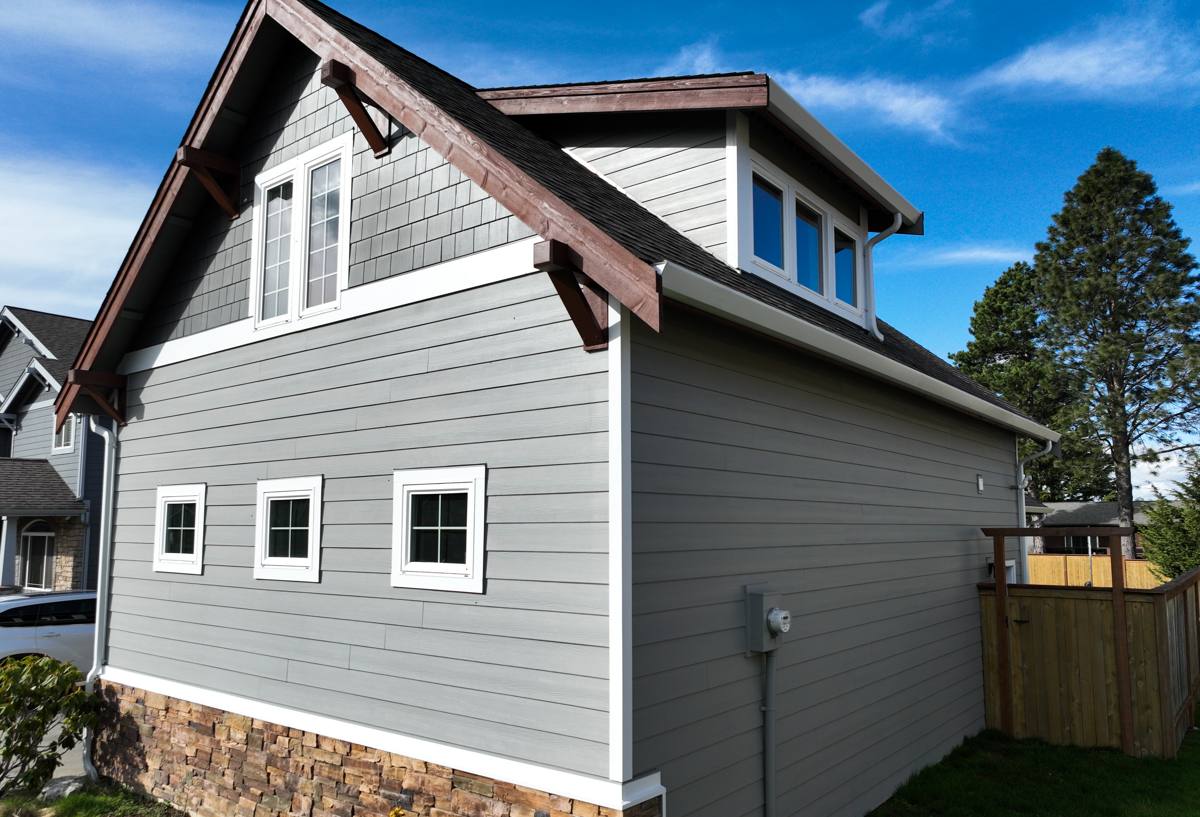
We install James Hardie fiber cement siding exclusively. We don't install vinyl, LP SmartSide, Cemplank, Allura, primed spruce, or cedar. That's not a marketing angle — it's a standard we've held to because of what we've seen play out on homes in this exact climate over time.
- Non-combustible: Fiber cement doesn't contribute fuel to a fire the way wood-based sidings can — relevant given wildfire smoke seasons the Pacific Northwest now sees most summers.
- Won't rot or swell from moisture: Cement-based composition means sustained dampness from shade and rain doesn't cause the material itself to deteriorate.
- Factory-applied ColorPlus finish: The color and protective coating are baked on at the factory under controlled conditions, holding up better against UV and moisture than field-applied paint, and resisting fading longer.
- Climate-engineered HZ product lines: Hardie's HZ10 formulation is specifically built for wetter, harsher climates like ours in the Pacific Northwest.
- Strong transferable warranty: Backed by a manufacturer warranty that holds real weight if you sell the home down the road.
We won't pretend other products don't have their place elsewhere. Vinyl is inexpensive and easy to install. LP SmartSide and engineered wood products have improved over the years. Cedar has genuine curb appeal. But for the specific combination of moisture, shade, and salt air that Sunnyland and the rest of Sudden Valley deal with, we've made the call that Hardie is the only material we're willing to put our name behind.
Comparing Siding Options for This Climate
| Material | Moisture Resistance | Moss/Algae Behavior | Maintenance Cycle |
|---|---|---|---|
| James Hardie Fiber Cement | Excellent — won't rot or swell | Doesn't feed organic growth; easy to rinse | Repaint/recaulk on decades-long cycle |
| Vinyl | Sheds water but can trap moisture behind panels | Growth sits on surface, can discolor over time | Low, but prone to cracking/warping in cold snaps |
| Cedar | Absorbs moisture, prone to swelling/checking | Highly susceptible in shaded, damp conditions | Frequent — stain/seal every few years |
| Primed Spruce / Engineered Wood | Moderate; edge and seam exposure is the weak point | Vulnerable if coating is compromised | Regular inspection and touch-up required |
How We Approach a Sunnyland Project
Assessing the site, not just the house
Before we talk product or price, we walk the property. Tree canopy, slope, which walls face the lake or catch prevailing weather, existing moisture damage, and how the home is currently trimmed and flashed all factor into the plan. A home tucked under fir and cedar trees needs different attention at trim and butt joints than one in a more open, sun-exposed lot even a few streets over.
Installation details that matter in this climate
- Correct fastener spacing and type — stainless or coated fasteners resist the corrosion that comes with sustained dampness and any salt-air influence.
- Proper clearance between siding and grade, decks, and roof lines so water has somewhere to go.
- Rain-screen or drainage plane details where the wall assembly and budget support it, giving damp-prone, shaded walls a way to dry out.
- Factory-cut and factory-primed edges kept intact wherever possible, since a raw cut edge is the most vulnerable point on any fiber cement installation.
These aren't exotic techniques — they're standard best practice for fiber cement. But skipping them is exactly how a good material ends up with a bad reputation, and it's why installation quality matters as much as the product itself.
Roofing, Windows, and Decks: The Rest of the Envelope
Siding doesn't work in isolation. We also handle roofing, windows, and decks, because on a home dealing with the moisture load Sudden Valley sees, the whole envelope has to work together. A new Hardie installation paired with flashing details that don't tie properly into an aging roof, or window trim that isn't sealed correctly, just moves the water problem somewhere else. When we're on site for siding, we look at how the roof edges, window openings, and any deck ledger connections interact with the wall — and we'll tell you plainly if something else needs attention before or alongside the siding work.
A practical pre-project checklist for Sunnyland homeowners
- Note any north- or shade-facing walls with visible moss, algae, or dark staining
- Check for soft spots, especially near ground level and around window sills
- Look at gutter and downspout condition — undersized or clogged systems dump extra water right onto the wall
- Check clearance where siding meets the deck, patio, or grade
- Ask any contractor bidding the job what fastener type and spacing they plan to use
What to Expect Cost-Wise
Every Sunnyland home is different — square footage, story count, trim complexity, tree removal or trimming needs, and how much of the existing wall assembly needs repair before new siding goes on all move the number. Fiber cement carries a higher upfront material and labor cost than vinyl, largely because it's heavier, requires specific tools and fastening technique, and takes a more skilled crew to install correctly. Homeowners weighing that difference should factor in the other side of the ledger: a repaint-and-recaulk cycle every few years on wood-based siding, versus a factory finish designed to go decades between major maintenance.
Why a Local Crew Matters Here
Whatcom County's microclimates aren't uniform, and Sudden Valley's lake-adjacent, tree-covered lots are their own animal compared to open coastal exposure or a drier inland neighborhood. A crew that works this area regularly knows which walls in this kind of setting need extra drainage detailing, which trim profiles hold up best under sustained shade, and how the local moss season actually behaves through the year — not just what a spec sheet says in general terms. That local knowledge shows up in the small decisions made during installation, and those small decisions are what determine whether siding looks good in year one and still looks good in year fifteen.
If you're weighing a siding project in Sunnyland or elsewhere around Sudden Valley, we're happy to walk the property, look at what your home is actually dealing with, and put together a free, no-pressure estimate — no obligation, just a straight look at your options.