 Sudden Valley Siding
 What LP SmartSide Actually Is
LP SmartSide is an engineered wood siding product — strand board or oriented strand board (OSB) that's treated with zinc borate for insect and fungal resistance, then coated with a resin-saturated overlay and factory primer. It comes in lap boards, panels, and trim, and it installs faster and lighter than fiber cement because the material is easier to cut and nail. For builders working on a tight schedule, that's a real advantage, and we're not going to pretend otherwise.
LP has also improved the product over the past couple of decades. Early-generation engineered wood siding from various manufacturers earned a rough reputation in wet climates, and LP's SmartSide line was built specifically to answer that history with better resin treatment and a more consistent factory coating. It's a legitimate, code-compliant product. We just don't install it, and homeowners in Sudden Valley and the rest of Whatcom County deserve to know exactly why before they sign a contract with someone who does.
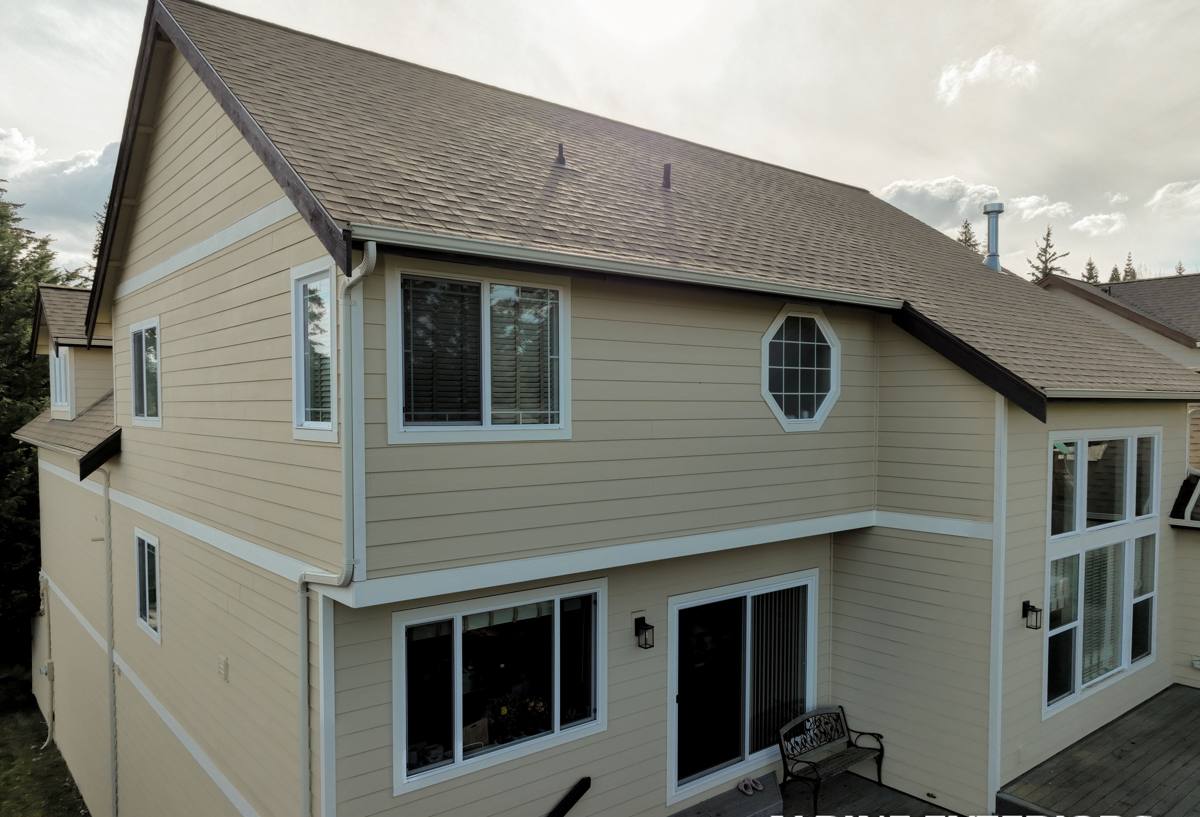
The Core Material Question: Wood Strand vs. Fiber Cement
The difference that matters most isn't the coating or the warranty paperwork — it's what's underneath. LP SmartSide is still wood fiber, engineered and treated, but wood fiber all the same. James Hardie siding is Portland cement, sand, and cellulose fiber pressed and cured into a non-combustible board. That single distinction drives almost everything else on this page.
Wood-based products, no matter how well engineered, respond to sustained moisture exposure differently than cement-based products. Fiber cement doesn't swell, doesn't rot, and isn't a food source for fungal growth. Engineered wood siding is designed to resist those things, but "resist" and "immune" are not the same word, and the gap between them shows up over years, not months.
Why This Matters More Here Than in Drier Climates
In a dry inland climate, that gap might never matter much. Sudden Valley isn't that climate. Sitting along Lake Whatcom in Whatcom County, homes here deal with a long wet season, driving rain off the lake and surrounding hills, and enough shade and humidity in the tree cover to keep exterior surfaces damp well after a storm passes. That's exactly the condition set that puts the most stress on any wood-based siding product's weak points.
Where Moisture Becomes the Real Issue
Cut Edges and Butt Joints
Every engineered wood siding product ships with a factory-applied coating on the face and back of the board — but the cut edges made on-site during installation are raw material until they're sealed. If an installer doesn't prime and caulk every field cut, butt joint, and corner return correctly, that's an open door for water intrusion. The product isn't necessarily failing; the installation detail is. But that puts an enormous amount of the long-term performance burden on installer discipline, on every single cut, for the life of the siding.
The Ongoing Caulk and Paint Cycle
Engineered wood siding is a maintained product. The factory finish is a primer, not a final topcoat, which means it needs to be painted after install and repainted on a cycle after that. Caulking at joints, trim, and penetrations needs to be inspected and refreshed periodically, because caulk is the first line of defense at every seam. Skip a cycle in a climate like ours, and moisture has more time to find a weak point before anyone notices.
Salt Air, Moss, and the Sudden Valley Climate Specifically
Sudden Valley sits inland from salt water compared to some Whatcom County waterfront, but the broader region still deals with marine-influenced air, and homes closer to Bellingham Bay and the Puget Sound shoreline see it directly. Combine that with the moss and algae growth that's a near-constant reality on north-facing and shaded siding anywhere in Western Washington, and you've got a climate that's actively working against any surface that depends on an intact paint film and sealed edges to stay dry.
Moss holds moisture against a wall. Salt-laden air accelerates the breakdown of caulk and paint film over time. None of that is unique to LP SmartSide — it's a challenge for any siding material — but wood-based products have less margin for error when that protective layer starts to degrade, because what's underneath is organic material that can support rot and fungal growth once it gets wet and stays wet.
Installation Sensitivity
We install fiber cement exclusively in part because of how forgiving it is compared to engineered wood when it comes to job-site conditions. Fiber cement doesn't need the same edge-sealing discipline on every cut, doesn't need to be kept as carefully dry in staging before install, and doesn't rely on a caulk joint being perfect at every seam to stay protected from moisture over the following decade.
LP SmartSide, done correctly, requires a crew that treats every cut edge, every joint, and every fastener penetration as a moisture-management detail — every time, on every wall, in every kind of weather a Whatcom County job schedule throws at them. That's achievable. It's also exactly the kind of installation-sensitive work where a rushed crew, a missed cut, or a skipped priming step doesn't show up as a problem for a year or two, and by the time it does, it's a repair instead of a five-minute fix.
Warranty Structure: What the Fine Print Actually Covers
Warranty length gets marketed heavily by every siding manufacturer, but the structure of the warranty matters more than the number on the brochure. Engineered wood warranties commonly carry maintenance obligations baked into the coverage — meaning the warranty can be reduced or voided if the required painting and caulking schedule isn't documented and followed. That's a real cost and a real obligation that falls on the homeowner for the life of the product.
| Factor | LP SmartSide (Engineered Wood) | James Hardie (Fiber Cement) |
|---|---|---|
| Base material | Treated wood strand/OSB with resin overlay | Cement, sand, and cellulose fiber |
| Factory finish | Primer — paint required after install | ColorPlus baked-on finish, no paint required on most lines |
| Combustibility | Combustible (wood-based) | Non-combustible |
| Maintenance requirement | Periodic repaint and caulk-joint upkeep to keep warranty valid | Occasional wash; no repaint cycle on ColorPlus finish |
| Moisture behavior | Resistant when properly sealed; edge/joint sensitive | Does not swell, rot, or support fungal growth |
| Warranty structure | Often conditioned on documented maintenance | Long-term transferable coverage on both substrate and finish |
None of this means LP's warranty is dishonest — it's a normal structure for a wood-based product. It just means the homeowner is signing up for ongoing upkeep as part of keeping that coverage intact, and that's a factor worth weighing against the lower up-front material cost.
Why We Standardized on James Hardie Instead
We made a decision as a company to install one siding system, and it's James Hardie fiber cement. That's not brand loyalty — it's a bet on fewer callbacks, fewer moisture-related repairs, and a product that performs consistently in the specific climate we work in every day. A few of the reasons that decision holds up for us:
- It's non-combustible, which matters more every wildfire season in the Pacific Northwest
- The ColorPlus factory finish eliminates the repaint cycle that engineered wood requires
- It doesn't swell, rot, or feed fungal growth the way any wood-based product can if a joint fails
- The HZ5 product line is engineered specifically for wetter, colder climates like ours
- The transferable warranty isn't conditioned on a homeowner maintaining a paint schedule
- One product system means our crews install it the same way, correctly, every time — no split expertise across multiple materials
That last point matters more than it might sound. A crew that installs three or four different siding systems is spreading its attention to detail across three or four different sets of moisture-management rules. We'd rather be excellent at one system that we trust in this climate than average at several.
A Practical Checklist Before You Choose Engineered Wood Siding
If another contractor has quoted you LP SmartSide or a similar engineered wood product, these are the questions worth asking before you commit — for your own protection, regardless of who ends up doing the work:
- Ask exactly how every field cut and butt joint will be primed and sealed, and get it in writing
- Ask what the manufacturer's warranty requires you to document to keep it valid — get the maintenance schedule in writing, not just verbally described
- Ask how soon after installation the siding needs its first paint coat, and who's responsible for that cost
- Ask what happens at inside corners, window returns, and any spot where two cut edges meet
- Ask how the installer plans to protect staged material from moisture before it goes on the wall
- Compare that full picture — material, install, and lifetime upkeep — against a fiber cement quote before deciding on cost alone
None of these questions are meant to scare you off engineered wood siding as a category. They're the questions that separate a product that performs for decades from one that starts causing problems in year eight or ten, and they apply just as much to any wood-based siding product as they do to LP specifically.
What This Means for Your Home in Sudden Valley
Every siding decision is really a bet on how a material will hold up against the specific weather your house sees year after year. For a home in Sudden Valley, that means a long wet season, driving rain, shaded and moss-prone walls, and marine-influenced air common to Whatcom County. We install James Hardie because it's the product we trust to hold up against that combination with the least amount of ongoing homeowner maintenance and the fewest moisture-related surprises down the road.
If you're weighing siding options for your home, we're happy to walk your property, look at your exposure and sun/shade patterns, and give you a straight answer about what we'd recommend and why — no pressure, no upsell. Reach out for a free estimate using the form below.