 Sudden Valley Siding
 Two Materials, One Very Wet Job
If you've priced siding in Sudden Valley, you've probably run into two products that get pitched as "the modern alternative to cedar": fiber cement and engineered wood. Both are a huge step up from old-growth cedar and vinyl in terms of durability and looks. Both come primed or pre-finished, both install in long planks, and both show up on contractor bid sheets around Whatcom County. But they are not the same material, and they do not behave the same way once they've spent a few winters absorbing runoff off Lake Whatcom, moss spores drifting in from the tree line, and the damp marine air that rolls in off Bellingham Bay and Puget Sound.
We install exclusively James Hardie fiber cement siding. We don't install engineered wood products like LP SmartSide. That's not a marketing position — it's a decision we made after weighing how each material actually performs in this specific climate, over a 20-30 year ownership window, not just how it looks on install day. This page explains that decision honestly, including what engineered wood does well, because pretending it has no upside wouldn't be straight with you.
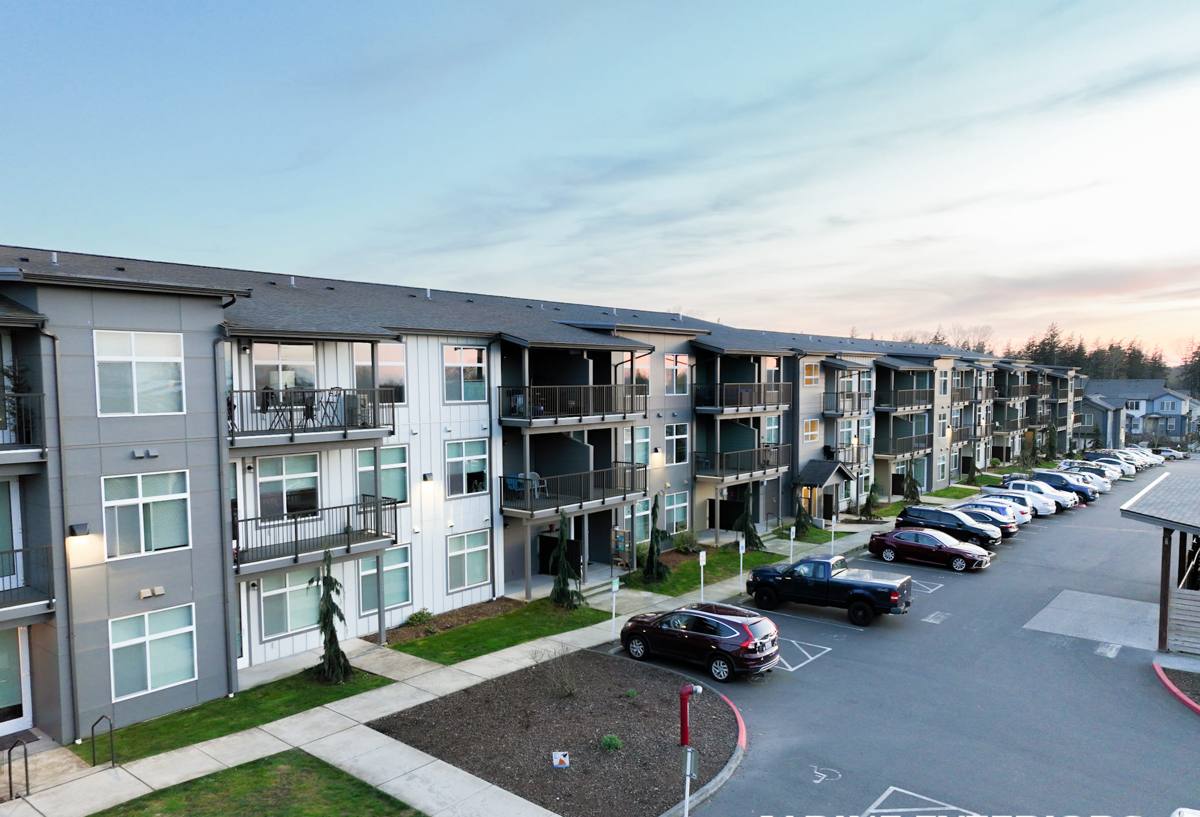
What Engineered Wood Gets Right
Engineered wood siding (strand-based products like LP SmartSide are the common example) is real wood fiber bonded with resins under heat and pressure, then coated with a wax-based moisture barrier and a factory primer. It has genuine advantages:
- It's lighter than fiber cement, which can mean faster installation and less strain on the crew handling long boards.
- It cuts and nails more like traditional wood, which some carpenters find faster to work with on trim-heavy homes.
- Impact resistance is generally good — strand-based substrates resist denting better than raw softwood.
- Upfront material cost is typically lower than fiber cement, which matters on tight budgets.
None of that is spin. On a dry-climate build, or a home with generous roof overhangs and minimal ground splash-back, engineered wood can perform reasonably well for years. The problems show up specifically in wet, moss-prone, marine-influenced climates like ours — which is most of what we see in Sudden Valley and the rest of Whatcom County.
Where It Struggles Here
Engineered wood's weak point is its Achilles' heel by design: it's still wood fiber. The resin bond and wax coating protect it, but that protection is a coating, not a change in the underlying material. Once water gets past a cut edge, a nail hole, a caulk joint that's failed, or a corner that wasn't properly sealed in the field, the wood fiber underneath can swell, delaminate, or soften from the inside out — often before it's visible from the outside. In a climate with driving rain, long stretches of overcast humidity, and a moss season that keeps siding damp for weeks at a time, those failure points get tested constantly, not occasionally.
The manufacturer's own installation requirements reflect this: field-cut edges must be primed and sealed before installation, gaps and joints have to be caulked correctly, and ground clearance has to be maintained. That's a lot of installer discipline required to keep a wood-based product performing to spec for decades. Skip one of those steps on one board, and you've created a slow leak that won't show up as a problem for a year or two.
What Fiber Cement Actually Is
Fiber cement siding is portland cement, sand, and cellulose fiber, cured into a rigid, non-combustible board. There's no wood fiber to swell, rot, or feed moss the way organic material can. It doesn't expand and contract with humidity the way wood-based products do, which matters in a region where the difference between a dry August afternoon and a soaked November week is significant.
James Hardie takes this a step further with its HardieZone system — siding formulated differently for different climate zones. Homes here fall into the HZ5 zone, engineered specifically for regions with sustained moisture exposure, freeze-thaw cycling, and high humidity. It's not the same board shipped to Arizona and Sudden Valley; the formulation is matched to what actually happens to siding in the Pacific Northwest.
Fiber cement is also non-combustible, which matters more every year as wildfire smoke seasons stretch later into the Whatcom County calendar, even though direct wildfire exposure risk here is lower than east of the Cascades. Insurance carriers increasingly recognize this in coverage and premiums.
Fiber Cement vs. Engineered Wood: Side by Side
| Factor | Fiber Cement (James Hardie) | Engineered Wood |
|---|---|---|
| Base material | Cement, sand, cellulose fiber | Wood strand fiber + resin |
| Moisture behavior | Does not swell or absorb like wood fiber | Can swell/delaminate if coating is compromised |
| Fire rating | Non-combustible | Combustible (wood-based) |
| Moss/algae resistance | Inorganic surface, less to feed on | Organic content can support growth if damp long-term |
| Upfront material cost | Higher | Lower |
| Installation sensitivity | Moderate — gapping, fastening, flashing matter | High — every cut edge and joint must be sealed correctly |
| Typical factory finish life | 15 years (ColorPlus finish) | Shorter, coating-dependent |
Installation Sensitivity: The Part Nobody Advertises
Every siding product performs worse when installed poorly, but the two materials fail differently when that happens. A fiber cement board installed with too-tight gaps or missed flashing can crack or trap moisture at a joint — a real problem, but usually a localized, visible one that a competent contractor catches on inspection. An engineered wood board with an unsealed cut edge can trap moisture inside the substrate itself, where it isn't visible until the damage has already spread along the board.
That difference is exactly why we made installation quality — not just product selection — a non-negotiable part of how we work. Correct Hardie installation means:
- Proper gapping at butt joints and corners per manufacturer spec, not "close enough."
- Correct fastener type, spacing, and penetration depth — under- or over-driven nails both cause problems.
- Flashing and weather-resistive barrier detailing at every window, door, and penetration.
- Minimum ground clearance maintained so splash-back and standing moisture aren't held against the bottom course.
- Factory-primed or ColorPlus-finished cut edges sealed where field cuts are unavoidable.
A product is only as good as the installation behind it, and that's true for both materials — but fiber cement gives you a wider margin for error before a mistake turns into a moisture problem.
Why the Climate Here Tips the Decision
Sudden Valley sits on Lake Whatcom, surrounded by tree cover that keeps north- and shade-facing walls damp longer than open, sun-exposed sites. Add Whatcom County's long stretch of grey-sky months, driving rain off Puget Sound weather systems, and a moss season that can run from fall through spring, and you get a set of conditions that stress-test any exterior product's weak points. Wood-fiber-based siding's weak point is moisture intrusion at compromised edges and joints. Fiber cement doesn't have that failure mode built into the base material — its main installation risks are mechanical (fastening, gapping, flashing), which are fully within a contractor's control.
That's the whole reasoning behind standardizing on one product. We'd rather turn down engineered wood work than install something we know needs near-perfect field execution, on every board, for decades, to avoid the exact failure mode our climate is best at causing.
What You're Actually Paying For
The material cost gap between engineered wood and fiber cement is real, and we won't pretend otherwise. But the fair comparison isn't sticker price — it's cost over the time you'll own the house. Fiber cement's ColorPlus factory finish carries a long finish warranty against fading and peeling, the substrate itself carries a separate long-term product warranty, and neither is contingent on you re-caulking and re-priming cut edges every few years the way wood-based products can be. Repainting cycles, moisture-related repairs, and moss remediation all factor into what a siding job actually costs you by year fifteen or twenty, not just what it costs on install day.
A Practical Checklist If You're Comparing Bids
- Ask what climate zone the fiber cement product is rated for, and confirm it matches Western Washington (HZ5), not a generic national spec.
- Ask specifically how cut edges will be sealed on-site, regardless of which product you choose.
- Get the manufacturer's written installation instructions and check that your contractor's gapping and fastening plan matches them.
- Ask about ground clearance and flashing details at windows, doors, and any roof-to-wall transitions — these are where most moisture problems start.
- Compare warranty terms line by line: what's covered, what voids it, and whether it's transferable if you sell the home.
- Ask how moss and algae growth is expected to be managed on shaded or north-facing walls over time.
If you're weighing siding materials for a home in Sudden Valley or elsewhere in Whatcom County, we're happy to walk your property, point out what your specific exposure and shade conditions mean for material choice, and put together a free, no-pressure estimate.