 Sudden Valley Siding
 Yew Street and the Sudden Valley Climate
Yew Street sits within the Sudden Valley community in Whatcom County, tucked against the timber and hillside terrain that surrounds Lake Whatcom. Homes here live under a lot of tree cover, on sloped lots, and in a marine-influenced climate that moves in off Bellingham Bay and the Salish Sea. That combination — shade, slope, and steady moisture off the water — is exactly the kind of environment that separates exterior materials that hold up from ones that don't.
Whatcom County doesn't get brutal winters, but it makes up for that with duration. Rain here isn't just frequent, it's persistent — weeks of low-intensity, driving rain that finds every gap, every unsealed joint, and every spot where water can sit instead of shed. Add the salt-tinged marine air common to this part of Western Washington and a moss season that can run eight months or longer on shaded north- and west-facing walls, and you've got a climate that tests siding, trim, roofing, and window seals every single year.
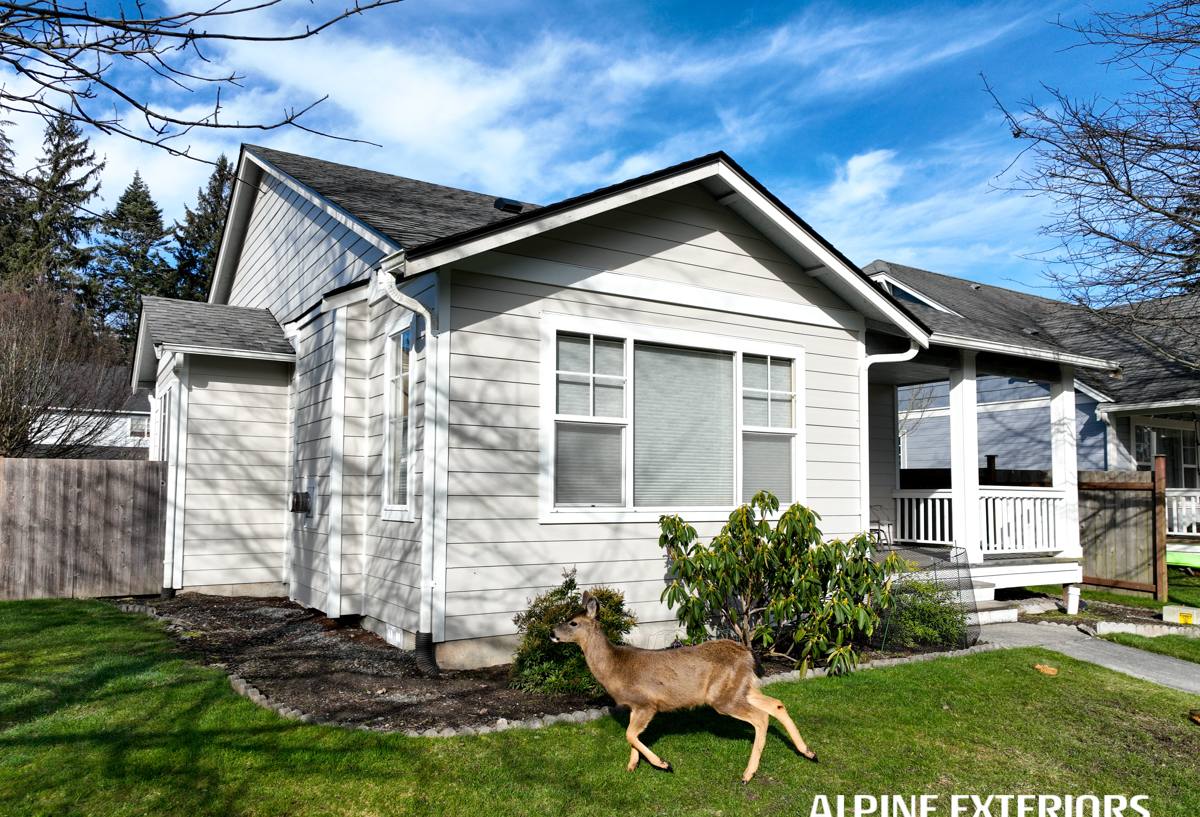
What This Climate Does to Exterior Materials Over Time
The damage rarely shows up as one dramatic failure. It's slow and cumulative:
- Moss and algae growth on shaded siding, especially under overhangs and along tree-lined lots common to Yew Street, holds moisture against the surface far longer than open, sun-exposed walls.
- Paint and finish breakdown from repeated wet-dry cycles, which is worse on field-painted materials than factory-finished ones.
- Swelling, delamination, and edge rot on wood-based and engineered wood siding products when moisture gets past the finish layer, particularly at butt joints and cut ends.
- Caulk and sealant fatigue around windows, trim, and penetrations, which quietly opens the door to bulk water intrusion behind the cladding.
- Corrosion and staining on fasteners and flashing that weren't rated for a coastal-influenced, high-moisture environment.
None of this is unique to Yew Street — it's the story for most of Whatcom County's older housing stock. But homes tucked into wooded, shaded lots see it faster because the siding simply doesn't get the drying time that a more exposed lot would provide.
Why We Install Only James Hardie Fiber Cement
We made a deliberate decision as a company to install James Hardie fiber cement siding and nothing else — not vinyl, not LP SmartSide, not Cemplank or Allura, not primed spruce or cedar. That's not a marketing angle; it's a standard we hold because of what we've seen this climate do to the alternatives over time, and it's why every recommendation we make for a Yew Street home starts from Hardie.
Built for This Kind of Weather
Hardie's HZ5 product line is engineered specifically for climates that cycle through freeze-thaw conditions and sustained moisture — which describes the Pacific Northwest well. Fiber cement is non-combustible, doesn't swell or rot the way wood-based products can when water gets behind them, and resists the moss and mildew staining that plagues shaded siding far better than wood fiber composites.
ColorPlus Factory Finish
Instead of a field-applied paint job that starts breaking down the moment it's exposed to Whatcom County's rain cycle, Hardie's ColorPlus finish is baked on in a controlled factory environment and backed by its own finish warranty. That matters most on shaded, north-facing walls — exactly the exposure a lot of Yew Street properties have — where a weaker finish would show wear first.
A Warranty That Reflects Confidence in the Product
Hardie backs its siding with a long, transferable limited warranty when it's installed to spec. That's meaningful for homeowners planning to stay long-term and for anyone who might sell — a documented, transferable warranty is worth something to a buyer in a way that a field-applied wood product with no manufacturer backing simply isn't.
We're not going to tell you competing products are junk — they're not, and plenty of them serve a purpose somewhere. What we will say is that after years of tear-offs and repair calls in this exact climate, we stopped installing anything but Hardie, because it's what we're willing to stand behind on our own warranty.
Installation Details That Matter More Here Than Elsewhere
Fiber cement siding is only as good as the installation behind it, and in a wet climate the details most homeowners never see are the ones that determine whether siding lasts fifteen years or fifty.
- A drainage plane and rain screen gap behind the siding so incidental moisture can escape instead of sitting against the wall sheathing.
- Correct flashing at every window, door, and roof-to-wall intersection — the single most common failure point on older homes we open up.
- Proper fastener spacing and type, matched to Hardie's published installation guidelines, not generic siding nailing patterns.
- Butt joints and trim sealed with the right sealant chemistry, not whatever caulk was on the truck.
- Clearance from grade, decks, and roof lines so siding isn't sitting in a splash zone or trapped against standing moisture.
Skipping any one of these doesn't usually cause an immediate problem — it causes a problem in year six or eight, after the warranty conversation has already gotten complicated. That's why installation quality is as much a part of our standard as the material choice itself.
Roofing, Windows, and Decks: The Full Exterior Picture
Siding doesn't work in isolation. On a wooded, sloped lot like the ones common in Sudden Valley, the roof, windows, siding, and any attached deck all share the job of keeping water out of the wall assembly — and a failure in one usually shows up as damage in another.
We handle roofing, window replacement, siding, and decks as a single crew for that reason. A roof-to-wall transition that isn't flashed correctly will soak the siding below it no matter how good that siding is. A window installed without proper pan flashing will feed water into the wall cavity around otherwise sound cladding. A deck ledger board attached without flashing will rot the wall it's bolted to. Coordinating all four trades under one crew means those transitions get built as a system, not four separate contractors hoping their work lines up with the next guy's.
Comparing Siding Options for a Home Like Yours
| Material | Moisture Behavior in This Climate | Finish | Long-Term Maintenance |
|---|---|---|---|
| James Hardie Fiber Cement | Non-combustible, dimensionally stable, doesn't swell or rot | Factory ColorPlus finish, long finish warranty | Periodic wash-down; minimal repainting |
| Vinyl Siding | Doesn't rot, but can warp, fade, and gap at fasteners over time | Color molded through, fades with UV exposure | Low, but limited repair options once damaged or discontinued |
| LP SmartSide / Engineered Wood | Vulnerable at cut edges and joints if moisture gets past the coating | Factory-treated, but edge sealing is critical | Moderate; edge and joint inspection matters |
| Cedar / Primed Wood | Absorbs moisture readily; prone to swelling, checking, and rot in shaded, wet areas | Field-applied paint or stain | High; regular repainting and moisture monitoring |
Every material on that list has a place somewhere. Our position is simply that for the moisture load and shade patterns typical of this part of Whatcom County, fiber cement is the material we're willing to put our name and warranty behind.
Finding a Local Contractor for Your Property
A crew that works Whatcom County regularly knows things an out-of-area contractor won't: how Sudden Valley's tree cover affects drying time on different elevations of a house, what Whatcom County's permitting and inspection process actually requires, and how to sequence work around a genuinely long rainy season without leaving a wall open to the weather for a week.
If your property is part of a homeowners association or community design review process, it's also worth checking on approval requirements for exterior color or material changes before work is scheduled — a good local contractor can usually tell you what that process typically involves and help you plan around it.
What to Look For Before You Hire
- Washington state contractor licensing and proof of current insurance
- Manufacturer training or certification specific to the siding product being installed
- A written scope of work that spells out flashing, drainage plane, and fastening details — not just "siding replacement"
- References or completed work you can actually see, not just photos
- A clear, transferable warranty in writing, covering both material and labor
What an Estimate Looks Like
Every home on a lot like Yew Street's is a little different — tree cover, roof pitch, existing siding condition, and how much of the wall assembly is exposed all change the scope of work. A proper estimate starts with a walk-around of the exterior, a look at problem areas like shaded walls, roof-wall intersections, and window flashing, and an honest assessment of whether you're looking at a full siding replacement or a more targeted repair.
If you're dealing with moss buildup, soft or swelling siding, paint failure, or you're just planning ahead for a home in Sudden Valley, we're happy to come take a look. The estimate is free, there's no pressure to sign anything on the spot, and you'll walk away with a straight answer about what your home actually needs.