 Sudden Valley Siding
 Living With Whatcom County's Wet Side: What Acme Homes Face
Acme sits in the rural, tree-covered stretch of Whatcom County east of Bellingham, in the shadow of the foothills leading up toward Mount Baker. It's a different exposure than a lot of the county — less direct salt air off the Sound or the lake, more shade, more standing moisture, and a growing season for moss and algae that runs a good chunk of the year. Homes tucked under conifers or set back from the road in a clearing get less sun on their north and east walls, and that means those wall sections stay damp far longer after a storm than a house sitting out in the open.
Across the wider Sudden Valley and Whatcom County service area, we see the same basic pattern with local variation: driving rain that gets pushed sideways by wind off the water, a long stretch of fall-through-spring dampness, and moss that doesn't care whether it's growing on your roof, your deck boards, or the bottom courses of your siding. In Acme specifically, the tree cover and rural siting tend to matter more than coastal salt exposure — but the end result for your exterior is the same: materials that can't handle sustained moisture eventually show it.
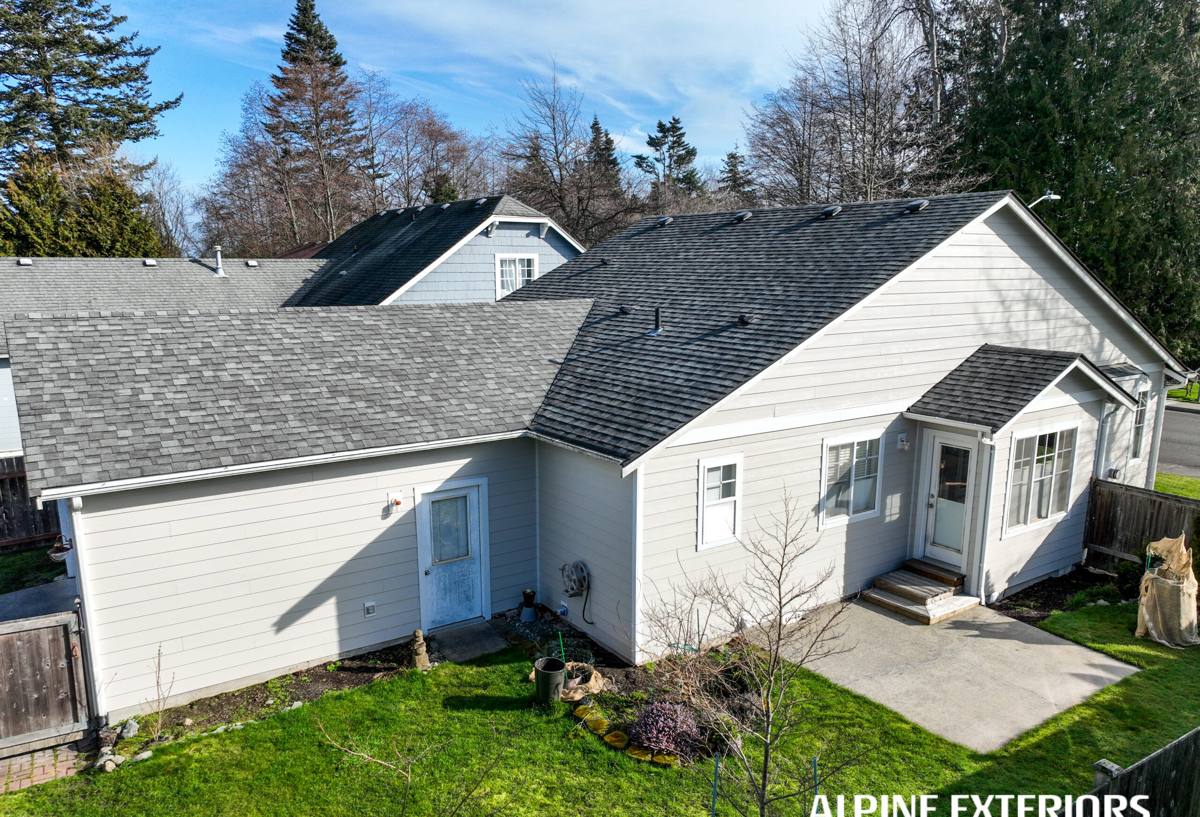
How Moisture and Moss Actually Damage Siding
It helps to understand the actual mechanism, not just the general idea that "wet weather is bad for houses." A few things happen over and over on Whatcom County exteriors:
- Wood-based and wood-fiber products absorb water at the edges and fastener points first. Once moisture gets into a cut edge or a nail hole, it wicks along the board, and that's where you see swelling, delamination, or soft spots even if the face of the board still looks fine.
- Moss and algae hold moisture against the surface longer than bare siding would on its own. A shaded wall with a moss film on it stays wet for days after a house in full sun would have dried out, which extends the amount of time any weak point in the material is under stress.
- Freeze-thaw cycles, even mild ones, work on trapped moisture. Whatcom County doesn't get brutal winters, but it gets enough cold snaps that water trapped behind or inside siding can expand and push joints and finishes apart over several seasons.
- UV and moisture together break down paint film faster than either one alone. A painted surface that's also holding moss and mildew loses its protective film unevenly, which is why you'll often see peeling concentrated on the shaded, damp sides of a house first.
None of this is exotic — it's just what a wet, partly shaded Pacific Northwest climate does to exterior materials over ten, fifteen, twenty years. The material choice determines how much of that damage actually reaches the wall behind the siding.
Full Exterior Protection: Siding, Roofing, Windows, and Decks Working Together
We work on siding, roofing, windows, and decks because on a house, those systems aren't really separate — they're one weather envelope. A roof that's shedding water properly but dumping it onto a wall without adequate flashing will rot that wall no matter how good the siding is. Windows with failed seals let moisture behind the siding at the trim line, which is one of the most common places we find hidden damage during a siding tear-off. Decks attached to the house share ledger boards and flashing details with the siding and wall assembly right behind them.
When we look at an Acme property, we're looking at the whole envelope, not just the wall cladding in isolation. That matters more in a damp, shaded climate than it would somewhere dry, because water finds the weakest connection point, and in a wet climate there's more water looking for that point more often.
What This Looks Like in Practice
On a typical exterior project we're checking window flashing and trim as we go, evaluating roof-to-wall transitions where they meet the siding, and making sure any attached deck structure isn't compromising the wall assembly it's fastened to. It's a more thorough approach than a siding-only crew that never looks past the cladding itself.
Why We Install Only James Hardie Fiber Cement
We made a deliberate decision to install James Hardie fiber cement siding exclusively, and not vinyl, not LP SmartSide, not Cemplank or Allura, not primed spruce or cedar. That's not a marketing position — it's a standard we hold because of what we see on wet-climate houses over time.
Fiber cement is made from cement, sand, and cellulose fiber, and it does not absorb and swell the way wood-fiber composite products can, and it will not rot the way solid wood siding can if a finish fails. It's also non-combustible, which matters given how much of Whatcom County borders wooded, rural land where wildfire risk is a real consideration, Acme included.
James Hardie's ColorPlus finish is baked on at the factory under controlled conditions, rather than field-applied paint that has to cure correctly on-site in variable weather. That factory finish is engineered to resist fading and to hold up to the freeze-thaw and moisture cycling that's common here, and it comes with a real, transferable warranty that backs both the substrate and the finish.
Hardie also makes climate-engineered product lines — its HZ5 line, for example, is formulated for regions like ours with wetter, more variable weather, as opposed to the HZ10 formulation built for hotter, drier climates. That's a meaningful distinction: the product was engineered with a Pacific Northwest-type climate in mind, not adapted from a warm-climate spec after the fact.
Being Honest About the Trade-Offs
Vinyl siding is inexpensive and low-maintenance in the sense that it doesn't need repainting, but it's a plastic product that expands and contracts significantly with temperature swings, can crack in impacts, and doesn't offer the fire resistance or the premium look of fiber cement. LP SmartSide, Cemplank, and Allura are all reasonable products with real advocates, but wood-strand composite (LP) still relies on an engineered wood core that depends heavily on correct installation and caulking to keep water out over decades, and other fiber cement brands vary in factory finish quality and warranty structure compared to what Hardie offers. Primed spruce and cedar are beautiful when new, but they're the products most exposed to the exact failure mode we described above — moisture wicking into cut edges and fastener points — and they demand the most ongoing maintenance of anything on this list. We'd rather put one product on every house, get very good at installing it correctly, and stand behind it, than offer five options and hope the cheaper ones hold up.
What Correct Hardie Installation Looks Like in a Climate Like This
Fiber cement siding is only as good as its installation. A lot of the siding failures we get called out to inspect aren't material failures at all — they're installation shortcuts that let water in behind a perfectly good product. In a climate with Acme's rain and shade profile, a few details matter more than usual:
- Proper clearance at the bottom edge. Siding needs a gap above the foundation, decks, roof lines, and grade so it isn't sitting in standing water or splashback.
- Correct fastener placement and spacing, per Hardie's published installation guidelines, so panels aren't over-driven or under-driven in a way that lets moisture track in at the nail line.
- Rain screen or drainage plane behind the siding where appropriate, so any incidental moisture that does get past the cladding has somewhere to drain and dry rather than sitting against the wall sheathing.
- Sealed and flashed joints at windows, corners, and butt joints — the transition points are where the vast majority of hidden water intrusion actually starts.
- Factory-cut edges used wherever possible, with any field cuts properly sealed, since a raw cut edge is the most vulnerable point on any fiber cement board.
This is also where a crew's experience with the specific climate shows. A contractor used to installing in a dry region may not weight rain-screen detailing or flashing sequencing the same way a crew that works Whatcom County's wet season year-round does.
Siding Materials Compared for Wet, Wooded Conditions
| Material | Moisture Resistance | Maintenance | Fire Resistance | Typical Warranty Structure |
|---|---|---|---|---|
| James Hardie Fiber Cement | Very high — does not swell or rot | Low; factory finish, occasional wash | Non-combustible | Strong, transferable substrate and finish coverage |
| Vinyl | High resistance to rot, but not a wood-analog material | Low; can crack, fade, or warp in heat/cold cycling | Combustible plastic, softens near heat | Varies widely by manufacturer and grade |
| LP SmartSide (wood-strand composite) | Moderate; depends heavily on sealed edges and caulking | Moderate; needs regular caulk/paint upkeep | Treated but wood-based core | Manufacturer-specific, installation-sensitive |
| Cemplank / Allura (other fiber cement) | Similar base material to Hardie | Low to moderate; finish quality varies by line | Non-combustible | Varies by product line and finish type |
| Primed Spruce / Cedar (solid wood) | Low; absorbs moisture at edges and fasteners | High; regular repainting and sealing needed | Combustible | Typically limited or none on the wood itself |
Signs Your Current Siding Is Losing the Battle
A lot of siding problems are quiet for years before they become obvious. On a walk-around of an Acme property, we're looking for:
- Soft or spongy spots when you press on siding near the bottom courses or below windows
- Persistent moss or dark streaking that comes back quickly after cleaning, especially on shaded walls
- Paint that's peeling or bubbling in patches rather than evenly across the whole house
- Visible gaps, warping, or separation at butt joints and corners
- Higher heating bills or drafts that suggest the wall assembly behind the siding isn't sealed the way it should be
- Staining on interior walls near exterior corners, which often traces back to a siding or flashing failure outside
Any one of these on its own might be minor. Several together, especially concentrated on the shaded side of the house, usually means it's worth having someone look at the whole wall assembly, not just patch the visible spot.
Why a Local Crew Matters in Acme
Rural properties around Acme come with their own logistics — longer driveways, tree cover that affects drying time and staging, and in some cases septic systems or wells that a crew needs to be mindful of when setting up equipment. A crew that works Whatcom County regularly understands the seasonal rhythm here: when the wet season realistically starts and ends, how much drying window you actually get between storms in a given month, and how tree cover changes the calculus on a specific lot compared to a house out in the open.
That local familiarity also shows up in smaller ways — knowing which details tend to fail first on wooded, shaded lots versus open ones, and sequencing a job so that vulnerable wall sections aren't left exposed longer than necessary during a stretch of unpredictable weather.
Getting an Estimate for Your Acme Home
Every house on a wooded, damp lot ages a little differently depending on sun exposure, drainage, and how the existing siding was installed. If you're noticing moss buildup, soft spots, or paint that won't hold anymore, or you're just planning ahead for a home in the Acme area, we're glad to take a look. The estimate is free, there's no pressure, and we'll give you a straight read on what your siding actually needs — whether that's a full replacement or something smaller.