 Sudden Valley Siding
 Why Sehome-Area Homes Take a Different Kind of Beating
Homes in and around Sehome and the broader Sudden Valley area sit in a stretch of Whatcom County where three things gang up on exterior siding at once: salt-laden air moving in off the Sound, long stretches of driving rain, and a moss season that can run most of the year under tree cover. Any one of these is manageable. Together, they shorten the life of siding that wasn't built or installed for the job.
Salt air accelerates corrosion on fasteners, flashing, and any metal trim tied into the siding system. Driving rain — rain that comes in sideways, not straight down — finds every gap in a wall assembly that a fair-weather installation would never expose. And moss, fed by shade, moisture, and mild temperatures, doesn't just sit on the surface. It holds water against whatever it's growing on, which matters a great deal depending on what that surface is made of.
This isn't a page about scare tactics. It's about what a siding installation actually needs to account for if it's going on a home in this specific part of Whatcom County, and why the details most homeowners never think about — house wrap laps, flashing sequence, fastener spacing, the gap at the bottom of the wall — are the difference between siding that looks good for two years and siding that performs for decades.
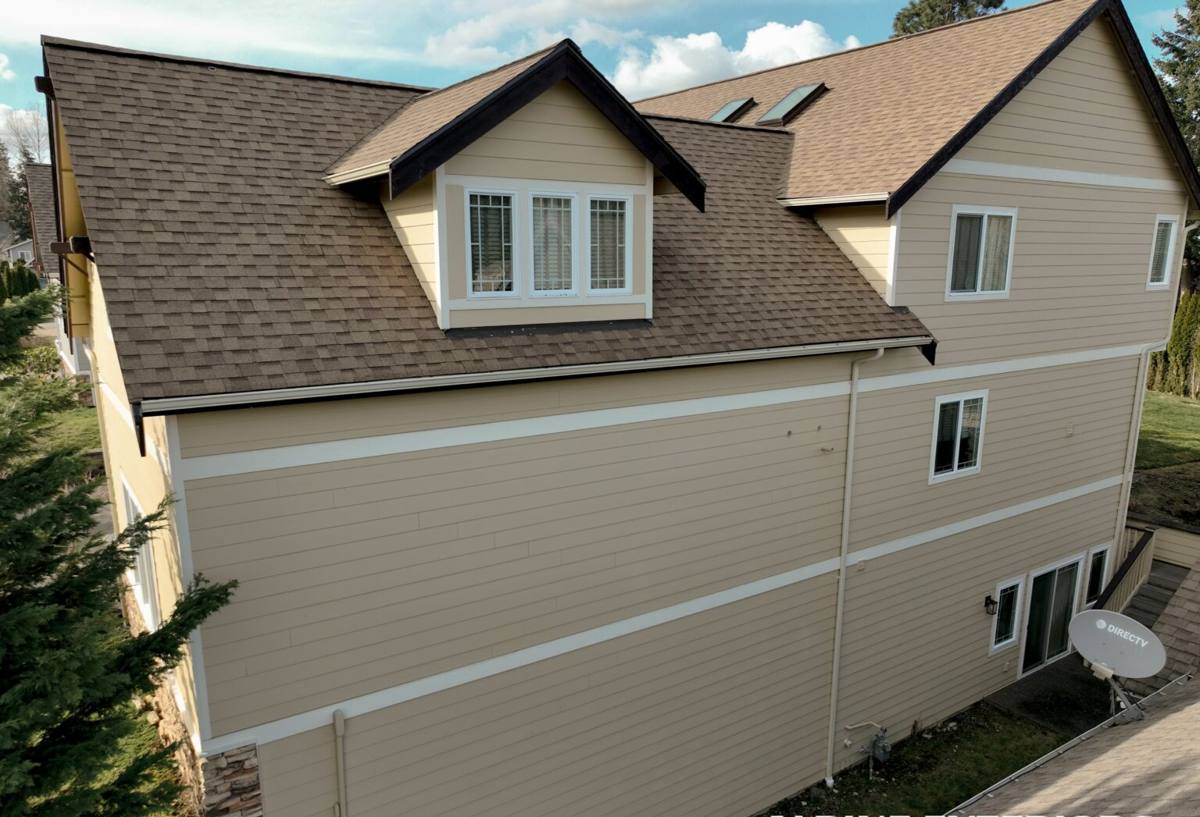
What a Correct Siding Installation Involves Here
Siding is a system, not a single product nailed to a wall. A correct installation in this climate has to get several layers right, in the right order, every time:
- Weather-resistive barrier: A properly lapped house wrap or building paper behind the siding, installed shingle-style so water is always directed outward and down, never into a seam.
- Flashing at every penetration: Windows, doors, hose bibs, vents, and any place two planes of the house meet need flashing that sheds water past the siding, not behind it.
- Rain screen or drainage gap where called for: A small air gap behind the siding lets any moisture that does get in dry out instead of sitting against the wall sheathing.
- Correct fastening: Fastener type, length, and spacing matter — driven wrong, siding can crack, blow off in wind, or trap water at the fastener head.
- Clearance at grade and hardscape: Siding needs a gap above the ground, decks, and patios so it isn't wicking up moisture or holding moss against the bottom courses.
- Caulking discipline: Sealed where it should be sealed, left open where it needs to breathe — over-caulking traps water in just as often as under-caulking lets it in.
Skip any one of these and the siding itself — no matter how good the product is — is set up to fail early. This is where most siding problems in this region actually start: not with a bad product, but with a rushed or incomplete installation underneath a product that looked fine on day one.
Why We Install Only James Hardie Fiber Cement
We made a decision a long time ago to install one siding system: James Hardie fiber cement, in the HZ product lines engineered for this climate zone. We don't install vinyl, LP SmartSide, primed spruce, cedar, or other fiber cement brands like Cemplank or Allura. That's not a marketing position — it's a standard we hold because of what we've seen play out on homes in wet, wooded, coastal-influenced conditions like this one.
Fiber cement is non-combustible and dimensionally stable, meaning it doesn't expand and contract with moisture the way wood-based products do. That stability matters a lot when a wall is cycling through wet Pacific Northwest winters and drier summers year after year. James Hardie's ColorPlus factory finish is baked on under controlled conditions rather than field-applied, which gives it more consistent coverage and better resistance to fading and moisture intrusion at the finish layer — the layer that's constantly under attack from salt air and standing moisture in a moss-prone yard.
None of this means other products are junk. Vinyl is inexpensive and low-maintenance in the right conditions. Engineered wood siding like LP SmartSide has real fans and a lower upfront cost. Cedar has a look plenty of homeowners want. But each comes with a trade-off we're not willing to install and stand behind in this climate: vinyl can warp and doesn't hold up as well against sustained wind-driven rain at seams; engineered wood and cedar are wood-based products that need consistent maintenance to keep moisture and moss from getting a foothold; other fiber cement brands vary in formulation, warranty structure, and factory finish quality. We'd rather install one product line well than several products with trade-offs we'd have to explain away later.
What "Engineered for This Climate" Actually Means
James Hardie makes region-specific HZ formulations rather than one universal product. The versions suited to the Pacific Northwest are engineered around moisture exposure and freeze-thaw cycling common to this part of Washington, not the dry-heat or hurricane conditions other HZ lines are built for. Getting the right HZ variant matters as much as getting the installation right.
Our Process on a Sehome-Area Project
- On-site assessment: We walk the exterior, check for existing moisture damage, moss buildup, flashing gaps, and any rot in the sheathing that needs to be addressed before new siding goes on — covering up a problem is worse than not touching it.
- Tear-off and substrate check: Old siding comes off and we inspect what's underneath. This is the point where hidden water damage from years of driving rain usually shows up, and it needs to be fixed, not sided over.
- Weather barrier and flashing installation: House wrap, window and door flashing, and any drainage gap components go in first, following manufacturer sequencing so water always has a path out.
- Hardie panel or plank installation: Installed to James Hardie's fastening and clearance specifications — this is also what keeps the manufacturer's warranty valid, since improper installation can void it.
- Trim, caulking, and touch-up: Final trim work and factory-matched touch-up paint at cut edges, done carefully so the ColorPlus finish stays protected at every seam.
- Walkthrough: We go over the finished work with the homeowner before calling the job done.
Material Comparison for This Climate
| Factor | James Hardie Fiber Cement | Vinyl | Wood / Engineered Wood |
|---|---|---|---|
| Moisture resistance | High — cement-based, doesn't absorb and swell | Moderate — seams and edges vulnerable to driving rain | Lower — needs consistent sealing and maintenance |
| Moss/mildew resistance | Good with factory finish; surface doesn't feed growth | Moderate — moss grows on the surface but material itself is inert | Lower — organic material can support growth if moisture sits |
| Salt air / coastal exposure | Strong — non-corrosive base material | Can become brittle over long exposure cycles | Needs more frequent refinishing near salt air |
| Fire resistance | Non-combustible | Combustible | Combustible |
| Maintenance | Occasional wash, repaint on a long cycle (factory finish) | Low, but limited repair options if damaged | Regular repainting/sealing required |
What Drives Cost on a Real Project
| Cost Factor | Why It Matters |
|---|---|
| Tear-off complexity | Multiple existing layers or damaged sheathing add labor and material |
| Home size and wall complexity | More corners, gables, and trim details mean more cutting and flashing work |
| Substrate repair | Hidden rot or water damage found during tear-off needs fixing before new siding goes on |
| Product line and profile | Panel vs. lap siding, and texture/color options, affect material cost |
| Site access | Steep lots, tree cover, or tight setbacks near the lake can affect staging and labor time |
We give honest, written estimates after seeing the actual condition of the home — not a phone-quote guess. Broad ranges vary a lot based on the factors above, which is exactly why we walk every project in person before pricing it.
Signs Your Current Siding Is Losing the Fight
- Moss or dark streaking that comes back quickly after cleaning
- Soft, spongy spots when you press on the siding, especially near the bottom courses
- Paint that's peeling or bubbling rather than just fading
- Visible gaps or warping at seams and corners
- Rising utility bills that suggest the wall assembly isn't holding heat the way it used to
- Interior wall staining or musty smell near exterior walls
Any one of these is worth a look. Several together usually mean the siding — or what's happening behind it — needs more than a cleaning.
Why a Crew That Already Works This Area Matters
Siding installation isn't just about following a spec sheet; it's about knowing how a given neighborhood's conditions actually behave through the seasons. A crew that regularly works homes around Sudden Valley and the surrounding Lake Whatcom area knows which walls take the worst of the driving rain, where moss builds up fastest under tree canopy, and how salt-influenced air moving through the region affects fastener and flashing choices over time. That local pattern recognition doesn't replace good installation practice — it sharpens it, because we're not guessing at conditions, we're accounting for ones we've already seen play out on nearby homes.
It also means we're not disappearing after the invoice clears. James Hardie's transferable warranty and our own workmanship standards mean something when the crew that installed the siding is still working in the same county next year and the year after.
Ready to Talk Through Your Project?
If your siding is showing its age or you're planning ahead of a renovation, we're happy to take a look and give you a straight, no-pressure estimate — no obligation, no high-pressure follow-up. Use the form below to get started.