 Sudden Valley Siding
 Building New in Happy Valley: What the Windows Have to Deal With
If you're framing a new home or a major addition in the Happy Valley area of Sudden Valley, the windows you choose and how they're installed will matter more than almost any other exterior decision you make. Whatcom County's marine climate sends a steady mix of salt-tinged air moving in off the Sound, long stretches of driving rain, and a moss season that can stretch from fall through spring. None of that is dramatic on its own, but it's relentless, and it finds every gap in a window installation that wasn't done right the first time.
New construction gives you an advantage that a remodel doesn't: you get to build the water management system correctly from the start, before siding, trim, and paint cover up the details. That's the opportunity — and the risk, because whatever gets buried behind the cladding stays there for decades.
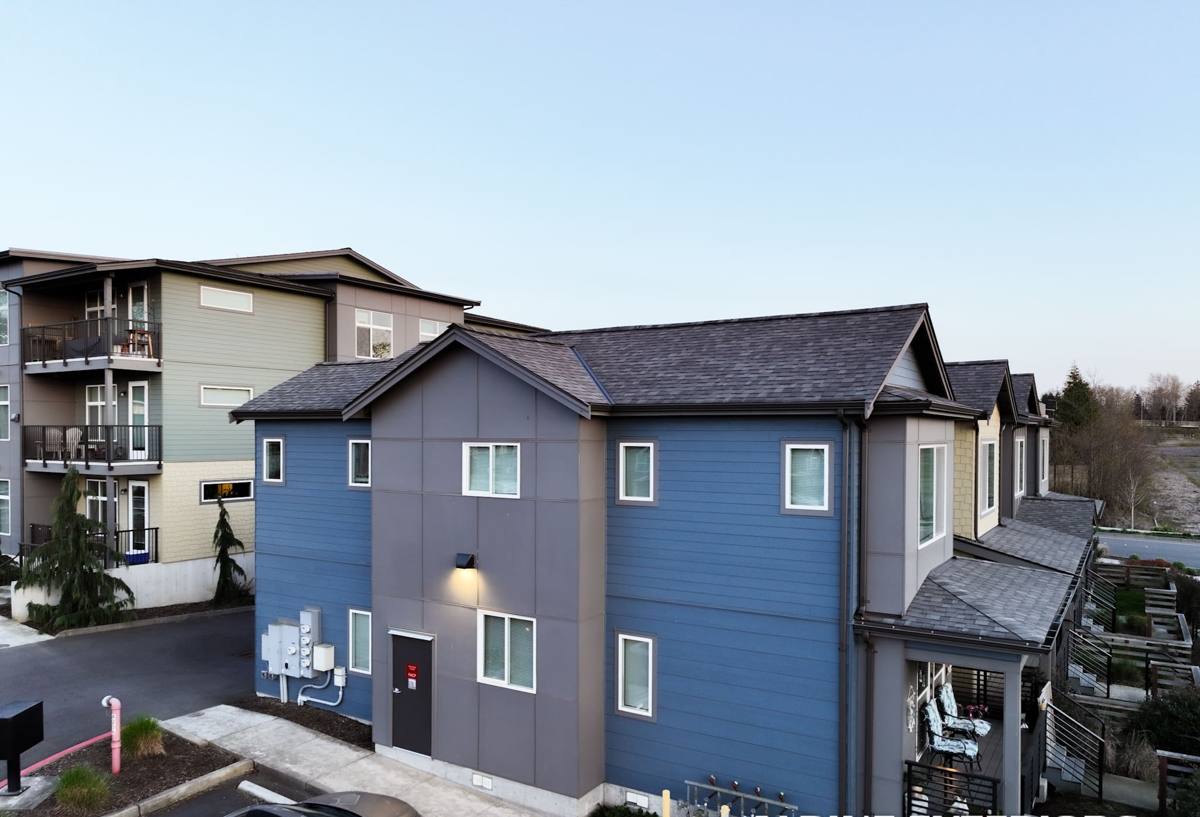
New-Construction Windows Are a Different Job Than Replacement
People sometimes assume "new construction window" just means a window that happens to go into a new house. It actually refers to a specific installation method. New-construction windows have a nailing fin (sometimes called a nail flange) around the perimeter of the frame that gets fastened directly to the sheathing, then integrated into the weather-resistive barrier (WRB) and flashing system before siding goes on.
That's different from a replacement or "pocket" window, which is designed to slide into an existing opening without disturbing the surrounding wall. The trade-off is real: new-construction windows give you a more durable, better-sealed opening because the flashing laps correctly with the building paper or housewrap in the proper shingle-style order — but only if the sequence is followed exactly. Skip a step, and you've built a leak path into the wall that won't show itself for a year or two, usually as a stain, soft spot, or musty smell nowhere near the window itself.
Why Sequence Matters More Here Than in Drier Climates
In a place with light rainfall, a minor flashing shortcut might never get tested. In Whatcom County, it gets tested constantly. Wind-driven rain doesn't just fall on a window, it pushes sideways and up under trim and sills. A correct install assumes water will reach the window opening and gives it a way back out — a mistake here assumes water won't, and eventually gets proven wrong.
What a Correct Installation Actually Involves
A proper new-construction window install in this climate isn't one step, it's a sequence, and every layer depends on the one before it being done right.
- Sill pan flashing — a sloped, sealed pan under the rough opening so any water that gets past the window has a dedicated path back outside instead of soaking into the framing.
- WRB integration — the housewrap or building paper is cut, folded, and taped in the correct shingle order (bottom to top) so every layer drains onto the one below it.
- Flashing tape at jambs and head — self-adhered flashing tape seals the nailing fin to the WRB at the sides and top, with the head flashing lapping over the jamb flashing, never under it.
- Backer rod and sealant, not caulk alone — the gap between frame and rough opening gets backed and sealed correctly, not just caulked over on the surface.
- Proper shimming and square check — a window that's out of square binds, doesn't lock tight, and stresses the seal over time.
- Insulation of the gap — low-expansion foam or mineral wool around the frame, not standard high-expansion foam that can bow the frame inward.
Any one of these done wrong won't fail on install day. It fails during the third or fourth wet winter, which is exactly why we treat every layer as non-negotiable rather than "good enough for now."
Choosing Windows for a Happy Valley Build
Frame material and glass package both affect how a window holds up here. This is a general comparison, not a recommendation of one brand — the right call depends on your budget, the home's design, and how much upkeep you want to take on.
| Frame Material | Moisture Behavior | Maintenance | Typical Fit for This Climate |
|---|---|---|---|
| Vinyl | Doesn't absorb water, won't rot | Low — occasional cleaning | Solid value option, good moisture resistance |
| Fiberglass | Dimensionally stable in wet/dry cycling | Low | Strong long-term performer, higher upfront cost |
| Wood-clad | Exterior clad protects wood, but any breach exposes it | Moderate to high — seals and caulk need monitoring | Can work, but installation quality is critical |
| Aluminum | Conducts cold, can condensate without thermal break | Low | Less common residentially here due to condensation risk |
For glass, an argon-filled dual-pane unit with a low-E coating is standard for new builds in this region and handles our overcast, moderate-temperature climate well. Triple-pane is worth discussing if the site is exposed to more wind and driving rain than average, but it's a cost-and-benefit conversation, not an automatic upgrade for every opening.
How Our Process Works
Before Windows Arrive
We review rough openings against the window schedule before anything ships, confirm sill pan and WRB details with the builder or GC, and flag any framing issues while they're still cheap to fix.
Install Day
Each opening gets sill pan flashing, the window set and shimmed square and plumb, fastened per the manufacturer's schedule, then flashed at jambs and head in the correct shingle-lap order. We check operation — opening, closing, locking — before we call an opening done.
After Install
We walk the openings with the builder before siding closes them in, since that's the last point where a flashing issue can be caught without demo. Photos of the flashing and WRB integration are documented at this stage for your records.
Mistakes We See on Other New Builds
A lot of what we do on new construction is simply refusing to let common shortcuts happen. The most frequent problems we run into on other jobs in this area:
- Housewrap taped in the wrong order, so water runs behind the layer instead of over it.
- No sill pan, or a flat one with no slope to drain.
- Flashing tape applied to dusty, wet, or cold sheathing so it never actually bonds.
- Windows fastened before they're checked for square, then forced into place.
- High-expansion foam used around the frame, bowing it and pinching the sash.
- Sealant used as the primary water barrier instead of as a backup to proper flashing.
Every one of these looks fine on install day. None of them show a problem until the house has been through a wet season or two.
What Drives Cost
Costs on a new build vary with the number and size of openings, so we don't quote a flat per-window price without seeing the plans. What generally moves the number:
| Factor | Effect on Cost |
|---|---|
| Frame material (vinyl vs. fiberglass vs. wood-clad) | Fiberglass and wood-clad run higher than vinyl |
| Glass package (dual-pane vs. triple-pane, coatings) | Upgraded glass adds cost per unit |
| Window size and configuration | Large picture windows and multi-unit combinations cost more than standard single units |
| Number of openings | More openings generally lower the per-unit labor cost |
| Wall height and access | Second-story and hard-to-access openings add labor time |
| Flashing and WRB coordination complexity | Custom details around bays, corners, or unusual framing add time |
A Checklist If You're Working With a Builder
If you're managing your own new build in Happy Valley and coordinating trades, this is worth confirming before your window install begins:
- Rough openings match the window schedule, with allowance built in for shimming.
- Sill pan flashing is specified for every opening, not just the exposed ones.
- WRB is installed and ready before window install starts, not added around it after the fact.
- Flashing tape is rated for the temperature and moisture conditions at install time.
- There's a documented walk-through before siding closes the openings in.
- The window and installation warranties are both explained to you in writing.
Why a Crew That Already Works Happy Valley Matters
New-construction window installation isn't exotic work, but it's unforgiving work in this climate. A crew that's already done openings around Sudden Valley and the broader Whatcom County area has already seen how the local wind and rain patterns test a flashing detail, and has already made — and corrected — the mistakes that show up in a wet climate but not in a dry one. That's not a marketing point, it's the difference between a crew guessing at best practices and one applying what's already held up locally through real winters.
We're not asking you to take our word for how a detail should be built. We're glad to walk through the flashing sequence, the sill pan detail, and the glass package options with you or your builder before a single window ships.
If you're planning a new build or addition in Happy Valley and want the window openings done right the first time, we're happy to take a look at your plans and put together a free, no-pressure estimate. There's a form below — reach out whenever you're ready to talk through the details.