 Sudden Valley Siding
 Why Lake Whatcom Roofs Wear Differently Than Roofs Ten Miles Away
Sudden Valley sits in a bowl of forest along the shoreline of Lake Whatcom, and that setting changes what a roof has to deal with compared to a house out on open ground closer to town. The tree canopy holds moisture against the roof deck long after a storm has passed. The lake itself adds humidity to the air on top of the marine weather that moves in off the Sound and pushes inland through the county. Add Whatcom County's long, gray, wet season and you get a roofing environment that's tough on anything porous, anything with a lot of seams, or anything that depends on granules and gravity alone to shed water.
We've worked enough roofs around the lake to know the pattern: north-facing slopes and roofs tucked under fir and cedar canopy grow moss faster than anywhere else in the valley, gutters and valleys collect needle litter that dams water behind it, and driving rain off the water finds every weak lap and fastener over a few winters. Metal roofing handles that combination better than most other coverings, but only when it's specified and installed correctly for this exact setting — not as a generic product dropped on a generic roof.
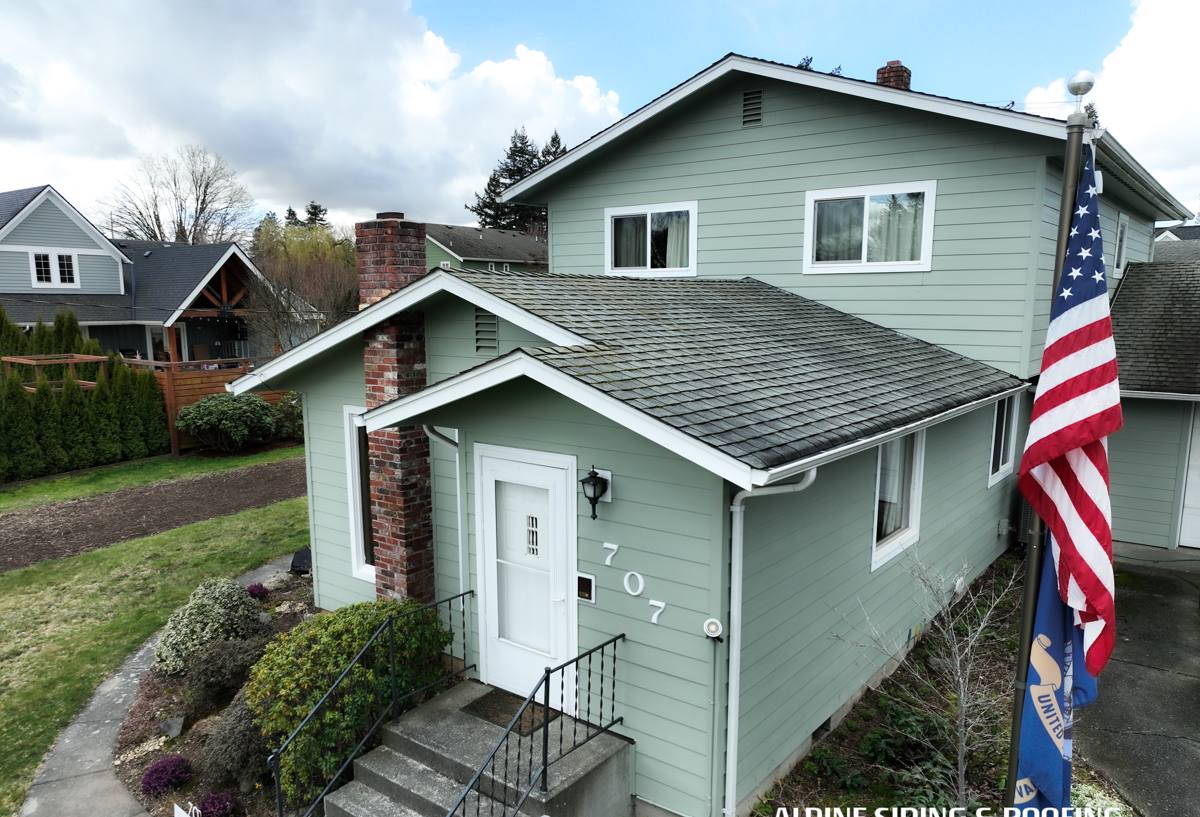
What the Local Climate Actually Demands From a Metal Roof
Moss and Organic Growth
The tree cover that makes Sudden Valley attractive is also what keeps roofs damp. Moss doesn't just look bad — it holds water against the surface, works into laps and fastener penetrations, and on the wrong material it accelerates surface breakdown. A smooth, properly coated metal panel gives moss and moisture far less to grip than a rough or granular surface, and it sheds standing water fast enough that spores have a harder time establishing in the first place. It's not moss-proof forever, but it buys years compared to alternatives, especially in the shaded, low-slope sections common on lake-view homes.
Driving Rain and Wind-Driven Water
Storms crossing the lake can push rain sideways into eaves, valleys, and wall-to-roof transitions. This is where the underlayment and flashing details matter as much as the panel itself — a metal roof is only as watertight as its weakest lap, valley, or penetration. We pay particular attention to valley design and eave protection on these homes because that's where we consistently see older roofs fail first, regardless of what material was on top.
Temperature Swings and Panel Movement
Whatcom County doesn't see extreme heat, but metal still expands and contracts with the seasonal swing, and panels need fastening systems that allow for that movement without loosening seams or over-stressing screws over time. Concealed-fastener panels handle this more gracefully than exposed-fastener systems, which is one reason we lean toward them on homes that will sit through twenty-plus wet seasons.
What a Correct Metal Roofing Job Includes Here
A metal roof is a system, not just a layer of panels. On a Lake Whatcom home, that system needs to account for tree debris, shade, and moisture load specifically. The components we treat as non-negotiable:
- A synthetic, high-temp underlayment rated for long UV and moisture exposure, not felt paper that degrades under years of damp shade
- Ice-and-water shield at eaves, valleys, and any low-slope transitions, since these are the spots where standing water and debris dams occur first
- Properly lapped and sealed valley flashing sized for real storm volume, not the minimum code allowance
- Concealed-fastener panel systems on most residential applications, for a cleaner water path and fewer long-term fastener failures
- Ventilation at the ridge and soffit sized to the actual roof, so trapped moisture in the attic doesn't undo the benefit of a dry exterior surface
- Panel and trim coatings rated for coastal-influenced marine climates, not a generic inland-spec finish
Skip any one of these and you can still end up with moss, leaks, or premature coating failure on a metal roof — the material gets blamed when the real issue is the installation choices underneath it.
Metal Roofing Options: What Actually Fits This Area
| Option | How It Performs Around the Lake | Where It Fits |
|---|---|---|
| Standing seam, concealed fastener | Best water-shedding and longest service life in wet, shaded settings; minimal maintenance | Most Sudden Valley homes, especially shaded or low-slope roofs |
| Exposed-fastener metal panel | Lower upfront cost but fasteners and washers need periodic checking as they age in a wet climate | Outbuildings, shops, budget-driven projects |
| Stone-coated steel | Good impact and wind resistance, mimics shake or tile look, but more seams and surface texture for moss to catch | Homeowners prioritizing a traditional look over minimal maintenance |
| Aluminum panel systems | Naturally corrosion-resistant, lighter weight, strong choice where marine air influence is a factor | Lake-adjacent and more exposed sites |
Our Process on Lake Whatcom Homes
1. On-Site Assessment
We walk the roof and the property, not just the roof plan. Tree overhang, shade patterns, existing moss or moisture staining, gutter condition, and attic ventilation all factor into what we recommend — a roof tucked under heavy canopy gets a different valley and underlayment spec than one in a clearer, more open lot in the same neighborhood.
2. Tear-Off and Deck Inspection
We don't install new metal over a deck we haven't checked. Years of trapped moisture under an old roof can soften sheathing, and that has to be addressed before anything new goes down — covering it up just moves the problem underground.
3. Underlayment and Flashing First
This is the layer that actually keeps water out long-term. We install it to the standard described above regardless of budget pressure to cut corners here, because it's the part of the job you can't see or fix cheaply once the panels are on.
4. Panel Installation
Panels are installed to manufacturer spec for fastening pattern, seam engagement, and expansion allowance, with valleys, ridges, and penetrations detailed to shed water even in sideways rain off the lake.
5. Walkthrough
We go over the finished roof with the homeowner, including what routine upkeep looks like — gutter clearing and occasional debris removal — so the roof performs the way it's supposed to for its full service life.
Why Hiring a Crew That Already Works Sudden Valley Matters
A metal roofing crew that's worked around Lake Whatcom knows where the shaded valleys sit on a typical lot, how fast moss establishes under fir canopy versus open sky, and which drainage details actually get tested by real storms here versus a spec sheet written for a drier region. That local pattern recognition shows up in small decisions — a slightly oversized valley, an extra course of ice-and-water shield, a ventilation adjustment for a shaded attic — that a crew unfamiliar with the area might not think to make until after a callback.
It also matters for access and logistics. Sudden Valley's private roads, tree cover, and lot layouts aren't always straightforward for material delivery and equipment staging, and a crew that's navigated that before plans for it instead of losing a day figuring it out.
Maintenance Reality for Metal Roofs in This Climate
Metal roofing is genuinely low-maintenance compared to most alternatives, but "low" isn't "none," especially under tree cover. A short seasonal checklist keeps a correctly installed metal roof performing for decades:
- Clear needles and leaf debris from valleys and gutters at least once a year, more often under heavy canopy
- Check that gutters and downspouts are draining freely, not backing water up under the eave edge
- Look for any moss establishing in shaded valleys and remove it early rather than letting it mat down
- Have flashing and penetrations (vents, skylights, chimneys) checked periodically, since these are the most common source of any leak on an otherwise sound metal roof
- Trim back branches that overhang the roofline where practical, to reduce both debris load and abrasion
Cost Factors Worth Understanding Before You Budget
| Factor | Why It Moves the Price |
|---|---|
| Roof complexity (valleys, dormers, penetrations) | More flashing detail work and cut panels, which is labor-intensive on any metal roof |
| Tear-off vs. deck repair needed | Soft or water-damaged sheathing found during tear-off adds material and labor before new roofing goes on |
| Panel system chosen | Standing seam and aluminum systems cost more upfront than exposed-fastener steel but ask less in long-term maintenance |
| Access and staging | Tree-covered, sloped, or private-road lots can add time for material handling and equipment setup |
| Ventilation and underlayment upgrades | Bringing attic ventilation and underlayment up to a real coastal-climate standard adds cost but protects the investment |
Exact pricing depends on your roof's size, pitch, and condition — we'll walk it with you and give a straight number rather than a rough guess over the phone.
Signs It's Time to Start the Conversation
You don't need active leaking to justify looking into a metal roof replacement. Homeowners around the lake usually start the process after noticing one or more of these:
- Moss regrowing within months of being cleaned off, especially on shaded slopes
- Granule buildup in gutters from an aging asphalt roof nearing the end of its service life
- Visible staining or sagging on interior ceilings after heavy storms
- An upcoming insurance renewal or home sale where roof condition and age are being questioned
- Wanting to stop repainting or patching a roof every few years and move to something closer to install-and-forget
If you're weighing metal roofing for a home in Sudden Valley or elsewhere around Lake Whatcom, we're happy to walk the roof, talk through what your specific lot and tree cover call for, and put together a clear, no-pressure estimate — just fill out the form below to get started.