 Sudden Valley Siding
 Why Lake Whatcom Homes Wear on Their Own Schedule
Houses around Lake Whatcom don't age the same way a house in a dry inland climate does. Sudden Valley sits inside a wooded, water-adjacent pocket of Whatcom County, and that setting cuts both ways. The tree cover and lake proximity are why people live here — and they're also why siding here takes on moisture, shade, and organic growth at a rate that a lot of national repair guides don't account for. Add in the marine-influenced air that moves through this part of Western Washington off Bellingham Bay and the Sound, and you get a climate that's mild in temperature but relentless in moisture exposure almost year-round.
When we get called out to a Sudden Valley home for a siding repair, the damage pattern is rarely random. It clusters on north- and west-facing walls, around tree-shaded sections of the lot, near roof-to-wall transitions, and low on the wall where splashback and standing moisture linger longest. Understanding that pattern is the difference between a repair that holds and one that's back on our schedule in two years.
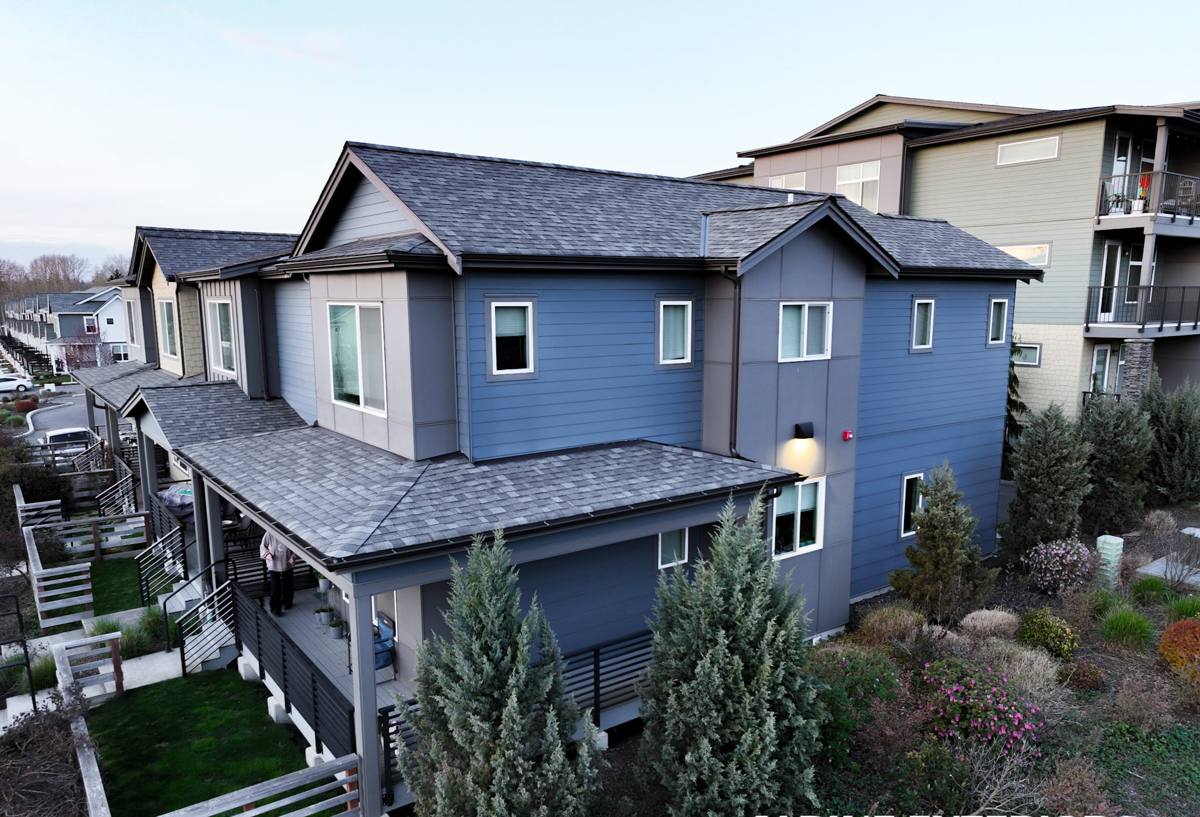
What Driving Rain, Marine Air, and Moss Season Actually Do to Siding
Moisture intrusion at the seams
Whatcom County's rain doesn't just fall — a lot of it comes in sideways off wind moving across the lake and through the valley. Driving rain finds every gap in caulking, every under-flashed trim joint, and every place where siding panels weren't lapped correctly. Once water gets behind the siding instead of running off its face, it stops being a cosmetic problem and starts being a structural one: sheathing rot, insulation damage, and eventually interior wall damage that costs far more than the siding repair itself would have.
The long moss and algae season
Between the tree canopy around much of Sudden Valley and the extended damp season typical of this part of the county, siding here stays wet longer after each rain than siding on an open, sun-exposed lot. That extra dry time — or lack of it — is what moss, algae, and mildew need to take hold. On porous or textured siding, that growth doesn't just sit on the surface; it holds moisture against the substrate and accelerates whatever damage is already starting underneath.
Marine air and material fatigue
The moisture-laden marine air common to this region carries more humidity than an inland climate, and materials that aren't engineered for it — untreated wood trim, some composite panels, certain caulks and sealants — break down faster. It's a slow, cumulative kind of wear, which is exactly why so many siding problems in this area go unnoticed until they're already serious.
Signs Your Lake Whatcom Home Needs Siding Repair
Most of what we get called for started small. If you're not sure whether what you're seeing is cosmetic or a real problem, walk your exterior and check for these:
- Soft or spongy spots when you press on siding, especially near the bottom of walls or below windows
- Visible moss, algae, or dark staining that keeps coming back after cleaning
- Bubbling, peeling, or cracked paint on painted wood trim or siding
- Gaps or separation at seams, corners, or where siding meets window and door trim
- Warped, bowed, or buckled panels, particularly on shaded or north-facing walls
- Caulk that's cracked, shrunk, or pulling away from joints
- Musty smell or discoloration on interior walls that back up to exterior siding
- Rust streaks near fasteners or flashing on older siding systems
Any one of these on its own might be minor. Two or three together, especially clustered in one area, usually means water has been getting behind the siding for a while.
What a Correct Siding Repair Actually Involves
Diagnosis before demolition
The visible damage is rarely the whole story. Before we pull a single board, we're checking how far the moisture has traveled — whether it's contained to the siding and building wrap, or whether it's reached the sheathing and framing. Repairing over a hidden rot problem is one of the most common mistakes in this trade, and it's why a repair that looks fine on day one can fail again within a season.
Matching material and finish
A repair should be close to invisible once it's done. That means matching board profile, reveal, and color as closely as the existing siding allows — not just nailing up whatever's on the truck. On homes with factory-finished siding, matching the finish matters as much as matching the material, since a mismatched sheen or shade stands out immediately, especially in flat coastal light.
Water management, not just patching
The actual repair has to fix the reason water got in, not just cover the hole. That usually means correcting flashing at windows, doors, and roof transitions, re-establishing proper laps and clearances, and making sure water has somewhere to go besides behind your wall. A patch that ignores the underlying water path is a temporary fix at best.
Why We Repair With James Hardie — Not Vinyl, Not Wood, Not LP
We install and repair with James Hardie fiber cement siding exclusively. We don't install vinyl, LP SmartSide, Cemplank, Allura, primed spruce, or cedar, and on a repair job that distinction matters just as much as it does on a full re-side. When we're patching a damaged section, we're not interested in propping up a material system we don't stand behind long-term.
| Factor | James Hardie Fiber Cement | Wood / LP / Vinyl Alternatives |
|---|---|---|
| Moisture behavior in a wet climate | Engineered fiber cement resists swelling and rot; HZ product lines are built for exactly this climate zone | Wood and wood-composite substrates can absorb moisture and swell, warp, or rot over time |
| Moss and algae resistance | Dense, non-organic surface doesn't feed organic growth the way wood fiber can | Wood and some composite panels give moss and mildew more to hold onto |
| Fire performance | Non-combustible | Wood is combustible; vinyl can soften, warp, or melt under heat |
| Finish durability | ColorPlus factory finish is baked on and warranted against fading and peeling | Field-applied paint on wood or LP needs repainting on a recurring cycle |
| Long-term cost | Higher upfront material cost, lower lifetime maintenance | Often lower upfront cost, higher recurring maintenance and repaint/replace cycles |
Vinyl and LP SmartSide both have legitimate uses and plenty of homes carry them without issue. Our decision to standardize on Hardie isn't a claim that those products don't work — it's that after years in this specific climate, we'd rather stand behind one material system we trust fully than repair or install several we have reservations about.
Our Process for a Lake Whatcom Siding Repair
- On-site inspection — we walk the affected area and check surrounding sections for related or early-stage damage, since Whatcom County moisture problems rarely stay isolated to one board
- Moisture and substrate check — we confirm whether damage is limited to the siding or has reached the sheathing, framing, or insulation
- Written scope and estimate — you get a clear explanation of what's being replaced, what's being resealed or reflashed, and why
- Removal and prep — damaged siding and any compromised trim or flashing come out; we address the water source, not just the symptom
- Reinstallation to spec — new James Hardie material is installed with correct fastening, laps, and clearances per manufacturer requirements
- Sealing and finish match — joints are sealed, and finish is matched as closely as the existing siding allows
- Final walkthrough — we review the completed repair with you before we consider the job done
Repair vs. Replace: Cost Factors to Weigh
Not every damaged wall needs a full re-side, but not every problem should be treated as a spot repair either. These are the factors that actually determine which makes sense:
| Factor | Favors Repair | Favors Full Replacement |
|---|---|---|
| Extent of damage | Isolated to one wall or a small section | Recurring damage across multiple walls or elevations |
| Age of existing siding | Relatively new, still within its expected service life | Approaching or past the end of its expected lifespan |
| Underlying cause | A single identifiable source (flashing, caulk, impact damage) | Systemic moisture intrusion across the building envelope |
| Material match availability | Existing product and finish can still be matched closely | Discontinued profile or finish that can't be matched |
| Budget timing | Addressing an active problem now, planning full re-side later | Ready to solve the whole envelope at once |
We'll give you an honest read on which category your home falls into. If a repair genuinely solves the problem, that's what we'll recommend — we're not trying to upsell a full re-side on a job that doesn't need one.
Why a Crew That Already Works Sudden Valley Matters
Siding repair is a trade where local familiarity actually changes the outcome. A crew that already works Lake Whatcom and Sudden Valley knows which wall orientations take the worst weather here, how the tree canopy on a given street affects dry time, and what flashing and water-management details tend to fail first on homes built to this area's older code cycles. That's not something you get from a crew driving in from outside the county for a one-off job — it's built from repeat exposure to the same climate and the same construction patterns, visit after visit.
It also matters for accountability. A local crew is easy to reach if a question comes up after the work is done, and has a reputation in the community worth protecting. That's a different incentive structure than a contractor who's just passing through Whatcom County for a single project.
Maintaining Your Siding After the Repair Is Done
A correct repair should hold for years, but a little seasonal attention extends that further, especially in this climate:
- Rinse siding annually to clear pollen, dust, and early moss growth before it takes hold
- Keep gutters clear so overflow doesn't run down the wall face during heavy rain
- Trim back vegetation and tree limbs that keep siding shaded and slow to dry
- Walk your exterior each fall and spring and check caulking at trim and penetrations
- Address small issues — a lifted board, a cracked seal — before the next wet season, not after
Fiber cement needs far less of this than wood, but no siding in a climate like this is fully maintenance-free. A few minutes twice a year is what keeps a good repair from becoming a repeat call.
If you're seeing early signs of trouble on your Lake Whatcom or Sudden Valley home, or you just want a second opinion on a section that's been bothering you, we're happy to take a look. Estimates are free and there's no pressure to move forward — fill out the form below and we'll get back to you.