 Sudden Valley Siding
 What Sunnyland's Climate Actually Does to Siding
Homes in Sunnyland sit in a stretch of Whatcom County where three things gang up on exterior walls at once: salt-laden air moving in off the water, long stretches of driving, wind-blown rain, and a moss season that can run most of the year on shaded north and east elevations. None of these is dramatic on its own. Together, year after year, they're what separates a siding job that still looks good at year fifteen from one that's chalking, cupping, or rotting at the seams by year eight.
Salt air is corrosive to exposed metal fasteners and trim flashing, and it accelerates the breakdown of lower-grade paint films. Driving rain doesn't just wet the surface of a wall — wind pressure pushes moisture sideways and upward into laps, seams, and butt joints that a calmer climate would never test. And moss, once it gets a foothold on a north-facing wall, holds moisture against the siding face for weeks at a time, which is exactly the condition that causes wood-based and wood-fiber products to swell, delaminate, or rot from the inside out.
Any siding product can survive a mild, dry week. What matters in Sunnyland is how a product — and the installation behind it — holds up to that combination running continuously for a decade or more.
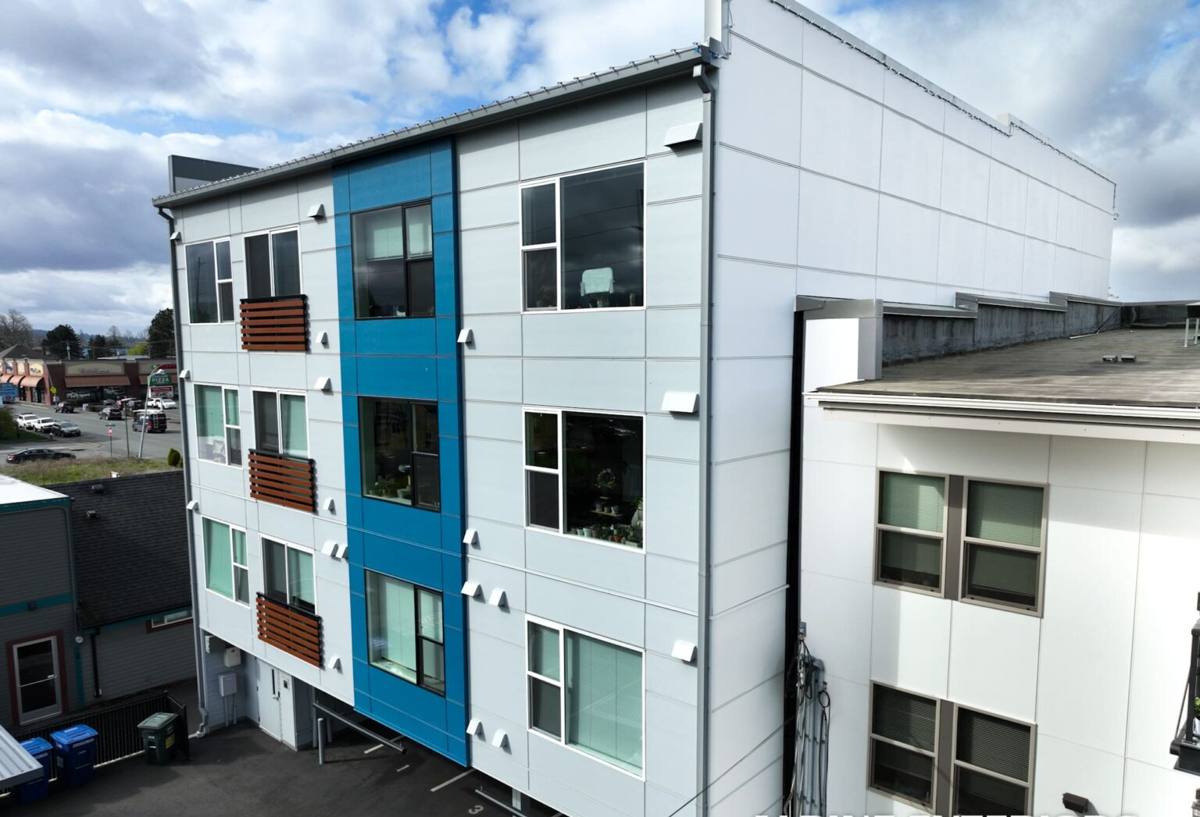
Why We Install James Hardie and Nothing Else Here
We standardized this business on James Hardie fiber cement siding, full stop. We don't install vinyl, LP SmartSide, cedar, primed spruce, or other fiber cement brands like Allura or Cemplank. That's not a marketing position — it's a practical one, built on what actually holds up in this specific climate.
Fiber cement is non-combustible and dimensionally stable, meaning it doesn't expand and contract with moisture the way wood-based products do. That matters directly in a high-moisture, moss-prone environment: wood fiber siding that stays damp against a shaded wall is at real risk of edge swelling and delamination over time, while cement-based siding doesn't absorb water into its structure the same way. Vinyl, for its part, handles moisture fine but is a poor match for driving-rain conditions at the seams and can become brittle and prone to cracking in cold snaps — and it can't be color-matched or repaired the way fiber cement can.
James Hardie also backs its ColorPlus factory-finish colors with a specific coating warranty, separate from the substrate warranty, and offers HZ5-engineered product formulated for wetter, colder climate zones like ours. We're not chasing the cheapest material that will pass inspection — we're installing the product we're willing to warranty our own labor against.
What Homeowners Sometimes Ask Us to Switch To
We get asked about vinyl and engineered wood siding regularly, usually on a budget basis. We'll always give a straight answer about the trade-offs — vinyl's lower material cost against its shorter realistic service life here, or engineered wood's warmer look against its moisture sensitivity in a moss-heavy microclimate — but we don't install either. If that's the direction a homeowner wants to go, we'll say so honestly rather than take the job and cut corners on a product we don't stand behind.
What a Correct James Hardie Job Actually Involves
James Hardie siding is only as good as the installation underneath it. The product is engineered to perform for decades, but that performance depends entirely on details most homeowners never see once the job is finished.
Weather-Resistive Barrier and Drainage Plane
Everything starts with the water-resistive barrier behind the siding. In a driving-rain climate, we're not just relying on the siding face to keep water out — we're building a drainage plane behind it so any moisture that does get past the exterior surface has somewhere to go besides your sheathing.
Flashing at Every Penetration
Windows, doors, hose bibs, vents, and deck ledgers are the places water actually gets in. Correct flashing detail at each of these — not just caulk over a gap — is what keeps wind-driven rain from tracking behind the siding at the exact spots where wall assemblies are most vulnerable.
Fastening and Clearances
James Hardie specifies fastener type, spacing, and embedment depth, and it specifies minimum clearances from grade, roof lines, and other siding-to-surface transitions. In salt air, corrosion-resistant fasteners aren't optional — the wrong fastener will bleed rust through a ColorPlus finish within a few seasons.
Joint Treatment and Caulking
Butt joints and trim transitions need the right sealant, applied correctly, at the manufacturer-specified gap. This is one of the most common places we find corners cut on prior installs — either the wrong sealant or none at all, which is a direct invitation for moisture intrusion during a hard rain.
Our Process for a Sunnyland Project
- Walk and assess: We look at existing siding condition, moss and moisture patterns on shaded elevations, and any signs of past water intrusion around windows, decks, and trim.
- Scope and product selection: We recommend the James Hardie profile and HZ line suited to the home's exposure — a wall that catches prevailing wind-driven rain gets treated differently than a sheltered one.
- Written estimate: Clear scope, product, and cost breakdown before any work begins — no verbal-only quotes.
- Tear-off and inspection: Once old siding is off, we inspect sheathing for hidden rot or moisture damage before closing the wall back up. This is often where prior moisture problems actually get found.
- Barrier, flashing, and install: Weather barrier, flashing at every penetration, then Hardie panels or lap siding installed to fastening and clearance spec.
- Final detail and walkthrough: Caulking, touch-up, trim, and a walkthrough so you know what was done and why.
Choosing the Right James Hardie Product for This Neighborhood
James Hardie makes several siding profiles, and the right one depends on the home's style and exposure as much as personal taste.
| Product | Best Fit | Notes for Sunnyland Exposure |
|---|---|---|
| HardiePlank lap siding | Most single-family homes | Widely used; pairs well with HZ5 formulation for wetter, colder climates |
| HardiePanel vertical siding | Modern or mixed-material facades | Fewer horizontal laps means fewer potential water-entry seams |
| HardieShingle | Accent gables, dormers | Good for architectural detail; needs the same flashing discipline as lap siding |
| HardieTrim | Corners, fascia, window/door casing | Matched system keeps expansion/contraction consistent with the field siding |
Cost Factors on a Sunnyland Job
We won't quote a number without seeing the home, but these are the variables that actually move the price:
| Factor | Why It Matters |
|---|---|
| Tear-off condition | Rotted sheathing found underneath old siding adds repair scope before new siding can go on |
| Wall complexity | Dormers, multiple gables, and cut-in trim take more labor per square foot than a plain rectangle |
| Product line and profile | HZ5 versus standard, and lap versus panel versus shingle, carry different material costs |
| Color | Factory ColorPlus finish versus a custom field-applied color affects both cost and long-term coating warranty coverage |
| Access and site conditions | Steep lots, limited staging area, or multi-story walls affect labor time |
Living With Fiber Cement Siding Here: What Upkeep Actually Looks Like
James Hardie siding is genuinely low-maintenance compared to wood, but "low-maintenance" doesn't mean "no maintenance" in a climate like this. A short annual routine keeps a correctly installed system performing for decades:
- Rinse siding annually, and check shaded north/east walls more often where moss and mildew tend to establish first
- Keep gutters clear so overflow doesn't run down the wall face instead of the downspout
- Trim back vegetation and landscaping so soil, mulch, and plant matter don't stay in contact with the bottom course of siding
- Inspect caulking at trim joints and penetrations every year or two, and re-caulk before a gap becomes an entry point
- Watch for any fastener bleed-through or discoloration, which usually signals a fastener issue worth catching early rather than later
Why a Crew That Already Works Sunnyland Matters
Installation quality is the real variable in how James Hardie siding performs here — the product itself is engineered to handle this climate, but a crew unfamiliar with Whatcom County's rain exposure and moss patterns can still miss the flashing and drainage details that make the difference over ten or twenty years. A crew that already works this area has seen where water actually gets into these homes, not just where a generic install manual says to check, and builds every job around that.
If you're weighing siding options for a home in Sunnyland, we're happy to walk the property, look at what your walls are actually dealing with, and put together a straightforward, no-pressure estimate for a James Hardie installation done to spec.