 Sudden Valley Siding
 Lake Whatcom Puts Different Demands on Siding Than a Typical Whatcom County Lot
Homes around Lake Whatcom sit in a microclimate of their own. Mature tree canopy along the shoreline keeps large sections of most homes in shade for much of the day, the lake itself keeps humidity higher at ground level than you'll find a few miles inland, and wind coming off the water drives rain sideways into walls that a house on a dry, open lot would never see at that angle. Add in the broader marine air that moves through Whatcom County off the Sound, and you get a combination that's genuinely tougher on exterior materials than the regional average.
None of that is a defect in these properties — it's part of why people want to live here. But it means the siding on a Lake Whatcom home is doing more work, more often, than siding on a similar house in a drier part of the county. Products that hold up fine elsewhere can start showing problems here years earlier.
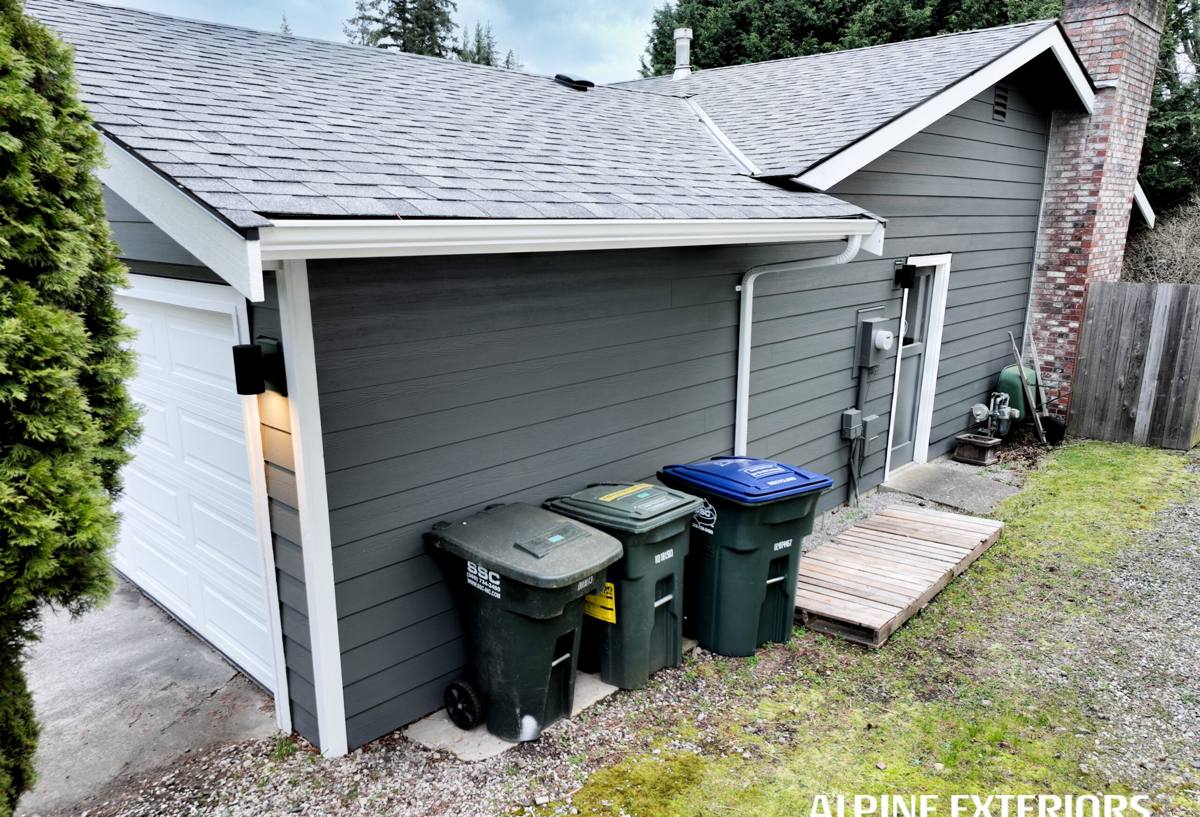
What Constant Moisture and Shade Actually Do to a Wall
The failure modes we see most often on lake and shoreline properties aren't dramatic — they're slow and cumulative:
- Moss and algae growth on shaded north- and east-facing walls, especially under overhangs and near tree lines, where surfaces rarely get direct sun to dry out
- Paint and coating failure from repeated wet-dry cycling, which shows up as chalking, peeling, or blotchy fading well before a manufacturer's coating warranty would expect it
- Swelling and softening at butt joints, corners, and any spot where water can sit against a wood-based or composite product instead of shedding off
- Caulk and joint failure where sealant that isn't rated for constant damp exposure dries out and cracks faster than it would on a drier elevation
The long moss season in particular is a Lake Whatcom problem more than a general Whatcom County problem — it's the combination of shade from the tree canopy and the lake's ambient moisture that lets moss establish and spread across a wall surface in a way that open, sunnier lots rarely deal with.
Why We Only Install James Hardie Fiber Cement
We made a decision a while back to standardize on James Hardie fiber cement and stop installing vinyl, LP SmartSide, primed spruce, cedar, or other fiber cement brands. That's not a marketing position — it's a practical one, and it matters even more on a lake property than on an average lot.
Fiber cement is a mix of cement, sand, and cellulose fibers, engineered specifically to resist the things that hurt siding in wet, shaded environments: it doesn't swell and rot the way wood-based products can when they stay damp, it's non-combustible (a real consideration for homes backed up against tree cover), and James Hardie's ColorPlus factory finish is baked on and warranted against fading and peeling in a way field-applied paint on other products generally isn't.
That last point matters most on this kind of lot. A coating that's engineered and warranted to hold color and adhesion through repeated wet-dry cycles is worth more here than almost anywhere else in the county — because Lake Whatcom's shade and humidity are exactly the conditions that stress a coating fastest.
What We Turned Down, and Why
Vinyl siding is inexpensive and low-maintenance in a lot of climates, but it flexes and can warp with temperature swings, and it doesn't hold up structurally or visually the way fiber cement does over the long run in a demanding, shaded, wet environment. LP SmartSide and other engineered wood products use a wood-strand substrate — treated and warrantied, but still wood-based, which means moisture management at every seam and cut edge is non-negotiable, and a callback risk we'd rather not carry on homes that already fight moisture year-round. We're not saying these products fail everywhere; we're saying we don't think they're the right call for what Lake Whatcom homes are up against, and we'd rather install one product correctly than several products with more caveats.
The Hardie Product Lines That Make Sense Here
James Hardie makes several siding profiles, and which one fits depends on the home's style and exposure. For most Lake Whatcom homes we're choosing between:
| Product | Best fit | Why it works here |
|---|---|---|
| HardiePlank lap siding | Traditional and craftsman-style homes | Most common choice; wide color range, proven track record in wet PNW conditions |
| HardiePanel vertical siding | Modern or A-frame lake homes, accent walls | Clean lines, sheds water efficiently on steep gables common near the shoreline |
| HardieShingle siding | Cottage-style homes, accent gables | Textured look without the moisture vulnerability of real wood shingle |
| HardieTrim | Corners, fascia, window/door trim | Matches the fiber cement system end-to-end instead of mixing in wood trim that will age differently |
James Hardie also engineers its products by climate zone (HZ5 for regions with freeze-thaw and heavy moisture, HZ10 for milder zones). Whatcom County, including the Lake Whatcom area, falls into the range where the moisture-and-freeze engineering matters — it's not a cosmetic upgrade, it changes how the product is formulated to handle the wet-cold cycling we get here.
What a Correct Installation Involves
Fiber cement performs the way it's rated to only when it's installed to spec. On a shaded, wet lot, the margin for sloppy installation is smaller than usual — a missed flashing detail that would take years to show up on a dry, sunny wall can show up in one or two wet seasons here. A correct job includes:
- A drainable weather-resistive barrier behind the siding, not just a wrap stapled flat
- Proper starter strip and minimum clearance from grade, decks, and roof lines — an easy spot to cut corners, and a common cause of rot we see when we tear off other siding
- Correct fastener type, spacing, and depth per James Hardie's installation instructions — hand-nailing or a properly calibrated pneumatic tool, not guesswork
- Flashing and kick-out flashing at every roof-wall intersection, window, and door — the single biggest source of hidden water intrusion on lake-adjacent homes
- Gapped and properly sealed joints using a sealant rated for the product, not general-purpose caulk
- Ventilation behind the cladding so trapped moisture has somewhere to go instead of sitting against the wall assembly
Skipping any one of these doesn't usually cause an immediate problem — it causes a problem two or three winters later, once water has had time to find the gap. That delay is exactly why installation quality is harder to judge from a quote alone, and why it's worth asking a contractor to walk through their process in detail before you sign anything.
Our Process for a Lake Whatcom Siding Project
1. On-Site Assessment
We walk the home, note shaded and high-exposure elevations separately, check existing moisture damage at trim, corners, and grade level, and identify any rot or framing issues that need to be addressed before new siding goes on — not covered up under it.
2. Tear-Off and Substrate Check
Old siding comes off and we inspect the sheathing underneath. This is where hidden moisture damage from years of shade and driving rain often shows up, and it needs to be repaired before the weather barrier goes back on.
3. Weather Barrier and Flashing
A drainable barrier goes on first, followed by flashing at every penetration and transition — windows, doors, roof lines, and any place two planes meet.
4. James Hardie Installation
Panels or planks go up per James Hardie's published installation guide, with attention to clearances, fastening, and joint sealing throughout — the details that determine whether the product performs for decades or needs attention in five years.
5. Final Inspection and Walkthrough
We walk the finished job with you, point out anything you should know for maintenance, and make sure every elevation — especially the shaded ones — was treated with the same care.
Cost Factors on a Lake Whatcom Job
Every home is different, so we don't quote broad averages without seeing the site — but the main factors that move the price on this type of property are usually the same ones:
| Factor | Why it matters |
|---|---|
| Existing siding removal and disposal | Tear-off adds labor, and more if there's rot to repair underneath |
| Home access and site slope | Many lake lots have steep grades or limited staging space, which affects scaffolding and material handling |
| Number of stories and roof complexity | More gables, dormers, and roof-wall intersections mean more flashing detail work |
| Product mix | Lap siding, panel, shingle accents, and trim all price differently |
| Substrate repair | Rot found at tear-off needs to be fixed before new siding goes on, which isn't always visible from the outside beforehand |
Why a Crew That Already Works Sudden Valley and the Lake Whatcom Area Matters
Lake and shoreline properties come with practical realities a contractor who mostly works flat, open subdivisions may not be used to: steep or limited driveway access, staging materials on a sloped lot, working around mature trees you don't want to damage, and coordinating around a home's actual sun and shade pattern rather than a generic install checklist. If your property is part of a community association, there may also be exterior guidelines worth checking on before work starts — something a crew familiar with the area can help you think through.
Experience with this specific environment also means we're not guessing at how a given elevation will behave five years out — we've seen which walls in this kind of setting need extra attention to flashing and drainage, and we plan for it up front instead of learning it the hard way on your house.
If you're weighing a siding replacement on a Lake Whatcom home, we're glad to take a look and give you a straight, no-pressure estimate — what your home actually needs, what it would involve, and what it would cost. There's no obligation, just an honest assessment from a crew that installs one product and knows it well.