 Sudden Valley Siding
 Why Happy Valley Homes Wear Out Siding Faster Than the Owner's Manual Says
Happy Valley sits close enough to Lake Whatcom and the surrounding tree cover that its houses deal with a specific combination of stresses most siding products were never engineered for: near-constant shade and moisture on the north and west-facing walls, salt-laden air drifting in off the Puget Sound weather systems, and a moss season that can run from late fall through spring. Any one of those on its own is manageable. Together, they shorten the useful life of the wrong siding material by years, sometimes by a decade or more.
We install siding across Whatcom County, but Happy Valley gets its own conversation because the microclimate here is not the same as a house two miles away in an open field. Homes tucked against tree lines or on shaded slopes hold moisture longer after a storm, and that extra dry-out time is exactly what turns ordinary weather exposure into rot, mold staining, and paint failure.
What "driving rain" actually does to a wall
Driving rain isn't just water hitting the siding face — it's wind-driven moisture forced sideways and upward, working its way behind laps, around trim, and into any gap the original installer left. On a lot of older Happy Valley homes we've looked at, the siding itself wasn't the failure point; it was flashing that was skipped, house wrap that was cut wrong around windows, or butt joints that were never caulked and sealed to spec. Replacement siding done right fixes those details, not just the visible surface.
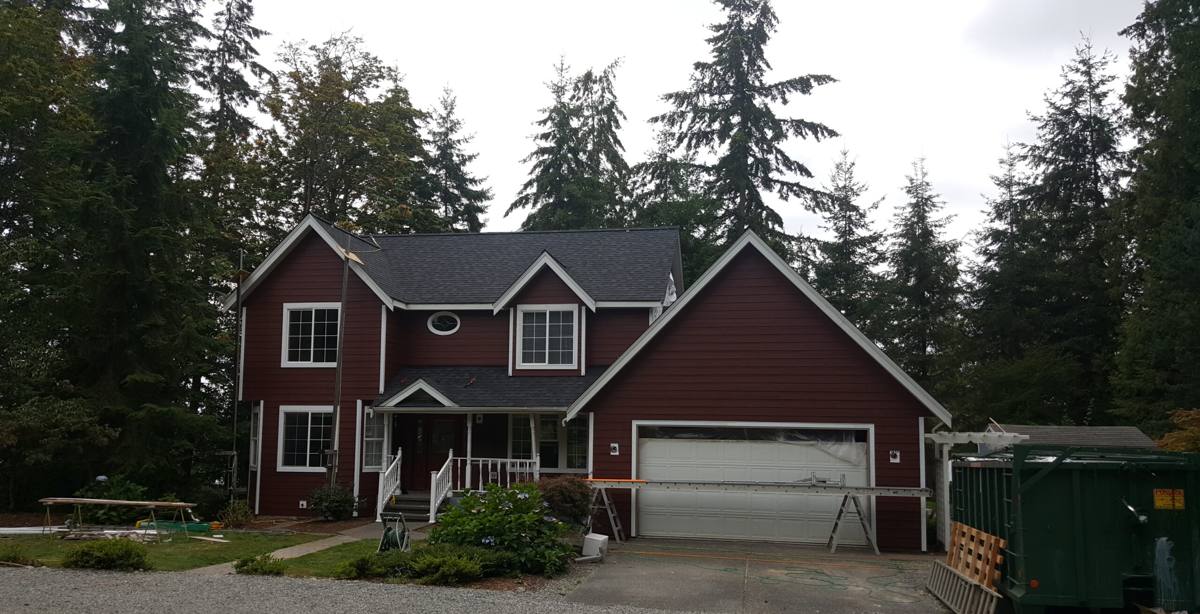
What a Correct Siding Replacement Actually Involves
A siding replacement is not a re-skin. If we're pulling old siding off a Happy Valley home, we're also inspecting and correcting everything the siding was hiding — because in this climate, whatever's wrong under there has usually been getting worse for years, quietly.
- Full removal of old siding and trim, with the sheathing exposed for inspection
- Identification and repair of any rot, soft spots, or water-damaged sheathing before anything new goes up
- Installation or correction of a proper weather-resistive barrier (house wrap), lapped correctly top-to-bottom
- New flashing at every window, door, deck ledger, and roofline intersection — not caulk used as a substitute for flashing
- Rain screen or drainage gap detailing where the wall assembly calls for it, so bulk water has somewhere to go
- Correct fastening pattern and nail placement per the manufacturer's installation instructions
- Factory-finished siding installed with the gaps, clearances, and caulking joints specified by the manufacturer
Skip any one of those steps and you've got a house that looks new for a season or two before the same underlying problems resurface — just under a fresh face.
Why We Install Only James Hardie Fiber Cement — Nothing Else
We don't offer vinyl, LP SmartSide, primed spruce, cedar, or the other fiber cement brands like Cemplank or Allura. That's a deliberate standard, not a lack of options. In a climate where a wall can stay damp for days after a storm and moss has months to establish itself, the material matters more than the color or the price point.
James Hardie fiber cement is non-combustible, dimensionally stable, and doesn't feed moss and mildew the way wood-based products can. It's engineered in HZ5 and HZ10 product lines specifically for regions with heavy moisture exposure — which describes Happy Valley about as well as anywhere in Whatcom County. The ColorPlus factory finish is baked on under controlled conditions, which gives it more consistent, longer-lasting color than a field-applied paint job, and it carries a strong transferable warranty when installed by a certified crew to Hardie's own specifications.
Vinyl expands and contracts with temperature swings and can warp or gap over time, giving water a path in behind it. Wood-based products — cedar, primed spruce, LP SmartSide — perform fine in a dry climate, but they all rely on an intact paint or coating layer to keep moisture out, and that layer is exactly what driving rain, salt air, and prolonged shade wear down fastest. Once moisture gets past that layer on a wood-based product, the material itself is vulnerable to swelling and rot. We're not saying those products are junk — they work, in the right climate, with diligent maintenance. We just don't think that's a fair bet to make with a Happy Valley homeowner's money and time.
What that means for maintenance, long term
Fiber cement doesn't need repainting on the same cycle wood siding does, and it won't develop the soft, spongy spots that signal rot. That doesn't mean zero maintenance — caulking joints, trim, and paint on cut edges still need periodic attention — but the maintenance burden and the failure modes are fundamentally different from what we see with wood-based siding after a few Whatcom County winters.
Comparing Siding Materials for a Shaded, Damp Lot
| Factor | James Hardie Fiber Cement | Vinyl | Wood-Based (cedar, LP SmartSide, primed spruce) |
|---|---|---|---|
| Moisture tolerance | Engineered HZ lines for wet climates; doesn't rot | Doesn't rot, but seams and gaps can let water behind it | Vulnerable once the coating is compromised |
| Moss/mildew resistance | Fiber cement doesn't feed organic growth | Resistant, but grime and moss can still cling to the surface | Organic material; more prone to moss and mildew staining |
| Fire rating | Non-combustible | Combustible | Combustible |
| Finish stability | Factory-baked ColorPlus finish | Color molded in, can fade | Relies on field-applied paint/stain, needs recoating |
| Typical repaint cycle | Well beyond 10+ years on trim/cut edges only | Rarely painted; replaced when damaged | Every 3-7 years depending on exposure |
| Warranty | Strong transferable manufacturer warranty when installed to spec | Varies by manufacturer | Varies; often shorter on coating performance |
How We Approach a Happy Valley Job
1. On-site assessment
We walk the exterior with the homeowner, looking specifically at the shaded and north/west-facing walls first, since those show problems earliest in this area. We check for soft sheathing, failed caulk joints, moss buildup at laps, and staining patterns that indicate where water has been getting behind the current siding.
2. A written scope, not a verbal estimate
We put the actual scope of work in writing — what's being removed, what's being repaired underneath, which Hardie product and profile we're proposing, and where flashing and drainage details need correction. No vague "and repair as needed" language that turns into surprise charges mid-project.
3. Tear-off and sheathing repair
Old siding and trim come off, and any compromised sheathing gets replaced before house wrap goes back on. This is the step that gets skipped when a job is rushed or priced too low to cover it — and it's the step that determines whether the new siding actually lasts.
4. Weather barrier and flashing correction
Given the driving rain this area sees, we treat house wrap lapping and flashing details as non-negotiable, not optional upgrades. This is where most of the "why did it fail again" complaints on older homes trace back to.
5. Hardie installation to manufacturer spec
Fastening, clearances, joint treatment, and caulking are all done per James Hardie's published installation instructions — which is also what keeps the manufacturer's warranty intact.
6. Final walkthrough
We go over the finished job with the homeowner, including care notes specific to a shaded, damp lot — mainly around keeping gutters and downspouts clear so runoff isn't hitting the wall assembly directly.
What to Check Before You Hire Anyone for This
- Are they certified to install the specific Hardie product line they're proposing, and will that certification keep the manufacturer warranty valid?
- Does their written scope mention sheathing inspection and repair, or just "remove and replace siding"?
- Do they talk about flashing and house wrap detailing without being asked, or only when you bring it up?
- Can they explain why they'd use a particular Hardie profile or HZ rating for a shaded, moisture-heavy lot like yours?
- Are they licensed and insured to work in Whatcom County, and willing to put that in writing?
- Do they have experience specifically with homes in wooded, low-sun-exposure settings, not just open-lot new construction?
A crew that already works this area knows which walls to check first, how long moss has typically been building before a homeowner calls, and which manufacturer's product actually holds up under these conditions instead of just how it looks in a showroom.
Signs a Happy Valley Home Needs Siding Replacement Now, Not Later
Some warning signs are obvious — visible rot, soft spots you can press in with a thumb, siding that's visibly buckled or separated. Others are easier to miss until they've been developing for a while:
- Persistent dark streaking or green/black staining on north- or west-facing walls that pressure washing doesn't fully clear
- Paint that's bubbling, peeling, or failing faster on one side of the house than the others
- Caulk joints that have cracked, shrunk, or pulled away from trim
- A musty smell near exterior walls inside the home, especially in closets or rooms on the shaded side
- Moss that keeps returning at the same spot within a season of cleaning it off
None of these mean the whole house needs replacement siding tomorrow, but they're worth a real inspection rather than a guess. Sometimes it's a localized repair; sometimes it's a sign the original installation was never sealed correctly and a fuller replacement is the more honest long-term answer.
Get a Straight Answer for Your Home
If you're dealing with moss that won't quit, a shaded wall that never seems to dry out, or siding that's just past its useful life, we'll come take a real look — not a sales pitch. We'll tell you honestly whether you need a full replacement, a partial repair, or just better maintenance, and walk you through why James Hardie is the only product we put our name behind for homes in this area. The estimate is free, and there's no pressure attached to it — fill out the form below and we'll set up a time to come by.