 Sudden Valley Siding
 Deck Repair Built for Edgemoor's Conditions
Edgemoor homes sit close enough to the water and the tree line that decks take a beating most inland properties never see. Salt-laden air corrodes metal fasteners and connectors faster than in drier parts of Whatcom County. Driving rain off the water finds every gap in flashing and fastener holes. And the long, wet moss season here — often stretching from fall through late spring — keeps deck boards damp for weeks at a time, which is exactly the condition wood rot and fungal decay need to take hold. A deck that would last two or three decades in a dry climate can start showing structural problems in half that time in this neighborhood if it wasn't built or maintained with these conditions in mind.
We repair decks in Edgemoor and the wider Sudden Valley area regularly, and the patterns repeat: soft spots near the house where the ledger board meets the siding, corroded joist hangers, cupped or splintering boards on the shaded side of the deck where moss and moisture linger longest, and railings that have loosened because the posts were never properly through-bolted. None of these are unusual problems — they're the predictable result of Pacific Northwest weather working on wood and metal, year after year.
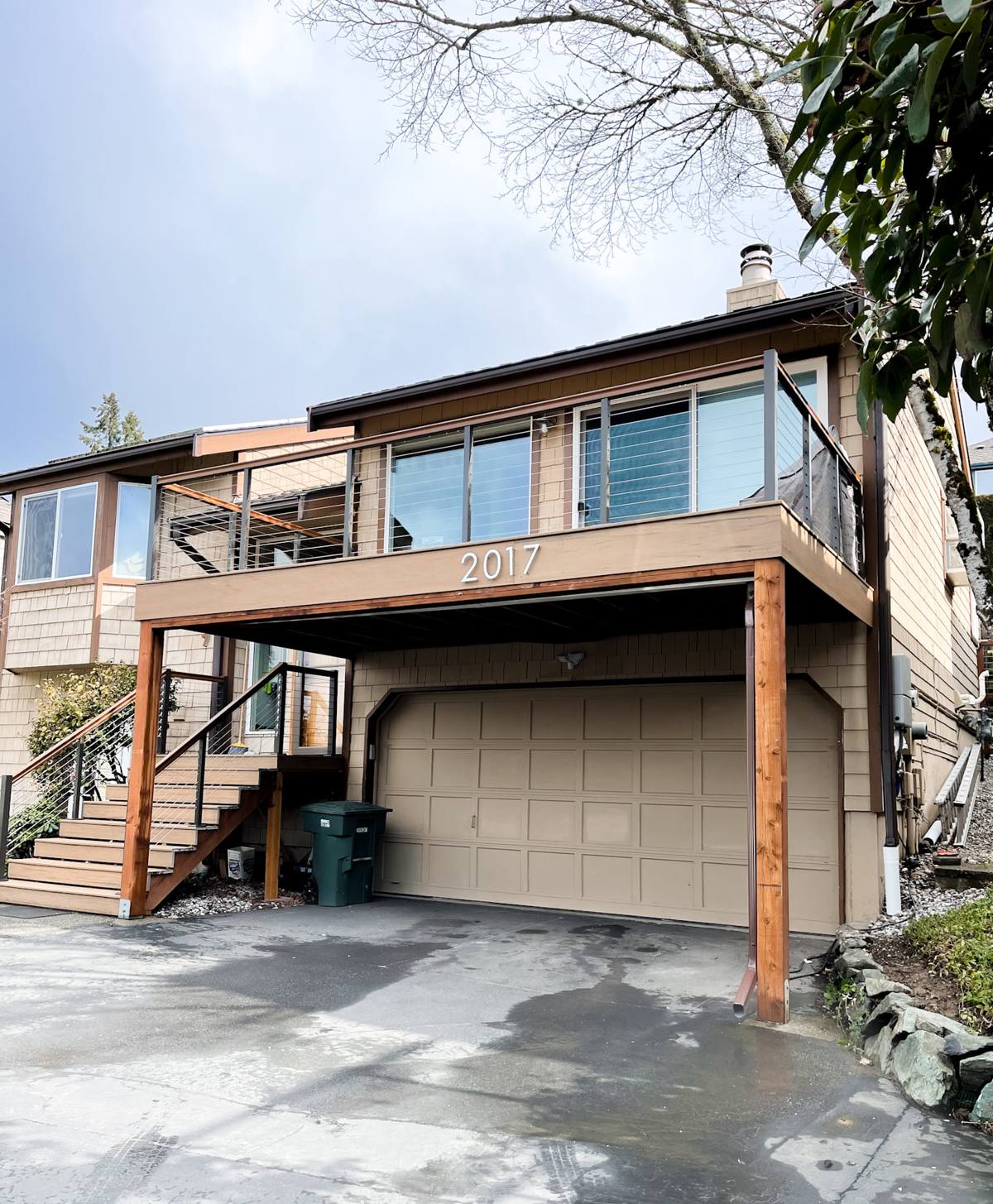
Signs Your Deck Needs Repair, Not Just a Cleaning
A lot of homeowners power-wash a deck, see it look better, and assume the problem is solved. Sometimes it is. But cosmetic cleaning doesn't fix structural issues, and in a climate like ours, surface staining is often a sign of something happening underneath. Here's what tells us a deck needs actual repair work rather than a wash-and-seal:
- Boards that feel spongy, spring back slowly, or flex more than neighboring boards when you step on them
- Visible gaps opening up between the ledger board and the house wall
- Rust streaks running down from screw heads or metal connectors
- Railings or posts that wiggle when pushed, even slightly
- Persistent moss or algae growth in the same spots even after cleaning — a sign that area stays wet longer than the rest of the deck
- Stairs that feel uneven or have visible gaps at the stringers
- A musty smell coming from underneath the deck, especially near the house
Any one of these on its own might be minor. Several together usually means the deck's structural elements — framing, ledger connection, or fasteners — have been compromised by sustained moisture exposure, and that's not something a cleaning or a fresh coat of stain will address.
Repair vs. Replacement: What Actually Drives the Decision
Homeowners often assume any deck problem means a full tear-out, but that's rarely true. Most of the decks we look at in Edgemoor can be repaired if the framing underneath is sound. The decision usually comes down to a few honest factors:
| Factor | Favors Repair | Favors Replacement |
|---|---|---|
| Framing condition | Joists and beams are dry, solid, no soft spots | Widespread rot in joists, beams, or posts |
| Ledger board | Properly flashed, no separation from house | Water intrusion behind siding, ledger pulling away |
| Decking surface | Isolated damaged boards, rest is sound | Most boards cupping, splitting, or rotting |
| Age of structure | Under 15-20 years, built to code | Original build predates current codes or was never permitted |
| Fasteners/hardware | Localized corrosion, easily swapped | Hardware failing throughout, hangers rusted through |
We won't sell a full replacement when a targeted repair will genuinely hold up — but we also won't patch a deck whose framing has already failed, because that's just delaying a bigger problem and putting people at risk. Every deck gets an honest assessment before we recommend either path.
What a Correct Deck Repair Actually Involves
Structural Inspection First
Before any board gets replaced, we check what's underneath it. That means getting under the deck to look at joists, beams, posts, and footings, and checking the ledger connection at the house — the single most common failure point on decks in wet climates, because it's where the deck meets the building envelope and where water most often gets trapped against wood.
Ledger Board and Flashing
If the ledger board isn't properly flashed, water works its way behind it and rots both the ledger and the house rim joist behind the siding. This is one of the most serious — and most common — repair issues we find, because it's invisible until the damage is advanced. A correct repair includes proper flashing that directs water away from the connection, not just caulking over the gap.
Framing Repairs
Any joist, beam, or post showing rot gets sistered with new lumber or replaced outright — not just capped or covered. Covering rotted framing with new decking is one of the more common shortcuts we see from past work, and it just hides the problem for a year or two before it resurfaces.
Fasteners and Connectors
Given the salt air common near the water in this area, we use fasteners and structural connectors rated for coastal or wet-climate exposure — hot-dip galvanized or stainless, matched to the wood treatment being used, since mismatched metals accelerate corrosion.
Decking and Railings
Damaged boards are replaced board-for-board or section-for-section depending on the extent of the damage. Railings get checked for proper post attachment — through-bolted into framing, not just screwed into decking — since loose railings are both a repair issue and a safety issue.
Moss, Mildew, and the Long Wet Season
Whatcom County's moss season is longer than most homeowners realize — shade, moisture, and mild temperatures create ideal growing conditions for months at a time. On a deck, moss isn't just cosmetic. It holds moisture against the wood surface, and on shaded or north-facing sections of a deck, that moisture can stay trapped long after the rest of the deck has dried. Over time this leads to surface decay even on boards that are otherwise structurally sound.
Part of a proper repair in this climate means addressing why moss keeps coming back in the same spots, not just scraping it off. That can mean improving airflow underneath the deck, trimming back vegetation that's shading a section, or in some cases adjusting board spacing during repair to improve drainage and drying.
Our Deck Repair Process in Edgemoor
- Free on-site assessment — we walk the deck, get underneath it, and check framing, ledger, fasteners, and surface condition
- Honest scope and estimate — a clear breakdown of what needs repair, what's optional, and what we'd flag as safety-critical
- Framing and structural repairs — done first, before any surface work, so nothing gets covered up
- Flashing and moisture management — corrected at the ledger and any other water entry points found during inspection
- Decking, railing, and fastener repairs — matched to the existing deck where possible, or upgraded where the original materials were the source of the problem
- Final walkthrough — we point out what we did, what to watch for, and what routine maintenance will extend the life of the repair
Materials We Use and Why
For framing repairs, we use pressure-treated lumber rated for ground contact where appropriate, since deck framing is exposed to splashback and standing moisture even when it's not touching soil directly. For decking surface repairs, the right material depends on the homeowner's priorities and the existing deck:
| Material | Strengths | Trade-offs |
|---|---|---|
| Cedar | Natural rot resistance, classic look, matches existing wood decks | Needs periodic sealing/staining to hold up long-term |
| Pressure-treated fir/pine | Cost-effective, strong, widely available for framing and decking | Requires consistent maintenance to prevent moisture damage |
| Composite decking | Very low maintenance, resists moss staining better than wood | Higher upfront cost; requires correct spacing/fastening for our wet climate |
We don't push one material as universally "better" — each has a real trade-off in maintenance, cost, or appearance, and we walk homeowners through what fits their deck and their tolerance for upkeep, rather than defaulting to whatever's easiest for us to install.
Why Hire a Crew That Already Works in Edgemoor
Deck repair done wrong doesn't fail immediately — it fails a year or two later, after the new boards are down and the framing problem underneath was never actually addressed. A crew that regularly works decks in Edgemoor and the surrounding Sudden Valley area already knows where the recurring failure points are in this climate: which ledger connections tend to trap water, which sides of a deck hold moss longest, and which fastener choices actually hold up against sustained salt air and rain rather than just looking fine on installation day. That local pattern-recognition is the difference between a repair that lasts and one that just resets the clock on the same problem.
Keeping a Repaired Deck in Good Shape
A repair is only as good as the maintenance that follows it. After we finish a repair, a little seasonal attention goes a long way toward making sure it holds up through Whatcom County's wet stretches:
- Sweep debris off the deck regularly, especially in fall — trapped leaves hold moisture against boards
- Clean moss and algae off shaded sections before it builds up thick enough to trap moisture
- Check railings and stair connections once or twice a year for any looseness
- Reseal or restain wood decking on the manufacturer's recommended schedule, not just when it looks faded
- Keep gutters and downspouts near the deck clear so runoff isn't draining directly onto or under it
- Watch the ledger board area at the house each fall for any signs of gapping or staining
If you're seeing soft spots, loose railings, persistent moss, or just aren't sure whether your deck needs repair or replacement, we're happy to take a look. We offer free, no-pressure estimates for Edgemoor and Sudden Valley homeowners — fill out the form below and we'll get back to you.