 Sudden Valley Siding
 Why Siding Replacement Looks Different in Columbia
Homes in the Columbia area of Sudden Valley sit inside a climate that is harder on exterior cladding than most homeowners realize until they're dealing with the consequences. Whatcom County's marine air carries salt and moisture year-round, Lake Whatcom's microclimate keeps humidity elevated even on days that look dry, and the region's long, gray moss season gives organic growth months at a time to take hold on north-facing walls and anything shaded by trees. Add driving rain that comes in sideways during winter storms, and you have a set of conditions that punishes siding that isn't built for wet-climate performance.
That combination is why siding replacement here isn't just a cosmetic project. It's a decision about what will actually hold up against wind-driven moisture, resist moss and mildew, and keep doing its job for decades without constant upkeep. We've built our process around those specific conditions, not a generic install checklist.
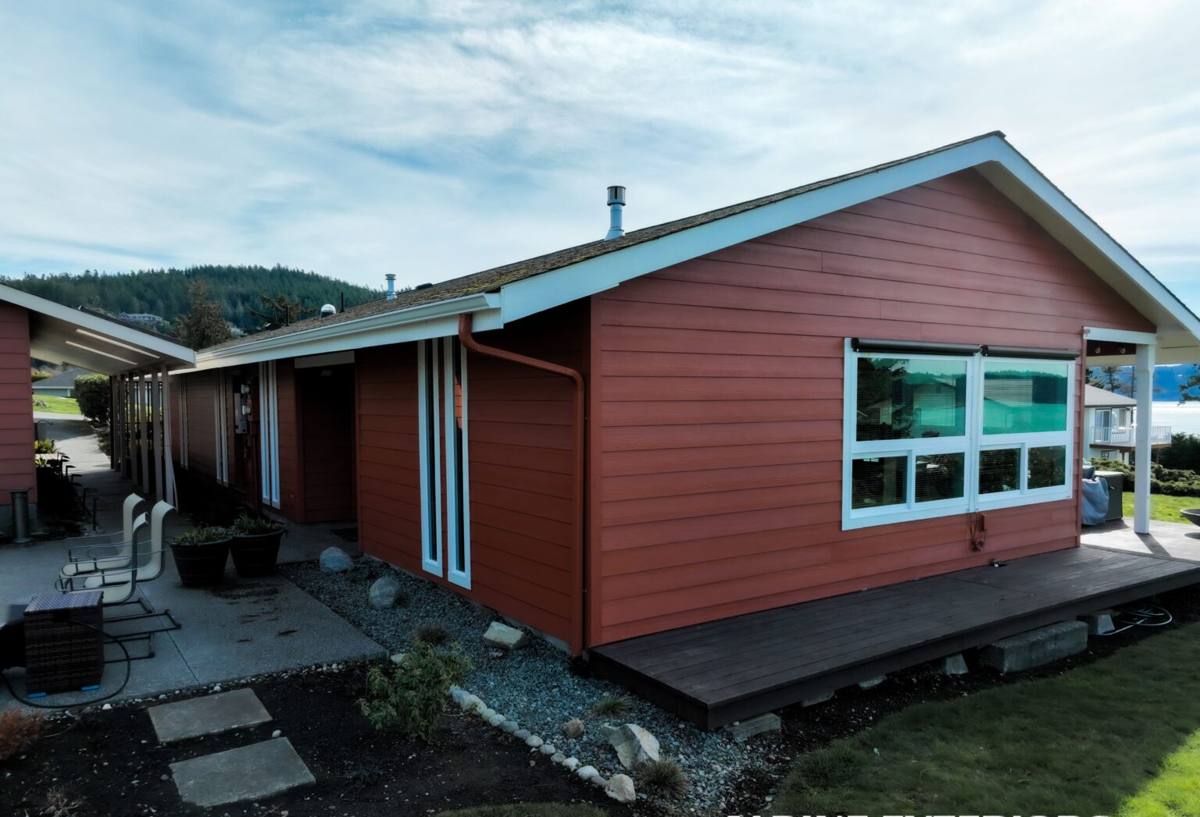
What Columbia Homes Are Up Against
Salt Air and Corrosion
While Sudden Valley isn't oceanfront, the broader Whatcom County air carries enough marine influence to accelerate corrosion on fasteners, trim, and lower-quality siding materials over time. Siding systems that aren't engineered for moisture resistance show it first at seams, butt joints, and fastener points — exactly where a lot of siding failures start.
Driving Rain
Rain in this region rarely falls straight down. Wind-driven rain pushes moisture up under laps and into gaps that wouldn't be a problem in a drier climate. Siding that isn't installed with the right clearances, flashing, and lap spacing will eventually let water behind the cladding, and once that happens you're dealing with sheathing and framing issues, not just a surface problem.
Moss and Organic Growth
The Pacific Northwest's extended wet season gives moss, algae, and mildew a long window to establish themselves, especially on shaded walls and anything near mature trees — common around Sudden Valley's wooded lots. Porous or wood-based siding gives organic growth something to root into. Non-porous, factory-finished materials give it far less to hold onto, which matters over a 20- or 30-year ownership horizon.
What a Correct Siding Replacement Job Actually Involves
Replacing siding correctly is not just pulling off old boards and nailing up new ones. In a climate like this, the details that don't show up in a driveway estimate are the ones that determine whether the job lasts.
- Full removal of old siding and inspection of the sheathing underneath for rot, soft spots, or existing moisture damage
- Repair or replacement of any compromised sheathing before new siding goes on — covering over a problem never solves it
- Installation of a weather-resistive barrier (house wrap) with proper overlaps and sealed penetrations
- Correct flashing at every window, door, and roof-to-wall intersection, since these are the highest-risk spots for water intrusion
- Proper lap spacing and fastener placement per the manufacturer's specifications, not just "close enough"
- Rainscreen or drainage gap detailing where the wall assembly calls for it, so any incidental moisture can escape rather than sit against the siding
- Caulking and sealant only where the manufacturer specifies it — over-caulking traps moisture just as badly as under-caulking lets it in
Skipping any one of these steps is how a siding job looks fine for a year or two and then starts failing at year five or six, usually right around the areas most exposed to wind-driven rain.
Why We Only Install James Hardie Fiber Cement
We don't install vinyl, LP SmartSide, Cemplank, Allura, or primed wood siding, and that's a deliberate standard, not an oversight. Each of those products has legitimate strengths, but none of them hold up to this climate's combination of moisture, humidity, and moss pressure as consistently as James Hardie fiber cement.
Vinyl expands and contracts with temperature swings, can crack in cold snaps, and doesn't offer the same fire resistance. Wood-based products like LP SmartSide use engineered wood strand technology that performs well when installed and maintained precisely, but any breach in that engineered coating gives moisture a path into wood fiber, which is a real risk in a climate this wet. Other fiber cement brands, including Cemplank and Allura, are legitimate competitors to Hardie, but we've standardized on one product line so our crews install to one spec, know its behavior in this exact climate, and back it with one manufacturer relationship — rather than juggling install specs and warranty terms across several product lines.
James Hardie fiber cement is non-combustible, engineered specifically for wet climates through its HardieZone HZ5 product line (the specification built for regions like the Pacific Northwest), and finished with ColorPlus factory-baked color that resists fading and doesn't require repainting on the same cycle as field-painted siding. It doesn't feed moss growth the way porous materials can, and it carries a strong transferable warranty when installed to Hardie's specifications — which matters if you sell the home before the siding's functional life is up.
Quick Comparison: Common Siding Choices in This Climate
| Material | Moisture Behavior | Moss/Mildew Resistance | Maintenance |
|---|---|---|---|
| James Hardie Fiber Cement | Engineered for wet climates (HZ5); dimensionally stable | Non-porous, resists organic growth | Low — factory finish, no repainting cycle |
| Vinyl | Doesn't absorb moisture but can trap it behind panels | Moderate; grime and moss can build in seams | Low, but prone to cracking in cold and fading in UV |
| LP SmartSide / Engineered Wood | Vulnerable if coating is breached | Moderate; depends on coating integrity | Moderate — coating and edges need monitoring |
| Primed Cedar/Spruce | Absorbs moisture readily if finish fails | Higher risk; wood is an organic substrate | High — repainting/resealing on a regular cycle |
How Our Process Works
1. On-Site Assessment
We start with a walk-around of the home, looking at current siding condition, trouble spots (shaded walls, areas with visible moss, low-slope roof-to-wall transitions), and anything that suggests moisture has already gotten behind the existing cladding.
2. Scope and Estimate
We put together a written scope that covers material, prep work, flashing and drainage detailing, and timeline. No surprise change orders for things that should have been identified up front.
3. Tear-Off and Sheathing Inspection
Old siding comes off, and we inspect the sheathing before anything new goes up. If there's rot or moisture damage, we address it — that's not an upsell, it's the difference between a repair that lasts and one that doesn't.
4. Weather Barrier and Flashing
House wrap, flashing, and drainage detailing go in per code and manufacturer spec, with particular attention to windows, doors, and any roof intersections — the areas most exposed to this region's driving rain.
5. James Hardie Installation
Siding goes up to Hardie's fastening and clearance specifications, which is what keeps the transferable warranty intact and keeps the assembly performing the way it's engineered to.
6. Final Walkthrough
We walk the finished job with you, point out anything you should know for long-term care, and make sure the work matches what was scoped.
Why Local Experience in Sudden Valley Matters
A crew that already works around Lake Whatcom and Sudden Valley knows which walls take the worst of the driving rain, which lots hold onto moss longest because of tree cover and shade, and how the area's humidity affects cure times and sequencing on a job. That's not something you get from a crew that's new to Whatcom County's specific conditions. It shows up in small decisions — where extra flashing attention matters, how drainage gaps are detailed on a heavily shaded elevation, how a job is sequenced around a wet forecast — that add up to a siding job that actually performs over 20 to 30 years instead of just looking good on install day.
What to Check Before You Hire a Siding Contractor Here
- Do they inspect and repair sheathing before installing new siding, or just cover what's there?
- Can they explain their flashing and drainage detailing, not just the siding brand they use?
- Are they installing to the manufacturer's published specifications (fastener pattern, clearances, lap requirements)?
- Do they have direct experience with this specific region's moisture and moss conditions?
- Is the warranty transferable, and is it backed by both the manufacturer and the installer?
Getting Started
If your home in the Columbia area of Sudden Valley has siding that's showing moss, staining, warping, or you're just planning ahead for a replacement, we're happy to come take a look and walk you through what we're seeing — no pressure, no obligation. Reach out for a free estimate using the form below.