 Sudden Valley Siding
 Building New in Barkley? The Windows Are Where Most Callbacks Start
Barkley sits close enough to Lake Whatcom and the broader Sudden Valley area that new-construction crews working here deal with the same set of conditions year-round: salt-tinged air moving in off the Sound, long stretches of driving rain from fall through spring, and a moss season that seems to start earlier every year. None of that is exotic information if you've lived in Whatcom County a while, but it matters enormously when a house is still open to the weather and the window openings haven't been protected yet. New-construction window installation isn't just "set the unit and caulk it" — it's a sequencing job, and the sequence is what either keeps a wall assembly dry for forty years or sets up a slow leak that doesn't show itself until there's already rot behind the siding.
We install new-construction windows on homes and additions in and around Barkley on a regular basis, and most of the problems we get called to fix later trace back to shortcuts taken during this exact phase — before drywall, before siding, when it would have taken twenty extra minutes to do it right.
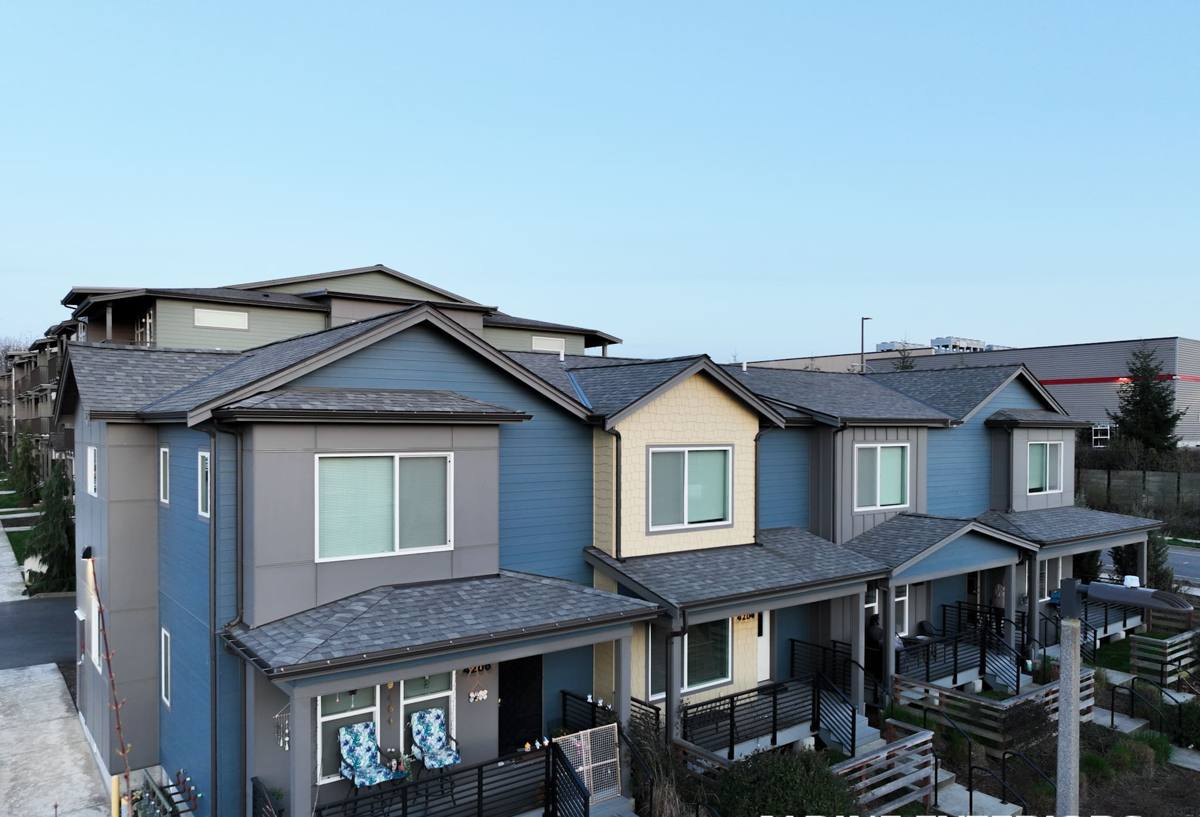
What "New-Construction Window" Actually Means
New-construction windows have a nailing fin (sometimes called a flange) built into the frame. That fin gets fastened to the sheathing and integrated into the building's water-resistive barrier before siding or stucco goes on. This is different from a replacement window, which is designed to be inserted into an existing frame from the exterior with no access to the framing behind it. Because a new build gives us access to bare sheathing, we can build a proper drainage plane around every opening — something you generally can't fully redo on a retrofit without removing siding.
Why That Access Matters in This Climate
With Barkley's exposure to sustained wind-driven rain, water will find any gap in a window opening eventually — not might, will. The nailing fin and flashing system is the only thing standing between that water and your wall framing. Get it wrong at rough-in, and it's often invisible until a moisture problem shows up two or three winters later as staining, soft trim, or a musty smell in a nearby closet.
The Correct Installation Sequence
There's real disagreement in the trades about window flashing details, but the core sequence for a proper new-construction install is well established and doesn't change based on brand or budget:
- Rough opening is checked for square, level, and correct size — not just "close enough."
- Sill pan flashing is installed first, sloped or with a back dam so any water that gets past the window drains back outside instead of pooling on the sill.
- The window's water-resistive barrier (housewrap or building paper) is prepped so it will later shingle-lap over the flashing correctly — this is planned before the window ever goes in.
- The window is set, shimmed plumb and square, and fastened through the nailing fin per the manufacturer's schedule — not just a few nails in the corners.
- Side flashing tape goes over the side fins, then head flashing goes over the top fin, in that specific shingle-lap order so water is always directed outward and downward, never into a seam.
- The housewrap is lapped back over the head flashing, sealing the top of the assembly.
- Interior and exterior sealant is applied at the specified points only — over-sealing every seam can trap moisture instead of letting incidental water drain out.
Skip the sill pan, reverse the flashing order, or seal a joint that's supposed to stay a drain path, and the window can look perfect from the outside while quietly funneling water into the wall.
Where We See Corners Cut on Local Jobs
- Sill pans omitted entirely — a huge one, given how much sideways rain this area gets
- Housewrap taped over the fins instead of properly shingle-lapped, which can reverse the drainage direction
- Under-fastening through the nailing fin, leaving the window loose enough to rack over time
- Foam sealant used as the primary water seal instead of an air-seal supplement to proper flashing
- Flashing tape applied to dusty, damp, or cold sheathing so it never actually bonds
Sizing, Placement, and Design Choices That Fit This Area
New construction gives you a rare chance to choose window placement and glazing to work with the site rather than around it. In Barkley, that usually means thinking through a few things before the openings are ever framed:
Sun and Moisture Exposure
Elevations facing prevailing weather take the brunt of wind-driven rain and benefit from slightly deeper flashing details and, where the design allows, more roof overhang. South and west exposures also see more UV, which matters for frame material choice and glass coatings.
Glazing Package
Double-pane, low-E glass is the baseline for new construction in this region; many homeowners in Whatcom County upgrade to a low-E coating tuned for solar heat gain control given how much grey-sky glare and seasonal sun swing we get. Argon-filled units are standard practice and worth the modest upcost for the improved thermal performance during our long heating season.
Frame Material
Vinyl, fiberglass, and clad-wood all show up in new construction here, and each has real trade-offs rather than a single "best" answer — see the table below.
| Frame Type | Moisture Tolerance | Maintenance | Typical Use Case |
|---|---|---|---|
| Vinyl | Excellent — won't rot or corrode | Low; occasional cleaning | Most cost-effective, widely used on standard new builds |
| Fiberglass | Excellent, very stable dimensionally | Low | Larger openings, areas with more temperature swing |
| Clad-Wood | Good on exterior clad face; interior wood needs protection | Moderate — interior finish upkeep | Homeowners wanting a wood interior look with a low-maintenance exterior |
| Aluminum | Prone to condensation without thermal breaks | Low | Less common residentially in this climate for that reason |
How This Ties Into the Rest of the Building Envelope
A window is only as good as the wall system around it. On new construction we coordinate window flashing with the housewrap and siding installers so the layers actually integrate — head flashing under the wrap, wrap over the flashing, siding weeps clear of the sill. This is one of the most common places for miscommunication between trades on a job site, and it's exactly where a coordinated crew earns its keep. We also factor in local moss and algae exposure: sills and trim details are set up to shed water and dry quickly rather than holding moisture against the frame, which cuts down on the black streaking and soft trim that shows up on homes where that detail was an afterthought.
Our Process on Barkley New-Construction Jobs
We work directly with builders, GCs, or homeowners acting as their own GC. A typical sequence looks like this:
- Plan review — we check window schedules against rough openings before framing is finalized, catching sizing conflicts early
- Product selection — we walk through frame material, glazing, and performance ratings suited to the site's exposure
- Rough opening verification — measured and squared on-site before install day, not assumed from plans
- Flashing and install — sill pan, window set, fin fastening, and shingle-lap flashing done to manufacturer spec
- Envelope coordination — housewrap and flashing integration confirmed with the siding crew before cladding goes on
- Final check — operation, seals, and trim details reviewed before we sign off
What to Ask Any Crew Installing Your New-Construction Windows
Whether you hire us or someone else, these are the questions that separate a crew that understands building envelopes from one that's just setting units in holes:
- Do you install a sill pan flashing on every opening, and how does it drain?
- What's your shingle-lap order for side and head flashing relative to the housewrap?
- How do you handle fastening schedules through the nailing fin — manufacturer spec, or your own standard?
- Who coordinates the flashing detail with the siding installer if that's a separate crew?
- What warranty applies to the installation itself, separate from the manufacturer's product warranty?
If a crew can't answer these clearly, that's worth knowing before drywall goes up and the whole assembly disappears behind finished walls.
Why Local Experience Matters Here
Window flashing details that work fine in a dry inland climate aren't automatically adequate for a site exposed to sustained wind-driven rain off the water and a moss season that runs much of the year. Crews that install new-construction windows across Whatcom County day in and day out build habits around this exposure — deeper flashing laps, sill pans as standard rather than optional, and material choices that account for how much moisture the assembly will actually see. That's the kind of judgment that comes from doing the work locally and repeatedly, not from a spec sheet alone.
If you're framing a new build or addition in Barkley and want the window openings done right the first time, we're happy to take a look at your plans and walk the site. Reach out for a free, no-pressure estimate — there's a form below.