 Sudden Valley Siding
 Why Acme Roofs Wear Differently Than You'd Expect
Acme sits in a part of Whatcom County where the weather doesn't do anything in half measures. Rain comes sideways as often as it comes straight down, the tree cover keeps roofs shaded and damp for long stretches of the year, and the moss season isn't really a season here — it's closer to a permanent condition that eases up for a couple of dry months and then comes right back. A roof in this area isn't just shedding water off a slope. It's dealing with constant moisture cycling, wind-driven rain that gets pushed up under laps and around penetrations, and organic growth that holds water against the surface long after a storm has passed.
That combination is hard on asphalt shingles in particular. Granule loss speeds up when moss roots into the surface, and the freeze-thaw swings we get in the colder months work into any spot where water has been sitting. Metal roofing handles this environment differently — not because it's immune to weather, but because a correctly installed metal roof gives water almost nowhere to sit, root, or pool. That's the whole conversation for homes in and around Acme: less surface area for moisture and moss to take hold, and a material that doesn't degrade the way it does elsewhere in the county.
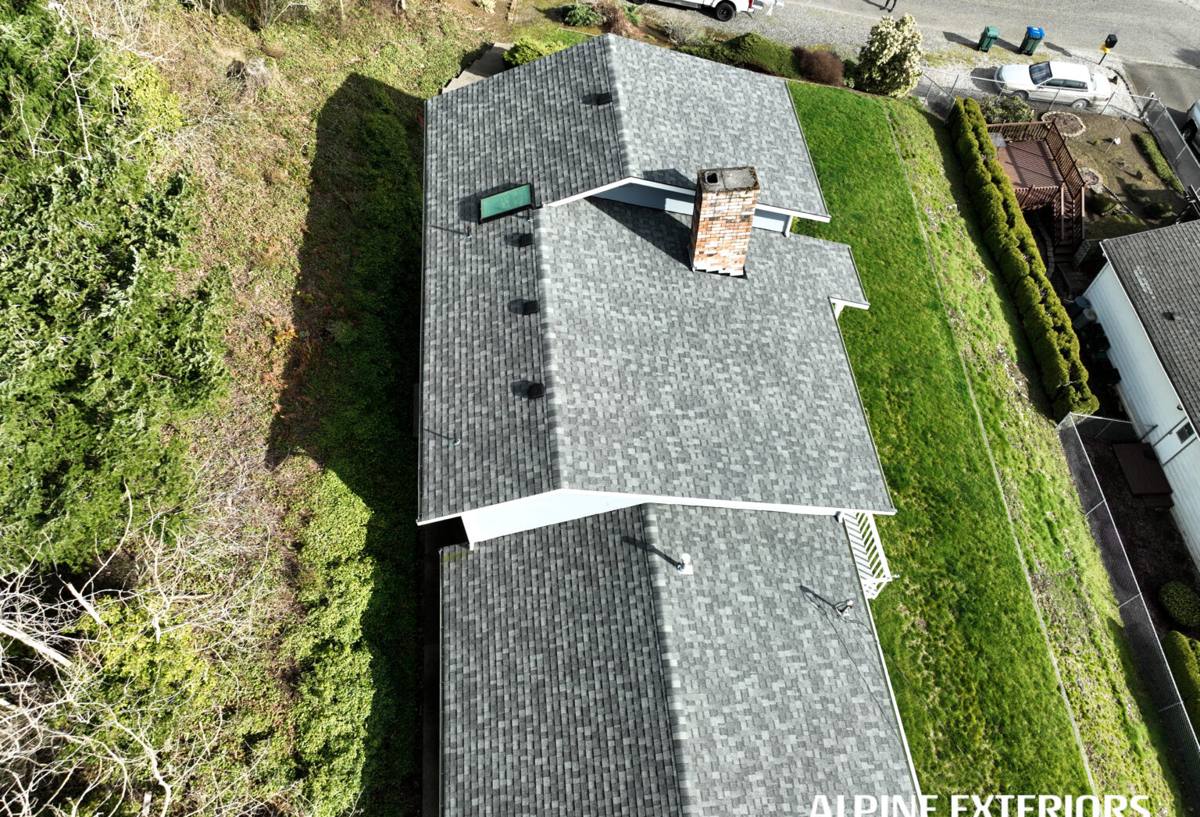
What Driving Rain and a Long Moss Season Actually Do to a Roof
It helps to understand the specific failure points before talking about the fix. Driving rain doesn't just land on a roof — in the right wind conditions it gets forced sideways and upward, which is why flashing detail and underlayment quality matter more here than in drier parts of the state. A roof that would perform fine in eastern Washington can leak in Whatcom County simply because the water is attacking from an angle the original installation never accounted for.
Moss adds a second, slower problem. It doesn't cause damage overnight — it works over seasons. Moss colonies hold moisture against roofing material, lift shingle edges as they grow, and create a spongy layer that keeps the surface wet long after everything else has dried out. On wood and composite materials, that sustained dampness leads to rot, granule breakdown, and eventually leaks at the weakest points, usually valleys, penetrations, and edges. On a well-installed metal roof, moss has a much harder time establishing itself in the first place because the surface sheds water fast and doesn't hold the fine debris and organic matter moss needs to root.
Why Metal Roofing Holds Up Better in This Environment
Metal roofing isn't a cure-all, and we won't pretend it's the right fit for every budget or every home. But for homes dealing with the rain and moss conditions common around Acme, it solves the two biggest long-term problems directly: it drains fast and it gives organic growth very little to hold onto. A steep-shed, tight-seamed metal roof moves water off before it has a chance to pool, and the surface itself resists the moss colonization that slowly eats away at other materials.
Standing Seam vs. Exposed Fastener Panels
Not all metal roofing is built the same, and the panel type matters a lot in a climate like this. Here's how the two most common residential systems compare for a wet, moss-prone area:
| Factor | Standing Seam | Exposed Fastener |
|---|---|---|
| Fastener exposure | Hidden clips, no surface penetrations | Screws through the panel face |
| Long-term leak risk | Very low if installed correctly | Higher — fasteners loosen and gaskets age |
| Upfront cost | Higher | Lower |
| Moss/debris resistance | Excellent — smooth, few catch points | Good, but seams and screw heads collect debris |
| Typical lifespan | 40-60+ years | 25-40 years |
For homes in the Acme area, we generally recommend standing seam where the budget allows, specifically because of the moss and moisture exposure. Exposed fastener systems are still a legitimate option — they cost less and perform well when installed and maintained correctly — but they ask more of the homeowner over time in terms of fastener checks and gasket wear.
What a Correct Installation Actually Involves
Metal roofing gets a reputation as "install it and forget it," but that's only true if the work underneath the panels is done right. Most metal roof problems we get called out to inspect trace back to shortcuts taken during installation, not the material itself.
Moisture Barrier and Underlayment
In a climate with this much sustained moisture, we don't treat underlayment as an afterthought. A synthetic, high-temp underlayment goes down as a continuous moisture barrier, with extra layers or peel-and-stick membrane at valleys, eaves, and anywhere driving rain is likely to push water uphill under the panels.
Fastening and Flashing
Flashing is where wind-driven rain finds weak roofs. Every penetration — vents, chimneys, skylights — gets flashed with attention to the direction our storms actually come from, not just a generic detail copied across every roof. Fasteners are set to spec, not overdriven or underdriven, since either mistake creates a future leak point.
Ventilation
A metal roof that's sealed tight but poorly ventilated traps moisture in the attic, which defeats the purpose of upgrading the roofing material in the first place. We check and correct intake and exhaust ventilation as part of the job, not as a separate upsell.
What Drives the Cost of a Metal Roof in This Area
Homeowners researching metal roofing usually want a straight answer on cost before anything else. There's a wide range, and it depends on a handful of factors specific to the home and the site conditions common around Acme:
| Cost Factor | Why It Matters Here |
|---|---|
| Panel type (standing seam vs. exposed fastener) | Standing seam costs more upfront but needs less long-term attention |
| Roof complexity | Valleys, dormers, and steep pitches increase flashing and labor time |
| Tree cover and access | Heavily wooded lots common in this area can affect staging and cleanup |
| Existing roof condition | Rot or moisture damage found during tear-off adds repair scope |
| Underlayment package | Extra moisture protection at valleys and eaves adds material cost but reduces leak risk |
We won't quote a number without seeing the roof — anyone who does is guessing. What we can tell you honestly is that in a climate like Whatcom County's, spending more on underlayment and flashing detail up front is almost always cheaper than dealing with a moisture problem five years in.
How We Approach Metal Roofing Jobs in Acme
Every job starts with an on-site inspection, not a phone estimate. We look at the existing roof structure, check for any signs of past moisture intrusion, and evaluate ventilation before we ever talk panel type or pricing. From there, we walk homeowners through the real trade-offs between panel systems for their specific roof — pitch, tree exposure, and how much of the year the roof stays shaded all factor into the recommendation.
During the job, tear-off and underlayment go down first, with special attention to valleys and any area where we expect wind-driven rain to be a problem based on the home's orientation. Panels go on next, with flashing detail finished before we consider any section complete. We don't leave a roof partially weathered-in overnight if it can be avoided — an unfinished roof and a wet week in this part of the county are not a good combination.
Simple Maintenance That Keeps a Metal Roof Performing
A metal roof needs far less upkeep than shingles, but "less" isn't "none." A short annual routine goes a long way in a moss-heavy climate:
- Clear needles, leaves, and debris from valleys and around penetrations, especially after fall
- Check gutters and downspouts for clogging, since backed-up water can push under eave flashing
- Look for any early moss or algae growth in shaded sections and address it before it spreads
- Have fasteners and flashing on exposed-fastener systems checked periodically
- Trim back overhanging branches that keep sections of the roof shaded and damp longer than necessary
Why Hiring a Crew That Already Works in Acme Matters
Roofing details that work fine in a drier climate can fail here, and a crew without local experience won't necessarily know that until a problem shows up. Knowing how hard the wind pushes rain in this part of Whatcom County, how long moss season really runs, and which details of a roof tend to fail first under those conditions isn't something you learn from a general installation manual — it's something you learn from doing the work here, on homes with the same tree cover, the same moisture exposure, and the same weather patterns as yours.
That local knowledge shows up in small decisions during the job: where we add extra underlayment even though it's not strictly required by code, how we detail flashing around penetrations, and which panel systems we steer homeowners toward based on how shaded and damp a particular roof stays. Those decisions are the difference between a metal roof that performs for decades and one that develops the same moisture problems it was supposed to solve.
Get a Straight Answer for Your Roof
If you're weighing metal roofing for a home in Acme or the wider Sudden Valley area, we're glad to come take a look and give you an honest read on what your roof actually needs — no pressure, no upsell. Fill out the form below for a free estimate.