 Sudden Valley Siding
 Siding Repair in South Hill: Why the Details Matter
South Hill sits up on the wooded slopes above Lake Whatcom, inside the Sudden Valley community, and homes here take on a specific kind of wear that flatter, more open neighborhoods don't see as much of. Tree canopy holds moisture against exterior walls longer after a storm. Driving rain off the water finds its way into laps and seams that a lighter climate would never stress. And the salt-tinged air that rolls through Whatcom County off the Sound works on fasteners, trim, and finishes year-round. None of that means siding repair on a South Hill home is more complicated than anywhere else — it means it has to be done to a higher standard, because the margin for a sloppy patch is thinner here than in a drier climate.
We repair siding on homes in and around Sudden Valley regularly enough to know what actually causes damage in this specific setting, versus what's just cosmetic. That distinction is the difference between a repair that lasts and one you're paying for again in three years.
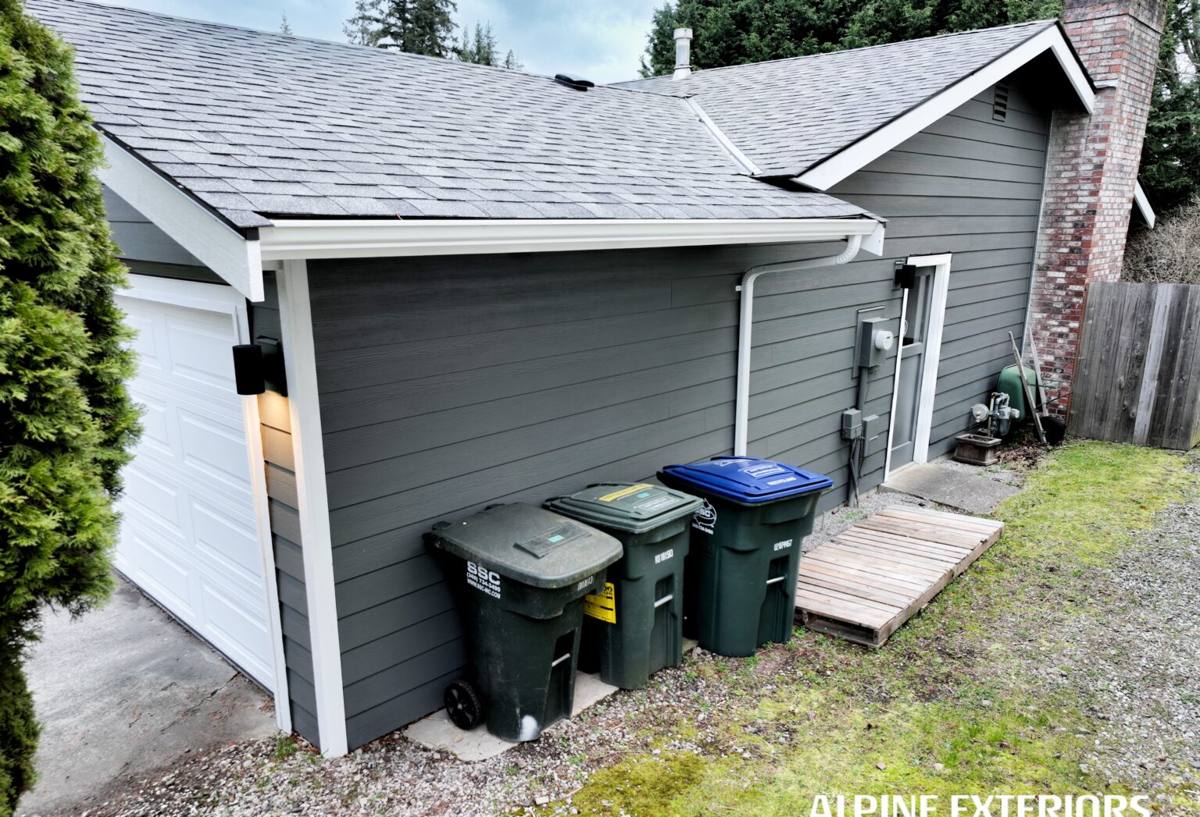
What Whatcom County Weather Does to Siding
A Long Moss Season
Shaded, tree-covered lots on South Hill don't dry out the way a south-facing, open lot does. Moss and algae get a foothold on siding, trim, and roof edges and stay there for most of the year. Moss itself doesn't eat through fiber cement or wood, but it holds water against the surface far longer than bare siding would, and that constant dampness is what eventually finds a way behind panels through a compromised seam, a nail hole, or failed caulking.
Driving Rain and Wind-Driven Moisture
Rain that comes in sideways during a Pacific storm doesn't behave like rain falling straight down. It gets pushed up under laps and into butt joints that were never designed to be hit head-on. A repair that only addresses the visible crack or gap, without checking whether wind-driven rain has already gotten behind the cladding, is a repair that fails again at the next storm.
Salt Air and Corrosion
The salt-tinged air that reaches inland from Puget Sound weather systems is harder on exposed metal than most homeowners realize — fasteners, flashing, and trim hardware corrode faster than they would in a dry inland climate. A repair that reuses corroded fasteners or skips proper flashing to save time is a repair with a shorter life than it should have.
Signs Your South Hill Home Needs Siding Repair
Most siding problems announce themselves quietly, well before they become expensive. On homes in this area, the pattern we see most often includes:
- Bubbling or peeling paint in one section while the rest of the wall looks fine
- Soft, spongy, or slightly bowed panels when pressed by hand
- Visible gaps opening up at butt joints or corners
- Dark staining or streaking below window sills or at panel seams
- Moss or algae creeping up under the bottom edge of a lap, not just sitting on the surface
- Cracked, chipped, or missing sections after wind or storm debris
- Fastener heads popping through the surface or leaving rust trails
- Warped or separating trim boards around windows, corners, or the foundation line
Any one of these, caught early, is usually a straightforward repair. Left alone through another wet season, several of them turn into a much larger job — and sometimes into damage that reaches the sheathing behind the siding.
What a Correct Siding Repair Actually Involves
Diagnosing the Cause, Not Just the Symptom
A crack or a stain is a symptom. Before we replace anything, we find out why that section failed — a missing piece of flashing, a caulk joint that dried out and split, a fastener driven at the wrong angle, or simple age. Patching over the symptom without addressing the cause means the same spot fails again, usually behind the new material where you can't see it until it's worse.
Checking What's Behind the Siding
Once damaged material is removed, we check the water-resistive barrier and flashing underneath. If moisture has already gotten past the siding, the repair has to include drying out and, where needed, replacing the barrier before anything new goes back on. Closing up a wall over a wet or damaged barrier is how a $400 repair turns into a $4,000 one two years later.
Matching the Installation Standard, Not Just the Look
A repair should be installed to the same standard as new construction — correct fastener spacing and clearance from grade, proper caulking at joints, and flashing that directs water out and away rather than trapping it. A patch that only looks right from the driveway isn't a finished repair.
Why We Repair Only With Matching James Hardie Fiber Cement
This company installs and repairs James Hardie fiber cement siding exclusively — we don't install LP SmartSide, vinyl, Cemplank, Allura, primed spruce, or cedar, and that standard carries through to repair work. When we patch a Hardie wall, we patch it with the correct-profile Hardie product, matched to the existing plank width, texture, and ColorPlus factory finish wherever the color line allows it.
The reason is straightforward: fiber cement, vinyl, and wood-based products don't move, absorb moisture, or age the same way. A vinyl or engineered-wood patch tacked onto a fiber cement wall may look acceptable for a season, but the two materials expand and contract differently, weather differently, and eventually telegraph the seam between them — sometimes as a visible line, sometimes as a moisture path where the materials meet. It's also a warranty problem: mixed-material repairs complicate any manufacturer coverage the original siding still carries.
| Repair Approach | Short-Term Result | Long-Term Result |
|---|---|---|
| Matching James Hardie panel, correctly flashed | Seamless with existing siding | Ages and weathers at the same rate as the rest of the wall |
| Mixed-material patch (vinyl, engineered wood, etc.) | Acceptable if painted to match | Different expansion/contraction and moisture behavior; seam often becomes visible or a leak path |
| Caulk-and-paint surface fix only | Hides the visible symptom | Underlying cause (moisture, failed flashing) continues unaddressed |
Repair or Replace? How We Decide
Not every damaged section on a South Hill home needs a full re-side, and we don't sell full replacements to homeowners who only need a repair. The decision usually comes down to a few factors:
| Factor | Repair Is Usually Right | Replacement Is Usually Right |
|---|---|---|
| Extent of damage | Isolated panels or a single elevation | Damage spread across most walls |
| Age of existing siding | Siding is well within its expected service life | Siding is old, brittle, or discontinued and hard to match |
| Moisture found behind siding | Localized, dried and repaired | Widespread rot or sheathing damage found during inspection |
| Ability to match material | Current or close-match Hardie profile and color available | Product discontinued or heavily faded, making patches obvious |
We'll tell you honestly which category your home falls into — including when a repair is genuinely the right call, even though a full re-side is the bigger job.
Our Repair Process
- Exterior walk-through: We look at the whole home, not just the section you called about — related trouble spots are often nearby.
- Moisture and cause check: We confirm whether the damage is surface-level or has reached the water-resistive barrier behind it.
- Careful removal: Damaged siding and trim come off without disturbing sound material around it.
- Barrier and flashing repair: Any compromised underlayment or flashing gets corrected before new material goes on.
- Matching Hardie installation: New panels are installed to the correct fastening and clearance spec, matched to the existing profile and finish.
- Finish work: Caulking, touch-up paint, and trim detailing are matched as closely as the product line allows.
- Cleanup: Moss, debris, and old material are cleared from the work area before we leave.
Why Hiring a Crew That Already Works South Hill Matters
Repair work on a home in a tree-covered, hillside neighborhood like South Hill rewards familiarity. Knowing which exposures hold moisture longest, which wall orientations grow moss fastest, and how storm-driven rain typically behaves on sloped lots means less time spent diagnosing and more time spent fixing the actual problem. A crew that's worked in Sudden Valley before also understands the practical side of working in a private community — respecting shared roads, neighbors, and access, and getting in and out efficiently without turning a repair into a disruption.
Maintaining Your Siding After the Repair
A correctly done repair should last as long as the surrounding siding, but a little upkeep protects that investment in this climate:
- Keep gutters and downspouts clear so runoff doesn't wash directly down the wall
- Trim back branches and vegetation close to the house to reduce shade and improve airflow
- Wash siding gently once or twice a year to keep moss and mildew from taking hold
- Check caulking at joints and trim annually, especially after winter storms
- Watch for any new soft spots, staining, or gaps and address them early
If you're seeing any of the warning signs above on a South Hill home, we're happy to take a look and give you an honest read on what's going on — no pressure, and no assumption that a repair automatically means a bigger job. Request a free estimate below and we'll walk the exterior with you.