 Sudden Valley Siding
 Siding Installation for Deming's Wooded, Wet Corner of Whatcom County
Deming sits inland along the Nooksack River corridor, in the shadow of the Mount Baker foothills, and that setting shapes what a home's siding has to deal with every year. Whatcom County as a whole gets driving rain, marine air, and a moss season that can run most of the year in shaded spots. Deming's heavy tree cover — fir, cedar, and hemlock crowding many lots — adds another layer: siding here stays wet longer after a storm than it would on an open, sun-exposed site, because the canopy blocks the drying wind and afternoon sun that would otherwise dry the wall out.
That combination — persistent dampness, filtered light, and organic debris (needles, pollen, leaf litter) collecting in siding laps and against trim — is exactly what breaks down the wrong siding material faster than a homeowner expects. It's also exactly what a correctly installed, climate-engineered siding product is built to withstand. This page is about that one job, done right, for homes in and around Deming.
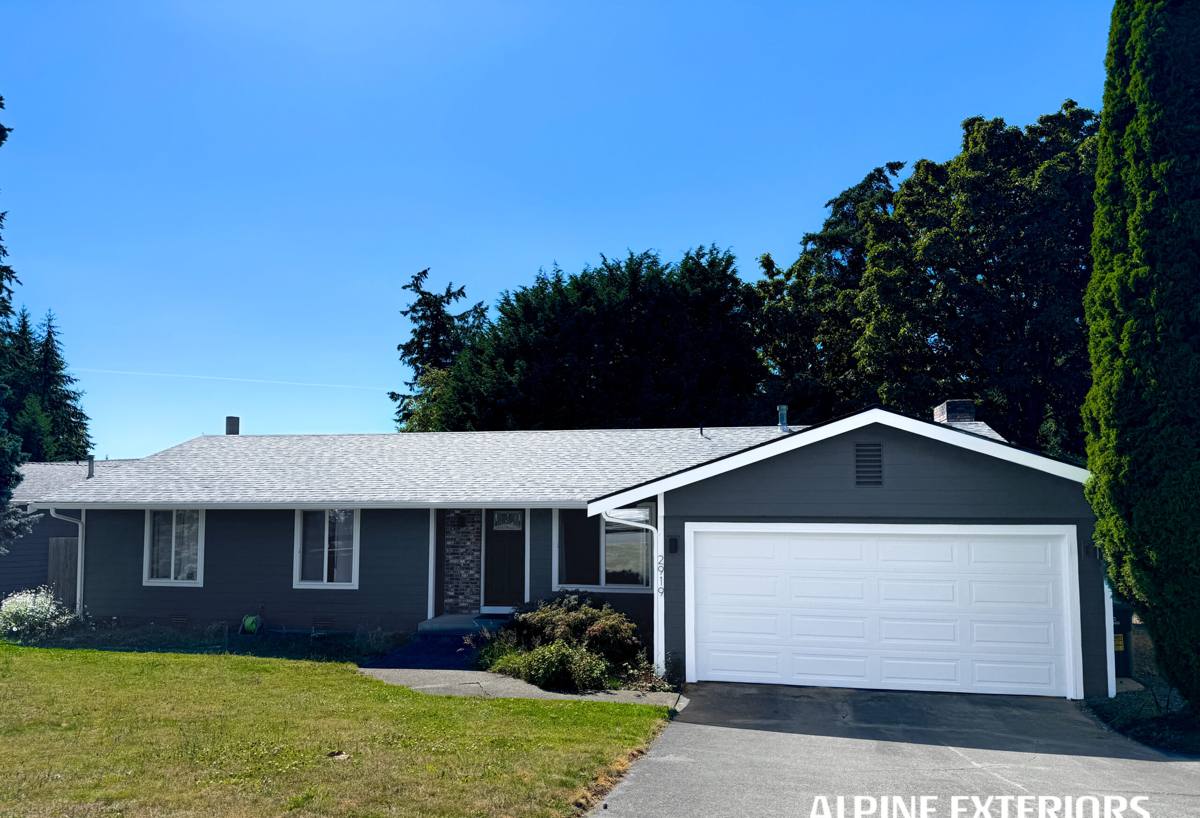
What Deming's Climate Actually Does to Exterior Siding
Moisture That Doesn't Get a Chance to Leave
Wood-adjacent or wood-based siding products absorb moisture at cut edges, fastener holes, and butt joints. In a shaded, tree-heavy setting like much of Deming, that moisture doesn't evaporate quickly between rain events. Over repeated cycles, it swells fibers, lifts paint film, and eventually leads to soft spots, delamination, or rot at the bottom courses and around windows and doors.
Moss, Algae, and Organic Buildup
Moss needs shade and standing moisture to establish, and Deming's tree cover provides both. Once moss takes hold on a siding surface or in a channel where two courses meet, it holds water against the substrate continuously — not just during storms — which accelerates whatever deterioration is already underway underneath.
Temperature and Humidity Swings
Even without extreme heat, the valley sees enough day-to-night and seasonal humidity swings to stress caulk joints, paint film, and any siding material that expands and contracts differently than the trim and flashing around it. Small movement, repeated for years, is how gaps and hairline cracks form at the worst possible places — right where water wants to get behind the cladding.
Why We Install Only James Hardie Fiber Cement Siding
We made a deliberate decision to install one siding system — James Hardie fiber cement — and to turn down jobs that call for something else. That's not a marketing position; it's a standard we hold because of what we've seen hold up in this climate and what doesn't.
Non-Combustible and Dimensionally Stable
Fiber cement is made from cement, sand, and cellulose fibers. It doesn't burn, it doesn't attract wood-boring insects, and it doesn't swell and shrink with moisture the way wood-based or wood-adjacent products do. In a damp, shaded environment like Deming's, that dimensional stability matters more than it might in a drier climate — there's simply less movement for caulk joints and paint film to fight against.
Engineered for This Region: HZ5 Product Line
James Hardie makes climate-specific formulations, and the HZ5 line is engineered for regions with significant moisture exposure and freeze-thaw activity — which describes the Pacific Northwest, including Whatcom County, reasonably well. That's the product line we specify here rather than a formulation built for a hot, dry climate.
ColorPlus Factory Finish
Most of what we install carries Hardie's ColorPlus finish — a coating baked on at the factory under controlled conditions, rather than field-applied paint. Factory finishing gives more consistent coverage and adhesion than a job-site paint crew can reliably match, and it comes with its own finish warranty separate from the substrate warranty. For a wet, shaded property, a finish that resists fade and moisture intrusion at the surface is one less variable to worry about.
We don't install LP SmartSide, vinyl, Cemplank, Allura, primed spruce, or cedar. Each of those has legitimate uses elsewhere, but we've standardized on one product we can install to spec, warranty with confidence, and stand behind on every job — rather than stocking multiple systems and installing whichever the customer read about online.
What a Correct Siding Installation Actually Involves
The material is only part of the equation. Most siding failures we get called out to inspect trace back to installation shortcuts, not the product itself. A correct job includes:
Water-Resistive Barrier and Flashing First
Before a single piece of siding goes up, the wall needs a properly lapped weather-resistive barrier, correctly integrated flashing at every window, door, and penetration, and flashing or drip cap detailing above trim boards. In a climate that sees as much driving rain as Whatcom County, this hidden layer matters more than the visible finish.
Clearances and Gaps
Hardie's own installation instructions specify minimum clearances — from grade, from roofing, from decks and patios, and gaps at butt joints and trim. Skipping these to save a few inches of siding, or to make a tight-looking reveal, is one of the most common shortcuts we see, and it's exactly what invites moisture wicking and rot at the bottom of a wall.
Fastening Pattern and Blind-Nailing
Fiber cement has a specified nailing pattern, fastener type, and embedment depth. Over- or under-driven nails, wrong fastener spacing, or face-nailing where blind-nailing is called for all shorten the life of an installation, even with the right board.
Common Mistakes We're Called to Fix
- Siding installed tight to grade or against a deck ledger with no clearance gap
- Caulk used in place of proper flashing at trim-to-siding transitions
- Cut edges left unsealed where Hardie's instructions call for factory or field sealing
- Nailing overdriven, crushing the board's face and voiding warranty coverage at that fastener
- House wrap gaps or reverse-lapped seams that funnel water behind the cladding instead of shedding it
Our Process for a Deming Installation
We run the same process on every siding job, adjusted for the specific house and site conditions:
- Site and substrate inspection — checking existing sheathing, framing, and any rot or moisture damage before pricing the job, so there are no surprises once tear-off starts.
- Water management plan — laying out where flashing, house wrap, and drainage need to go before ordering material, especially around windows, roof lines, and any spots where tree cover keeps a wall shaded and damp longer.
- Product and color selection — walking through Hardie's board profiles (lap, shingle-style panel, vertical) and ColorPlus palette against the home's trim and roofline.
- Tear-off and prep — removing old siding, repairing any compromised sheathing, and installing a correctly lapped weather barrier.
- Installation to Hardie spec — correct clearances, fastening pattern, flashing integration, and joint treatment at every course.
- Final walk-through — checking caulk lines, touch-up needs, and cleanup, including site debris from the old siding.
Cost Factors for Siding Installation in Deming
Every home is different, and we don't quote sight-unseen, but these are the main variables that move the number:
| Factor | Why It Matters |
|---|---|
| Home size and wall complexity | More corners, gables, and dormers mean more cutting, flashing, and labor time per square foot |
| Substrate condition | Rot or water damage found under old siding adds sheathing repair before new siding can go on |
| Siding profile chosen | Lap siding, shingle-style panels, and vertical siding differ in material and labor cost |
| Site access | Tree cover, slope, and tight lot lines common around Deming can slow staging and scaffolding |
| Trim and detail work | Window and door trim, fascia, and corner boards add labor beyond flat wall area |
| Tear-off vs. new construction | Removing and disposing of existing siding adds a cost step that new builds skip |
Signs a Deming Home May Need New Siding
- Soft or spongy spots when you press on the siding, especially near the bottom courses
- Visible moss or algae growth that returns soon after cleaning
- Paint that's peeling, bubbling, or chalking faster than a normal repaint cycle
- Warping, buckling, or boards that no longer sit flat against the wall
- Gaps opening at butt joints, corners, or trim that weren't there when the siding was new
- Rising heating bills that suggest the wall assembly is no longer holding a tight envelope
Why a Crew That Already Works Deming Makes a Difference
A crew that regularly works this part of Whatcom County already knows what a shaded, tree-lined lot does to a job schedule and a wall assembly — where extra flashing attention is worth it, which sides of a house hold moisture longest, and how to stage material and equipment on the kind of lots common out here. That's not something a crew unfamiliar with the area picks up on the first visit. It also means we're not guessing at code or permitting expectations for the county, and we're building a track record of Hardie installations in this specific climate rather than treating every job as a first attempt.
If you're weighing a siding project on a Deming home, we're glad to take a look and give you a straight, no-pressure estimate — no obligation, just an honest read on what your home actually needs.