 Sudden Valley Siding
 Why Sehome Roofs Wear Differently Than Roofs Inland
Sehome sits close enough to Bellingham Bay that homes here deal with a combination most inland Whatcom County neighborhoods don't: salt-laden air, wind-driven rain off the water, and long stretches of overcast, damp weather that never quite dry out a roof deck. An asphalt shingle roof that would hold up fine in a drier climate can start showing granule loss, moss colonies, and soft spots years earlier here if it wasn't installed with this specific exposure in mind. We work on roofs in this neighborhood regularly, and the failure patterns we see are consistent enough that we plan for them before the first shingle goes down, not after a leak shows up.
A Long Moss Season
Whatcom County's wet season runs long, and Sehome's shaded lots and tree cover only extend it. Moss and algae need moisture and shade to establish, and a north-facing slope or a roof under mature trees can hold both for most of the year. Once moss gets a foothold, it doesn't just look bad — it lifts shingle edges, traps water against the mat, and accelerates granule loss underneath the growth, which is the part homeowners can't see until the shingle is already failing.
Driving Rain and Wind Exposure
Storms coming off the water tend to push rain sideways rather than straight down, which puts stress on details that a calm-weather roof rarely tests: shingle sealant strips, ridge caps, and flashing laps. A roof that's watertight in a light rain can still let water track sideways under shingles during a wind-driven storm if those details weren't built for it.
Salt Air and Metal Components
The metal parts of a roofing system — flashing, drip edge, vent caps, fasteners — corrode faster near the bay than they would ten or twenty miles inland. It's a slow process, but it's real, and it's one more reason we don't treat every roof in Whatcom County as if it faces identical conditions.
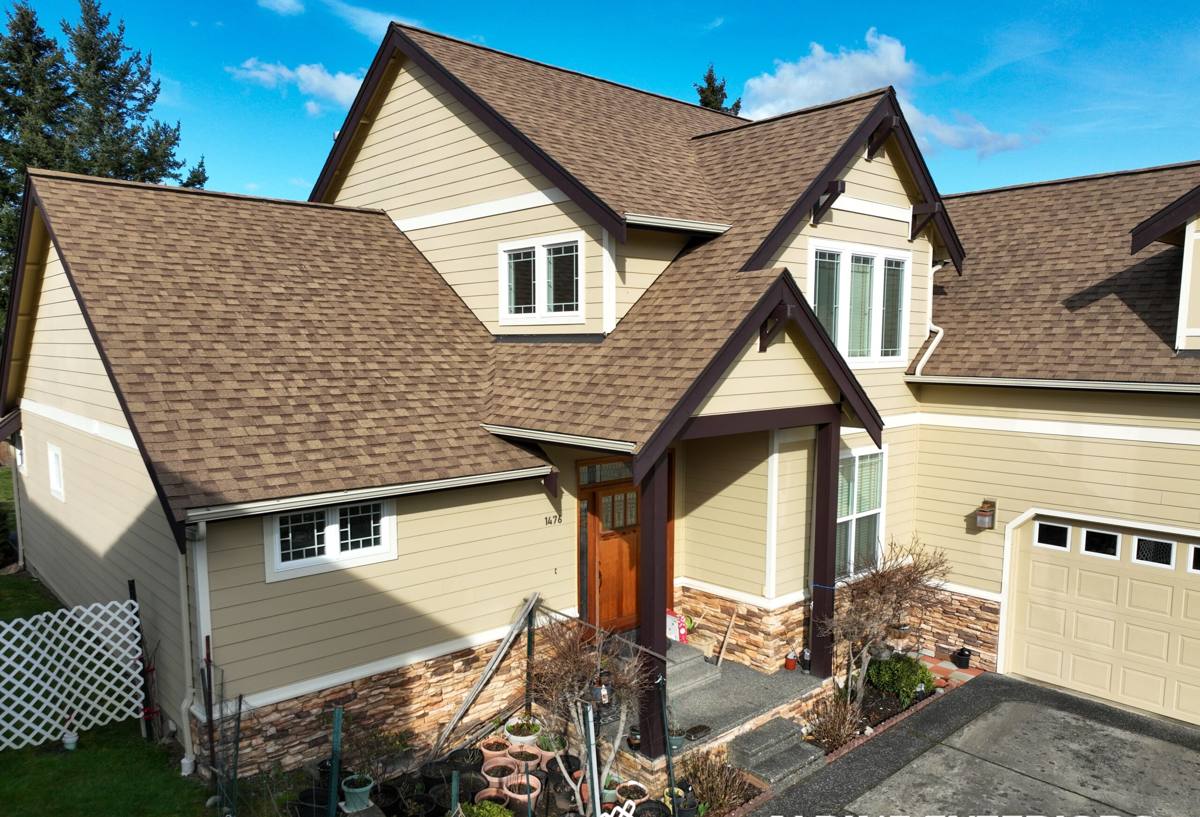
What a Correctly Built Asphalt Shingle Roof Needs Here
A roof that's going to hold up in Sehome's conditions needs a few things done right underneath the shingles, where most homeowners never look and most corner-cutting happens.
Underlayment and Water Barrier
Synthetic underlayment across the whole deck is the baseline, and we add self-adhering ice-and-water membrane at the eaves, valleys, and any roof-to-wall transitions — the spots where wind-driven rain is most likely to find a way in. This isn't optional upgrade material in a climate like this; it's the difference between a roof that sheds a sideways storm and one that lets water track back under the first course of shingles.
Ventilation That Actually Balances
Attics that trap moisture cook shingles from underneath and encourage mold and rot in the decking, and in a damp climate that moisture has nowhere easy to go if intake and exhaust venting aren't balanced. We check net free vent area on every roof, not just whether there's a ridge vent installed, because a ridge vent with no matching intake at the soffits does very little.
Flashing Details
Chimneys, skylights, sidewall transitions, and valleys are where the vast majority of roof leaks actually originate — almost never in the open field of shingles. We use step flashing and counter-flashing at wall transitions rather than relying on caulk or roof cement, which degrades and needs to be reapplied; proper flashing is a one-time install that doesn't ask for annual maintenance to keep working.
Signs a Sehome Roof Needs Attention
Most asphalt shingle roofs give warning signs well before they leak into the living space. Worth checking for, or asking us to check for, at least once a year:
- Dark streaking or green-black patches on north-facing or shaded slopes (algae or moss)
- Granules collecting in gutters or at downspout outlets
- Shingle edges that look lifted, curled, or cupped
- Soft or spongy spots when walking the roof (a sign of deck rot underneath)
- Daylight visible through the attic roof deck, or damp insulation below it
- Missing or cracked shingles after a windstorm
- Rust streaks below metal flashing or vent caps
- Ceiling stains, even faint ones, especially near chimneys or skylights
Any one of these on its own isn't necessarily an emergency, but they're worth acting on before the next wet season rather than after.
Our Asphalt Shingle Roofing Process
The process is the same whether we're doing a full replacement or a targeted repair — we just scale the steps to the scope of the job.
- On-site inspection. We look at the shingles, flashing, ventilation, and — where accessible — the attic deck from underneath, not just the roof surface from a ladder.
- Written scope and estimate. You get a clear breakdown of what's being replaced or repaired and why, in plain language, before any work starts.
- Tear-off and deck check (for replacements). We don't install new shingles over rotten or spongy decking — any damaged sheathing gets replaced and documented before we move forward.
- Underlayment and water barrier installation at eaves, valleys, and wall transitions, matched to what that specific roof's exposure calls for.
- Shingle installation following manufacturer nailing patterns and exposure specs — this is where a lot of warranty claims get denied on other jobs, so we don't shortcut it.
- Flashing and ventilation finish work at every penetration and transition point.
- Final walk-through where we point out what was done and answer questions before we consider the job finished.
Choosing the Right Shingle for a Whatcom County Home
Not every asphalt shingle product handles moss, wind, and moisture the same way. Here's how the common tiers compare for a home in a climate like Sehome's:
| Shingle Type | Algae/Moss Resistance | Wind Rating | Typical Lifespan Here |
|---|---|---|---|
| 3-Tab (economy) | Lower unless treated; moss establishes faster | Lowest of the three | 15–20 years, often less in shaded, damp areas |
| Architectural / Dimensional | Good, especially with algae-resistant granules | Higher, better wind warranty | 25–30 years with proper ventilation |
| Premium / Designer | Best available in asphalt, heaviest algae-resistant treatment | Highest wind ratings in the asphalt category | 30+ years, most forgiving of moss exposure |
For most homes in this neighborhood, we recommend at least an architectural shingle with algae-resistant (copper-infused) granules. The upfront cost difference over 3-tab is modest compared to the added years of service in a climate that's actively working against the roof.
Repair or Full Replacement — What Actually Decides It
Age and Remaining Warranty Life
A roof under ten years old with isolated damage is usually a repair candidate. Past 20 years, especially with visible granule loss across multiple slopes, a repair is often just delaying a replacement that's coming anyway.
Deck Condition
If the plywood or OSB decking underneath has soft spots or rot, that changes the math regardless of the shingles' age — decking issues need to be fixed before new shingles go on top, and the extent of that damage sometimes tips a project from repair into replacement.
Extent of Moss and Algae Damage
Moss on a small patch of one slope can often be treated and the affected shingles replaced. Moss established across most of the roof, especially on a shaded lot, usually means the granule loss underneath is more widespread than what's visible on the surface.
Why Hiring a Crew That Already Works in Sehome Matters
A roofing crew that only occasionally works this close to the bay doesn't always know to plan for wind-driven rain at wall transitions, or to check moss buildup on shaded northern lots before it becomes structural. We work throughout Whatcom County and know which details matter more in this specific stretch of it — the same reason a roof built for a dry inland town doesn't always hold up the same way here. That local familiarity shows up in the flashing choices we make and the ventilation we spec, not just in the shingles we sell.
Keeping a New Roof Performing After Installation
Asphalt shingle roofs in this climate benefit from a small amount of upkeep rather than none at all:
- Keep gutters clear so water isn't backing up under the eave line during heavy rain
- Trim back branches that keep a slope shaded and damp longer than it needs to be
- Treat moss early with a proper roof-safe treatment rather than pressure washing, which strips granules
- Have flashing and attic ventilation checked every few years, not just after a visible problem shows up
None of this is intensive, but skipping it is exactly how a well-installed roof loses years of its expected life.
If you're dealing with moss, a suspected leak, or just want an honest read on how much life is left in your current roof, we're happy to take a look. Request a free, no-pressure estimate using the form below and we'll walk the roof with you before recommending anything.