 Sudden Valley Siding
 Why Lake Whatcom Windows Wear Out Faster Than You'd Expect
Homes around Lake Whatcom sit in one of the more demanding micro-climates in Whatcom County. The lake itself holds moisture in the air longer than it lingers in town, the surrounding tree cover keeps siding and window trim shaded and damp well after a storm passes, and the marine air moving through western Washington carries enough salt and moisture to accelerate corrosion on hardware, screens, and metal flashing over time. Add a moss season that can run from fall through spring, and you've got a combination that punishes any window with a weak seal, a soft frame material, or flashing that wasn't detailed correctly the first time.
Most of the window failures we see in Sudden Valley and the surrounding Lake Whatcom neighborhoods aren't really about the glass. They're about moisture finding a way behind the frame, driving rain getting past a sill that wasn't pitched or sealed properly, or a frame material that couldn't hold up to years of freeze-thaw cycles and constant dampness. Energy efficiency and moisture management are the same conversation here — a window that leaks air is very often a window that's also letting in water.
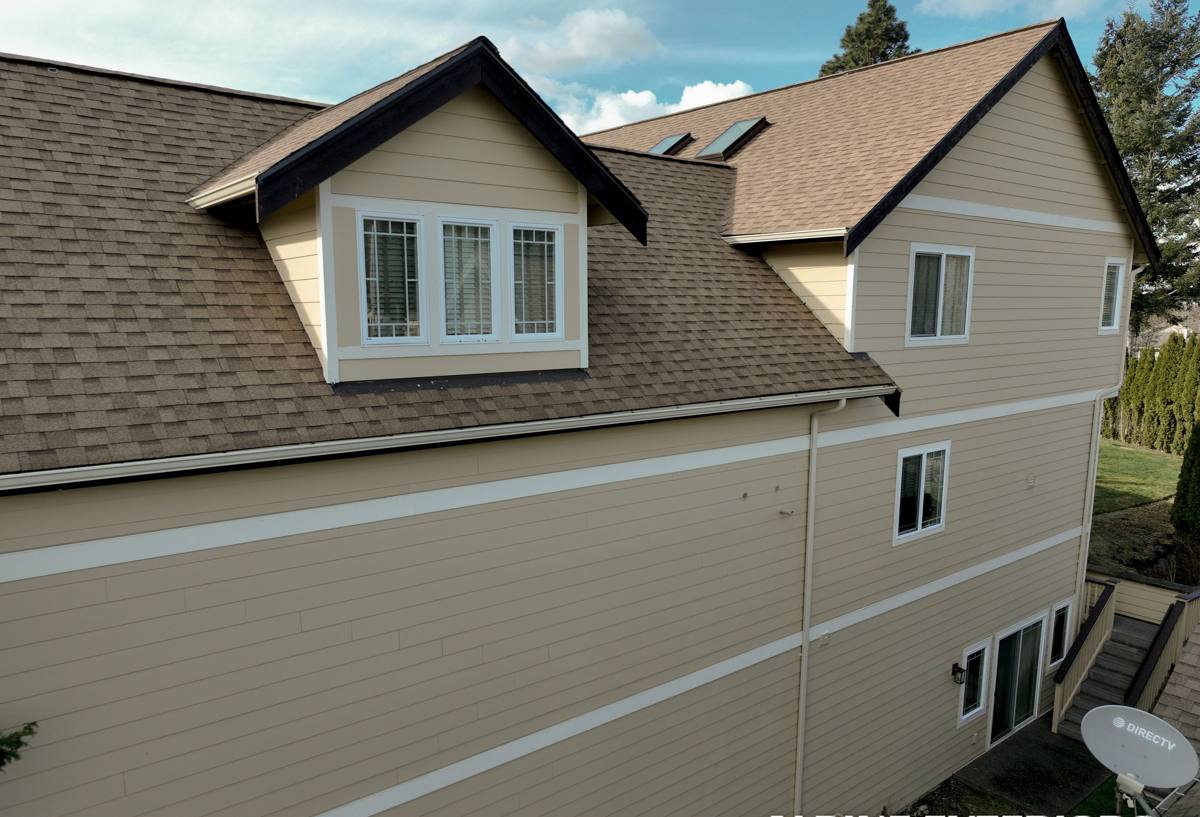
What "Energy-Efficient" Actually Means in This Climate
Manufacturers throw the term "energy-efficient" around loosely. For a Lake Whatcom home, what actually matters is how a window performs under our specific conditions: mild but persistently wet winters, cool summers, and long stretches of grey, damp weather rather than extreme heat or cold. That changes which ratings matter most.
The Numbers Worth Understanding
- U-factor — measures how well the window resists heat loss. Lower is better. This is the number that matters most for our heating-dominated climate.
- Solar Heat Gain Coefficient (SHGC) — measures how much solar heat passes through the glass. In our overcast climate, a moderate SHGC often makes more sense than the ultra-low ratings pushed for hot, sunny regions — you actually want some free solar heat on clear days.
- Air Leakage (AL) — lower numbers mean less drafting, which matters more here than in drier climates because drafts also pull in humid outside air.
- Condensation Resistance — a rating that doesn't get discussed enough, but it's directly tied to how well a window holds up against our persistent humidity and temperature swings between indoor and outdoor air.
We look at the full NFRC label on any window we recommend, not just the marketing sticker. A window can advertise "energy-efficient" and still be a poor match for a shaded, damp lot near the lake if its condensation resistance and air-leakage numbers are mediocre.
Signs Your Current Windows Are Costing You Money
Homeowners in this area usually come to us for one of a few reasons, and most of them show up gradually enough that people get used to living with them.
- Fogging or a hazy film between the panes — this means the seal on a double- or triple-pane unit has failed and the gas fill has escaped. It cannot be fixed; the sealed unit needs replacement.
- Visible condensation on the inside of the glass most mornings, especially in rooms that face the lake or sit under heavy tree cover.
- A noticeable draft near the frame even when the window is latched shut.
- Soft or discolored wood at the sill or corners — a sign moisture has already gotten behind the frame.
- Windows that are difficult to open, close, or latch, often from swelling or warped frame material.
- A heating bill that's crept up over the years without any other explanation.
None of these are cosmetic issues. Each one is either actively wasting energy, letting moisture into the wall cavity, or both.
What a Correct Installation Actually Involves Here
The window unit itself is maybe half the job. The other half — the part that actually determines whether the window performs for the next 20 years in this climate — is the installation detailing. This is where we see the most corner-cutting from crews who don't work this area regularly.
The Details That Matter for Driving Rain
- Sill pan flashing — a sloped, waterproof pan under the window that directs any water that does get past the frame back outside instead of into the wall.
- Proper flashing sequencing — flashing tape and building paper (or house wrap) have to be layered in the correct shingle-style order so water sheds outward at every layer, not just at the surface.
- Head flashing — critical on any wall that catches wind-driven rain, which describes most exposures around Lake Whatcom during a fall or winter storm.
- Sealant selection — not all exterior sealants hold up to constant damp-dry cycling. We use products rated for sustained moisture exposure, not just general-purpose caulk.
- Correct shimming and squaring — an out-of-square frame stresses the seals over time and creates gaps that widen as the house settles.
A window that's beautifully rated on paper but installed with shortcuts on any of the above will leak, fog, or draft within a few years — often while still technically under a manufacturer warranty that doesn't cover installation error.
Our Process for a Lake Whatcom Window Project
We keep this straightforward because a window replacement shouldn't feel mysterious.
- On-site assessment — we look at each window's current condition, the exposure of that wall (how much rain and shade it gets), and any signs of existing moisture damage around the frame or sill.
- Product recommendation — based on that assessment, we recommend frame material and glass package suited to that specific opening, not a one-size answer for the whole house.
- Written estimate — a clear breakdown of materials, labor, and timeline before any work starts.
- Removal and prep — old units are removed carefully to check the rough opening and sheathing underneath for hidden moisture damage before anything new goes in.
- Installation — sill pan, flashing, shimming, insulation, and sealant, done in the correct sequence for our climate.
- Final check and cleanup — operation, seal, and weatherproofing verified, site left clean.
If we find rot or moisture damage in the framing once an old window is out, we'll show you before covering it up and talk through the repair before proceeding — not surprise you with it on the invoice.
Frame Materials: What Holds Up Around the Lake
| Material | Moisture Performance | Maintenance | Typical Fit |
|---|---|---|---|
| Vinyl | Won't rot; seams and welds are the weak point if not manufactured well | Low — occasional cleaning | Good value for most Lake Whatcom homes |
| Fiberglass | Excellent — very stable in wet, temperature-swinging conditions | Low | Best long-term option for heavily shaded, damp exposures |
| Wood-clad | Good if maintained; vulnerable where cladding is breached | Higher — finish and seals need periodic attention | Homes prioritizing a specific interior wood look |
| Aluminum | Poor thermal performance and prone to condensation in our climate | Low | We generally don't recommend it for this area |
We don't push wood-clad windows on shaded, high-moisture walls near the lake as a matter of professional standard — not because the product is bad, but because the maintenance schedule required to keep the exterior cladding sealed is a lot to ask on an exposure that barely dries out between storms. If you want that look, we'll talk through where on the house it makes sense and where fiberglass or vinyl is the more practical call.
What Drives the Cost of a Window Project
| Factor | Why It Matters |
|---|---|
| Frame material | Vinyl is the most budget-friendly; fiberglass costs more upfront but often less over the window's lifespan |
| Glass package | Double-pane with a quality low-E coating covers most needs; triple-pane adds cost and is worth it on north-facing or heavily exposed walls |
| Number and size of openings | Larger or custom-sized windows cost more per unit than standard sizes |
| Condition of the rough opening | Hidden rot or moisture damage found during removal adds repair scope |
| Access and site conditions | Steep lots, second-story openings, or limited access around a home add labor time |
| Trim and siding tie-in | Matching existing trim or integrating new flashing with siding can add finish work |
We give a broad range up front once we know the general scope, then a firm number after the on-site assessment. We're not going to quote a whole-house number before we've seen the actual openings and their condition — that's how homeowners end up with surprise add-ons partway through.
Why It Matters That We Already Work This Area
Sudden Valley is its own community with its own review process for exterior changes, and a crew that hasn't worked here before is often learning that on your project's timeline instead of before it starts. We already know what to expect from the local approval process, how the tree-heavy lots around the lake affect drying time and scheduling, and which exposures on this side of Whatcom County take the worst of the driving rain each season.
That familiarity also shows up in smaller ways: knowing which streets get heavier moss buildup on north-facing walls, planning installation timing around the wetter months when possible, and recognizing early signs of moisture intrusion that a crew unfamiliar with lake-adjacent homes might miss until it's a bigger repair.
Protecting Your Investment After Installation
New windows are only energy-efficient for as long as the seals, hardware, and finish stay in good condition. A little seasonal attention goes a long way in this climate.
- Clean moss and algae off window trim and sills before it holds moisture against the frame — don't let it accumulate over a full moss season.
- Check exterior caulking annually for cracking or separation, especially after a hard winter.
- Lubricate hardware and tracks once or twice a year to prevent corrosion from salt-tinged marine air.
- Keep gutters and downspouts clear so runoff isn't sheeting directly down over window heads.
- Watch for early condensation between panes — it's the first sign of a failing seal and is easiest to address before it leads to interior moisture damage.
If you're not sure whether your current windows are worth repairing versus replacing, or you just want an honest read on what a project like this would actually cost for your home, we're glad to come take a look. The estimate is free, there's no pressure attached to it, and you can use the form below to get started.