 Sudden Valley Siding
 Windows Built for the Nooksack Valley, Not a Showroom in Seattle
Deming sits in a different micro-climate than a lot of homeowners realize. You're tucked along the Mount Baker Highway corridor in the Nooksack River valley, with dense evergreen canopy holding shade and moisture on the north and west sides of most homes, and cold air draining down off the foothills on clear winter nights. Add in the driving rain that rolls up from the Puget Sound lowlands and the long moss season that comes with all that shade and damp, and you've got a climate that finds every weak point in a window within a few years, not a few decades. We work on homes in Deming and around Sudden Valley regularly, and the failure patterns we see out here are consistent enough that we can usually tell you what's wrong with a window before we've even opened the sash.
This page is about one thing: replacing windows with energy-efficient units, done correctly, for homes in the Deming area. Not a general overview of every siding or roofing service — just what this job actually requires here, and how we do it.
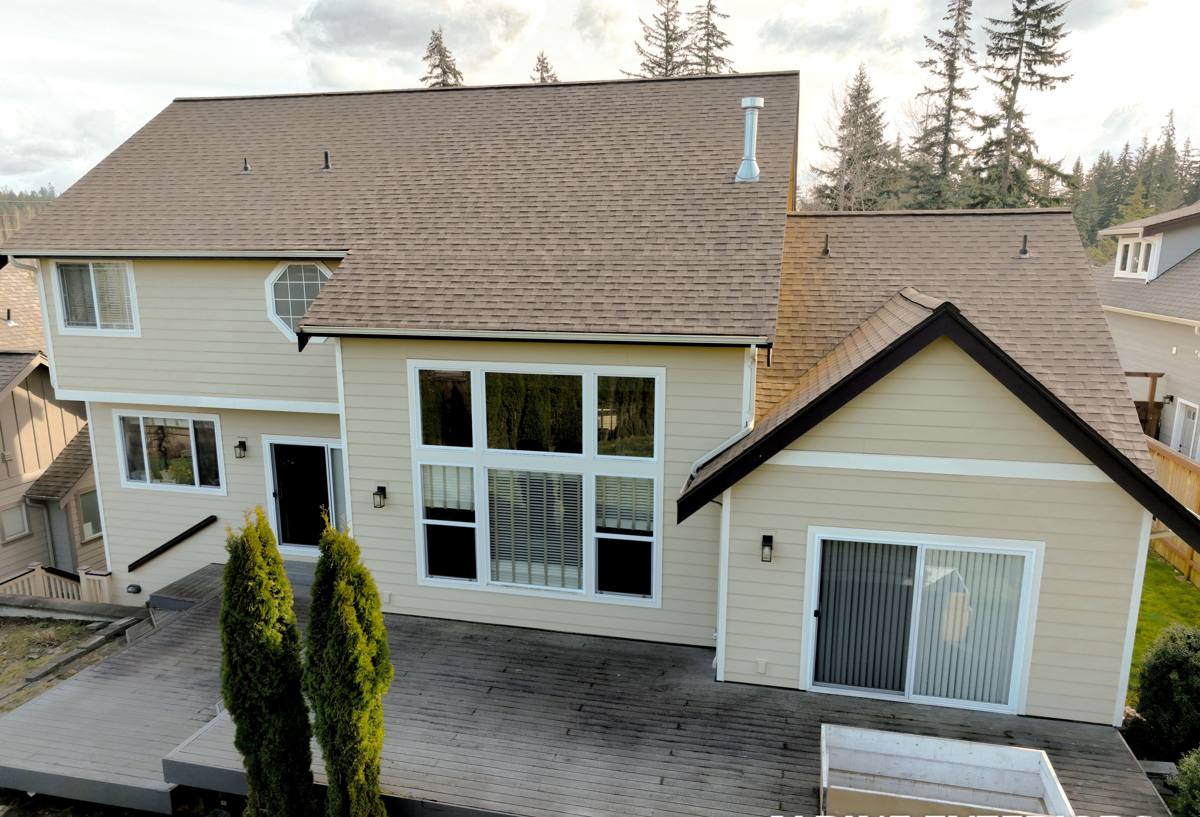
What Whatcom County's Climate Does to Old Windows
Three things drive most of the window failures we find on Deming properties:
- Driving rain and wind-driven moisture. Storms moving up the valley push rain sideways against west- and south-facing walls. Old flashing details and dried-out caulk let water track behind the trim and into the framing long before anyone notices a leak inside.
- Shade and moss. Properties with heavy tree cover — common through Deming — stay damp longer after every rain. Moss and algae take hold on sills, tracks, and exterior trim, holding moisture against wood and vinyl and accelerating rot and seal failure.
- Cold-air pooling and temperature swings. On clear nights the valley floor can run noticeably colder than surrounding higher ground. Older single-pane or early dual-pane windows condensate heavily in that kind of cold, and repeated freeze-thaw cycling on trapped moisture stresses seals and glazing faster than a milder, more even climate would.
None of that is exotic — it's just steady, cumulative wear that's a little more aggressive here than it is twenty minutes closer to town. It's also entirely predictable, which is the point: a window and installation spec that ignores it will underperform here even if it's a fine product somewhere drier.
Signs Your Windows Are Already Costing You Money
Most homeowners don't replace windows because of one dramatic failure — they replace them because a handful of small problems finally add up. Worth checking for:
- Visible fog, haze, or water droplets between the panes (a failed seal — the argon or air gap is gone and the glass is no longer insulating)
- Condensation on the inside of the glass most mornings, especially in bedrooms or on north-facing walls
- Drafts you can feel with a hand near the frame, even with the window latched
- Wood trim or sills that are soft, discolored, or growing moss at the base
- Windows that are difficult to open, close, or lock — a sign the frame has shifted or swollen
- A noticeable difference in room temperature near the window versus the rest of the house
- Rising heating bills that aren't explained by anything else in the house
Any one of these on its own might not justify replacement. Several of them together, especially on a home more than 20-25 years old, usually do.
What Actually Makes a Window "Energy-Efficient"
U-Factor and Solar Heat Gain, in Plain English
Two numbers matter most. U-factor measures how much heat escapes through the window — lower is better, and it's the number that matters most in a heating-dominated climate like ours. Solar Heat Gain Coefficient (SHGC) measures how much solar heat comes through the glass. In Whatcom County, ENERGY STAR's Northern Climate Zone criteria apply, which prioritize a low U-factor above all else since blocking summer sun matters far less here than holding onto heat the other nine months of the year. For most Deming homes, we're steering customers toward glass packages with a U-factor in the neighborhood of 0.27 or lower, with SHGC selected based on how much direct sun a given wall actually gets rather than a blanket rule for the whole house.
Glass and Gas Fill
Dual-pane, low-E coated glass with an argon gas fill is the standard baseline for this climate — it's a meaningful step up from clear dual-pane and doesn't carry the cost or diminishing returns of triple-pane in a climate that's mild rather than extreme cold. Triple-pane can make sense on a north-facing wall that never sees sun, or for a homeowner prioritizing sound reduction along the highway corridor, but we'll tell you honestly when it isn't worth the added cost.
The Frame Matters as Much as the Glass
A high-performance glass package installed in a frame that isn't suited to a wet, shaded, moss-prone site will still fail early — usually at the corners and the sill, where water sits longest. Frame material and installation detailing are where most of the real-world difference between a window that lasts 10 years and one that lasts 30 actually shows up.
Choosing a Frame Material for a Deming Property
| Frame Material | How It Handles Our Climate | Trade-Offs |
|---|---|---|
| Vinyl | Good moisture resistance, no rot risk, low maintenance — a solid default for most Deming homes | Can expand/contract with temperature swings; quality varies a lot between manufacturers |
| Fiberglass | Very stable in temperature swings, excellent moisture and rot resistance, holds paint well if a custom color is wanted | Higher upfront cost than vinyl |
| Wood-clad | Traditional look for older or historic-style homes; cladding protects the exterior face | Any breach in the cladding lets moisture reach the wood core — a real risk on heavily shaded, moss-prone lots; requires more diligent installation and upkeep |
| Aluminum | Strong and slim sightlines | Conducts heat and cold efficiently, which works against energy efficiency here unless thermally broken; prone to condensation without it |
We don't push wood-clad windows on shaded, high-moss Deming lots as a rule — not because the product is bad, but because that combination of constant dampness and reduced airflow is the exact scenario where any gap in the cladding turns into a hidden rot problem. If a homeowner wants the wood-clad look and understands the maintenance commitment, we'll install it correctly. Otherwise, fiberglass or a quality vinyl line does the job with far less long-term risk.
What a Correct Installation Actually Involves
The window itself is maybe half the job. The other half is how it's sealed into the wall — and in a climate with this much driving rain, that half is non-negotiable:
- Full removal of the old unit and inspection of the framing and sill for hidden rot or prior water damage before anything new goes in
- Correct flashing sequence at the sill, jambs, and head so water is shed outward and down, never trapped behind the trim
- A sill pan to catch and direct any water that does get past the primary seal
- Proper shimming and squaring so the window operates smoothly and the seal isn't stressed unevenly
- Quality low-expansion sealant and backer rod at the perimeter, not just a bead of caulk over gaps
- Interior and exterior trim reinstalled or replaced cleanly, with attention to any spot where moss or algae had already taken hold on the old trim
Skip the flashing detail or rush the sill pan, and even a top-tier window will leak within a few wet seasons. This is where most of the "the window failed" complaints we hear about actually trace back to installation, not the product.
How Our Process Works
- Walkthrough and assessment. We look at each window individually — not every window on a house needs replacing at the same time, and we'll tell you honestly which ones do.
- Measurement and product selection. We measure precisely and talk through frame material, glass package, and grille style based on the wall's sun and shade exposure.
- Written estimate. Clear scope, clear numbers, no pressure to decide on the spot.
- Scheduling around the weather. We plan installs for drier stretches when possible, and for jobs that can't wait, we take extra precautions to keep the opening protected while it's exposed.
- Removal and installation. Old unit out, framing inspected and repaired if needed, new unit flashed, sealed, and set — one opening at a time so your home is never left wide open.
- Cleanup and walkthrough. We test every window we install and walk you through operation before we call the job done.
Why It Matters to Hire a Crew That Already Works in Deming
Window installation isn't the same job everywhere. A crew that mostly works drier, more exposed neighborhoods can do fine work and still get caught off guard by a shaded, moisture-heavy Deming lot — the moss growth on the old trim, the way water actually moves off a valley-floor roofline, the extra care a sill pan needs on a north wall that barely sees direct sun from October to April. We already know these patterns because we see them on every job in this area. That means fewer surprises mid-project, flashing details specified correctly the first time, and a realistic read on which windows on your house genuinely need replacing versus which ones have years left in them.
It also means practical local knowledge: realistic scheduling around Whatcom County's wet season, straightforward answers about Whatcom County permitting when a job requires it, and access planning for the longer driveways and wooded lots common on Deming properties.
What Affects the Cost
We don't publish fixed prices because the honest cost of a window job depends on real variables — but here's what actually drives the number up or down:
| Factor | Why It Matters |
|---|---|
| Window size and number of units | Larger openings and whole-house jobs cost more per unit to produce and install, but often less per window than piecemeal replacement |
| Frame material | Vinyl is typically the most affordable; fiberglass and wood-clad cost more upfront |
| Retrofit vs. full-frame replacement | Retrofitting into an existing frame is faster and cheaper; full-frame replacement costs more but is the right call when the old frame or sill has rot or water damage |
| Access and site conditions | Second-story windows, tight access, or dense landscaping around an opening add labor time |
| Trim and finish work | Matching existing exterior trim or repairing moss/water damage around the opening adds scope beyond the window itself |
As a broad range across the industry, expect anywhere from several hundred to a couple thousand dollars per window installed, depending on those factors — a wide range on purpose, because a small vinyl retrofit and a large full-frame fiberglass replacement with trim repair aren't the same job. We'll give you real numbers for your actual windows during the estimate, not a guess based on square footage.
Keeping New Windows Performing Through Whatcom County Winters
A correctly installed, energy-efficient window still benefits from basic upkeep in this climate:
- Clean weep holes at the sill periodically so water can drain rather than pool
- Rinse moss and algae off exterior sills and trim before it gets a foothold, especially on shaded walls
- Check exterior caulking annually, particularly after a hard winter, and touch up any cracking before it lets water behind the trim
- Wipe down interior sills if condensation builds up on cold mornings — occasional condensation is normal in our climate, but standing water on a windowsill for days is not
- Trim back vegetation that's shading a window and keeping it damp longer than the rest of the house
None of this is difficult, but skipping it is how a well-installed window ends up with an avoidable moss or rot problem five or ten years down the road.
If your windows are drafty, foggy between the panes, or just costing more to heat around than they should, we're happy to take a look. We'll give you a straightforward, no-pressure estimate based on what your specific windows and walls actually need — fill out the form below to get started.