 Sudden Valley Siding
 Building a Deck That Actually Holds Up in Deming
Deming sits in the Nooksack River valley, tucked under tree cover on the way up toward Mount Baker, and that setting is exactly what makes deck-building here different from a deck job in a dry, open subdivision. Whatcom County runs the gamut from salt-air shoreline near Bellingham Bay to shaded river-valley lots like Deming's, but the common thread everywhere is the same: driving rain for a good chunk of the year, high humidity, and a moss season that can start in October and not really let go until June. A deck that's framed and finished without that in mind will show problems within a few seasons — soft spots, black staining, sagging boards, rusted hardware. A deck built for it can go decades with nothing more than routine cleaning.
This page covers what a custom deck in Deming actually needs, what a correct build looks like from the ground up, and how we handle these jobs from first visit to final walk-through.
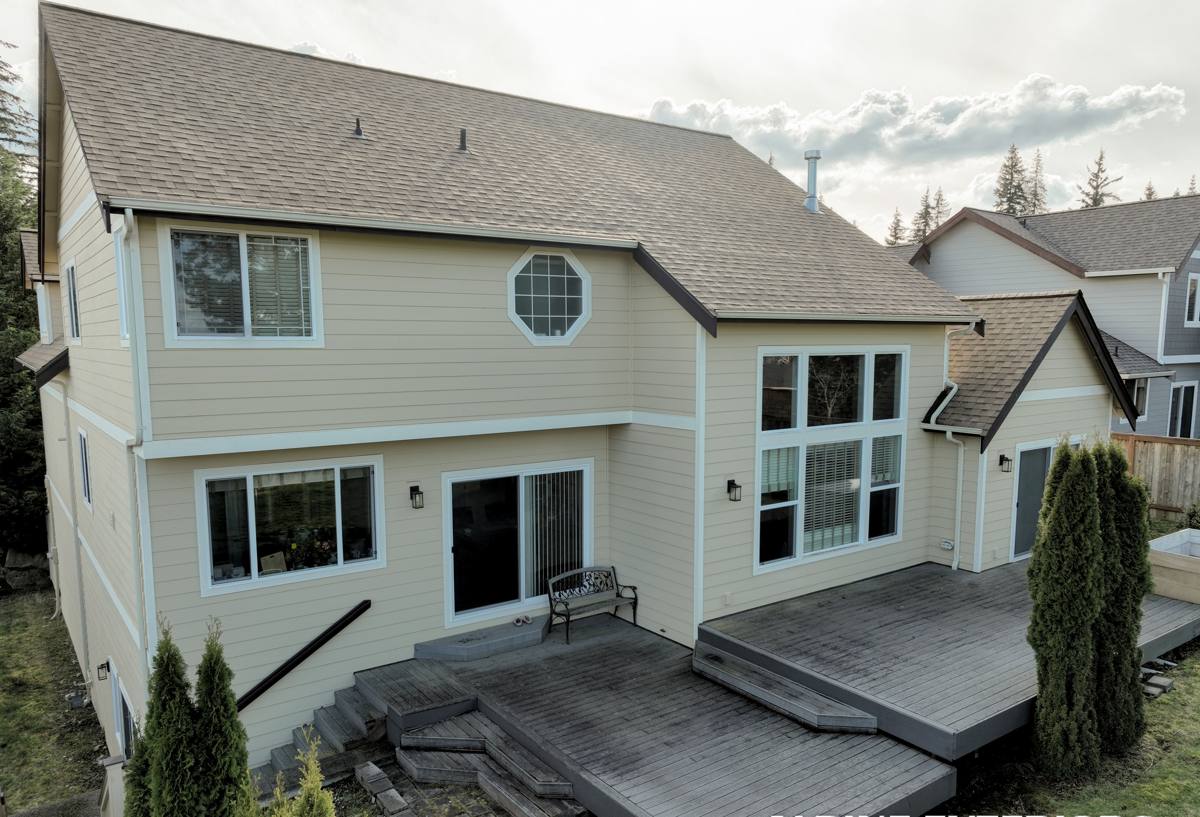
What Deming's Climate Does to an Unprotected Deck
A lot of deck failures we get called out to fix aren't design failures — they're moisture failures. Wood and even some composite products behave differently when they're wet more often than they're dry, which is the normal state of affairs for months at a stretch out here.
Moisture Sits, It Doesn't Just Pass Through
Shaded lots near trees and river bottomland don't dry out between rain events the way an open, sun-exposed yard does. That means deck surfaces, the undersides of joists, and anywhere two pieces of wood meet stay damp longer, which is exactly the environment moss, algae, and rot fungus need to get established.
Moss Isn't Cosmetic — It Holds Water Against Wood
Green and black staining on decking boards isn't just an appearance issue. Moss and algae hold a film of moisture directly against the board surface, which slows drying even further and accelerates decay in untreated or under-finished wood. Left alone through a few wet seasons, it works into board grain and fastener holes.
Hardware Corrodes Faster Than People Expect
Standard or under-spec fasteners and connectors rust in this kind of sustained damp, and a rusted joist hanger or ledger bolt is a structural problem, not a cosmetic one. This is one of the most common corners we see cut on older or budget decks in this area.
What a Correctly Built Deck Needs Here
| Component | What It Needs in Deming's Climate | What Goes Wrong Without It |
|---|---|---|
| Framing lumber | Properly rated pressure-treated lumber, correct fastener compatibility | Hidden rot inside joists years before the surface shows it |
| Ledger connection | Proper flashing and standoff so water can't track into the house wall | Rot at the rim joist, water intrusion into the structure |
| Fasteners & hardware | Hot-dip galvanized or stainless-rated, matched to the lumber treatment | Rust streaks, weakened connections, hanger failure |
| Footings | Set to proper frost depth and bearing on stable soil | Heaving, settling, wobble at posts and stairs |
| Decking surface | Gapped correctly for drainage and seasonal movement | Standing water, cupping, premature wear |
| Airflow underneath | Clearance and, where possible, ventilation under low decks | Trapped moisture, mold, and faster rot in framing |
Choosing a Decking Material for a Deming Lot
There's no single "right" decking material — it depends on how much sun your lot gets, how much maintenance you want to do, and your budget. Here's how the common options actually compare once you factor in shade, rain, and moss:
| Material | Moisture/Moss Behavior | Maintenance | Relative Cost |
|---|---|---|---|
| Pressure-treated wood | Resists rot when properly finished; needs upkeep to shed water and stay clean of moss | Annual cleaning, periodic sealing/staining | $ |
| Cedar | Naturally decay-resistant but still needs finish maintenance in shaded, wet spots | Regular cleaning and refinishing | $$ |
| Capped composite | Doesn't absorb water or rot, but surface film can still grow algae if never cleaned | Occasional washing, no staining/sealing | $$$ |
| PVC/cellular decking | Fully moisture-resistant, most consistent performance in shade | Lowest — periodic washing only | $$$ |
We'll walk through the trade-offs honestly on-site. A well-finished and properly maintained wood deck can last a very long time here, but it does require actual upkeep. Composite and PVC products cost more up front and shift that burden away from ongoing maintenance and toward material and installation quality — the fastening system, ventilation, and edge detailing on those products matter as much as the board itself.
Why We Don't Push One Product on Every Job
We install a range of decking systems rather than one house brand, because the right call depends on your lot's shade, your maintenance appetite, and your budget — not on what's easiest for us to install. Where a manufacturer's installation spec calls for specific hidden-fastener spacing, ventilation gaps, or flashing details, we follow it, because that's usually what keeps the warranty valid and the deck performing as designed.
Design Details That Matter Specifically Here
Ledger and House Connection
Where the deck attaches to the house is the single most common source of hidden water damage on decks in wet climates. Correct flashing, a drainage gap, and proper fastening at this joint matter more than almost anything else on the structure — it's the detail most likely to be shortcut on a fast, cheap build.
Drainage and Grading Underneath
On sloped or shaded Deming lots, water needs somewhere to go once it's shed off the deck surface. We look at grading under and around the structure so runoff doesn't pool against footings or foundation walls, which is a slower but very real problem on lots that stay damp most of the year.
Board Spacing for Wet-Dry Cycling
Wood and wood-based composite boards expand and contract with moisture. Gapping needs to account for that seasonal swing so boards don't cup, buckle, or close up so tight that water has nowhere to drain in the wet months.
Railings, Stairs, and Shaded Corners
Shaded stair treads and rail-post bases are where moss and slick surfaces show up first, and where a fall risk actually matters. We think about sun exposure and airflow at the design stage, not just after someone complains their stairs are slippery.
Our Process for a Custom Deck Build
1. On-Site Assessment
We look at your lot's sun and shade pattern, drainage, soil, and how the deck will tie into the house before we talk materials or layout. This is also when we flag anything unusual — old footings, a problem downspout, low clearance — that affects the design.
2. Design and Material Selection
We go over layout, decking material, railing style, and budget together, with the trade-offs laid out plainly. You should understand what you're paying for and why before we ever cut lumber.
3. Permitting
Most new deck construction in Whatcom County requires a building permit, and we handle that process as part of the job rather than leaving it to you.
4. Framing and Structural Work
Footings, posts, beams, and joists go in to spec — this is the part of the job nobody sees once it's finished, and it's the part that determines whether the deck is still solid in fifteen years.
5. Decking, Railing, and Finish Work
Surface installation, railing, stairs, and any finishing or sealing happen last, with attention to the gapping, fastening, and flashing details covered above.
6. Final Walk-Through
We go over the finished deck with you, including what maintenance it needs and roughly when, so there are no surprises the first wet winter.
Warning Signs on an Existing Deck
If you're not sure whether your current deck needs repair or full replacement, these are the signs worth checking for before winter rain sets in:
- Soft, spongy, or springy spots anywhere on the deck surface
- Heavy green or black staining that comes back quickly after cleaning
- Any gap or separation where the deck meets the house at the ledger board
- Rust streaks running down from screws, bolts, or metal connectors
- Wobble at railing posts or stair stringers
- Water that stands on the surface instead of draining off after rain
- Boards that have cupped, split, or pulled away from fasteners
Any one of these on its own might be minor. Several together, especially near the ledger or at the posts, usually means it's worth having someone look at the structure, not just the surface.
Maintaining a Deck Through Whatcom County's Wet Season
Whatever material you choose, a little seasonal attention goes a long way here:
- Clear leaves and debris from between boards before fall rains set in — trapped debris holds moisture against the surface
- Wash off moss and algae buildup at least once a year, more often on heavily shaded sections
- Check and clear drainage paths underneath and around the deck before winter
- Re-seal or re-stain wood decking on the manufacturer's or finish product's recommended schedule, not just when it looks faded
- Look over railing posts and stair connections annually for looseness or corrosion
Why a Crew That Knows Deming Matters
A contractor who mostly builds in drier, sunnier parts of the state can still frame a deck that's structurally fine on paper and still underperform here, because the details that matter — ledger flashing, fastener choice, drainage, board gapping for a long wet season — are exactly the details that don't show up as problems until a couple of winters in. Working regularly in Whatcom County, including river-valley communities like Deming, means we've already seen what fails first in this climate and we build to avoid it from day one, not after a callback.
If you're planning a new deck or trying to figure out whether an existing one needs repair or replacement, we're happy to take a look and give you a straight answer. Reach out for a free, no-pressure estimate using the form below.