 Sudden Valley Siding
 Why Metal Roofing Behaves Differently in Cordata
Cordata sits in a part of Whatcom County where three things work against a roof at the same time: moisture from Puget Sound and Bellingham Bay carrying salt into the air, long stretches of driving rain off the water, and shaded, tree-lined lots that keep roof surfaces damp long after a storm passes. Any one of those is manageable on its own. Together, they're why we treat metal roofing in this neighborhood as its own project rather than a copy-paste of what works inland or in drier parts of the state.
Salt-laden air accelerates corrosion at fasteners, panel seams, and any exposed cut edge where bare steel is left uncoated. Driving, wind-blown rain finds its way under improperly lapped panels and around flashing that was installed to a minimum standard instead of a Cordata standard. And moss doesn't just sit on a roof looking bad — its root structure holds water against the panel finish and, over years, works into seams and fastener penetrations. A metal roof that's correctly specified and installed handles all three. One that isn't will show problems in the first few wet seasons, not after twenty years.
What This Means for a Homeowner Deciding on Metal
If you're comparing metal to asphalt for a home in Cordata, the honest answer is that metal earns its higher upfront cost specifically because of this climate. It sheds water fast, doesn't absorb moisture the way organic shingle mats can, and — done right — gives moss far less to grip onto than a textured asphalt surface. The trade-off is that installation quality matters more with metal than with almost any other roofing material. A great metal roof and a mediocre one can look identical from the ground and perform completely differently in a Whatcom County winter.
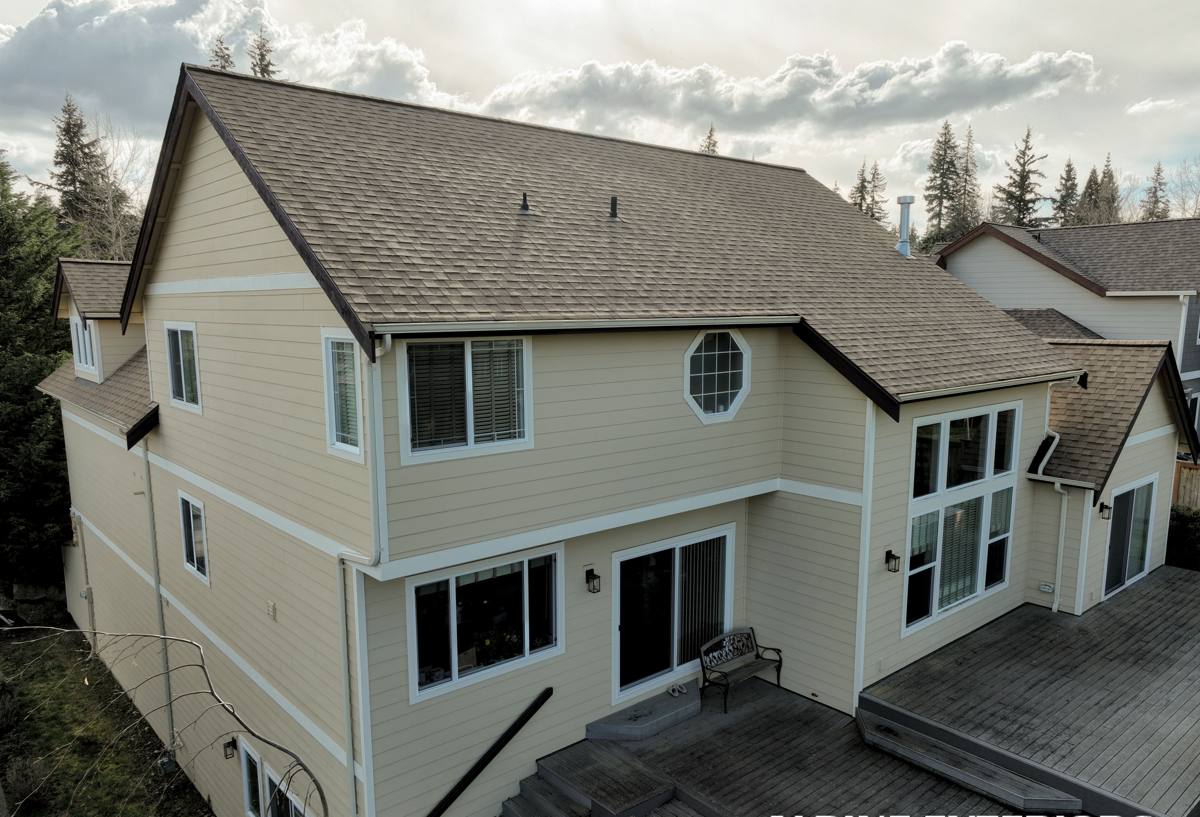
What a Correctly Installed Metal Roof Includes
"Correct" isn't a marketing word here — it's a specific set of decisions that either get made or get skipped. For a Cordata home, that includes:
- A water-resistive underlayment rated for high-moisture climates, not a builder-grade felt, installed with proper overlap at every seam
- Fasteners and clips matched to the panel's metal type so two dissimilar metals aren't sitting against each other and corroding (galvanic corrosion is a real issue with mismatched steel, aluminum, and stainless components)
- Closed or properly vented ridge details that keep wind-driven rain out without trapping moisture inside the attic
- Kick-out flashing at every roof-to-wall transition, sized and bent for the actual pitch, not a generic stock piece forced into place
- Ice-and-water shield or equivalent membrane at valleys, eaves, and any low-slope transition where standing water is possible
- Panel seams and end laps sealed to spec — not caulked over as an afterthought once the crew notices a gap
Skipping any one of these doesn't usually cause a failure in year one. It causes a failure in year five or eight, after the warranty conversations have already happened and the original install is a distant memory. That's the real cost of a rushed metal roof — it's deferred, not avoided.
Choosing a Metal Roofing System for a Cordata Home
Not every metal roofing product performs the same way in a salt-air, high-rainfall environment. We walk homeowners through the real differences rather than pushing a single product line.
| System | How It Handles Salt Air & Rain | Moss Resistance | Typical Trade-Off |
|---|---|---|---|
| Standing seam (concealed fasteners) | Best — no exposed fastener heads for salt to attack, raised seams shed water fast | Very good — smooth surface gives moss little to hold | Higher material and labor cost |
| Exposed-fastener panel | Good if fasteners are coated/gasketed correctly and inspected periodically | Good on clean panel field | Fastener seals are the long-term maintenance point |
| Metal shingles/shakes | Good — interlocking profile sheds water well | Moderate — more surface texture than standing seam | More seams and details than a simple panel run |
| Uncoated or mill-finish steel | Poor in this environment without an added protective coating | Not typically recommended near the water | We generally advise against this specification here |
Coatings and Finishes Matter as Much as the Panel
The paint or coating system on a metal roof is doing real structural work, not just providing color. A quality PVDF (Kynar-type) finish holds up to UV and salt exposure far longer than a basic polyester coat, and it resists chalking and fading in the persistent overcast and rain that Whatcom County gets for much of the year. We'll tell you plainly when a lower-cost finish is a reasonable choice for a budget and when it's going to cost more in five years than it saved today.
The Moss and Overhang Problem Specific to This Area
Cordata's tree cover is part of what makes the neighborhood attractive, and it's also the reason moss and organic debris are a constant maintenance factor rather than an occasional one. Overhanging branches drop needles and leaves into valleys and against any roof-to-wall junction, and that debris holds moisture right where a roof is already most vulnerable. On a metal roof, the fix isn't chemical treatments or aggressive pressure washing — it's design and clearance.
We look at branch clearance over the roof plane, valley width and slope, and whether gutters are sized to actually move the volume of water and debris this area produces during a wet fall and winter. A metal roof paired with undersized or poorly pitched gutters will still back up water at the eaves, no matter how good the panel installation is above it.
Signs an Existing Metal Roof in Cordata Needs Attention
- Rust streaking below fastener heads or at cut panel edges
- Moss or algae buildup concentrated in shaded valleys or north-facing slopes
- Panel fasteners visibly backing out or oil-canning (visible waviness) across panel faces
- Water staining on interior ceilings near chimneys, skylights, or wall transitions
- Loose or missing sealant at ridge caps and flashing joints
Our Process From First Call to Finished Roof
We keep this straightforward because a roof project shouldn't feel opaque to the person paying for it.
- On-site assessment. We walk the roof (or use a lift/drone where pitch or access makes that safer), check the current substrate, ventilation, and any moisture already trapped under existing roofing.
- Honest scope discussion. We tell you what's actually needed versus what's optional, including whether full tear-off or a recover is appropriate for your situation.
- Written estimate. Panel type, underlayment, flashing details, and fastener spec are all listed — not a lump-sum guess.
- Installation. Tear-off (if needed), underlayment, flashing, panel installation, and final detailing at ridges, valleys, and penetrations.
- Final walkthrough. We go over the finished roof with you, including what routine maintenance looks like going forward.
What Metal Roofing Costs in This Area, and What Drives the Range
We won't quote a number without seeing the roof, but the factors that move the price up or down are consistent enough to talk about honestly.
| Factor | Effect on Cost |
|---|---|
| Panel system (exposed-fastener vs. standing seam) | Standing seam typically runs higher due to labor and specialty tooling |
| Roof pitch and access | Steep or hard-to-access roofs increase labor time and safety equipment needs |
| Tear-off vs. recover | Full tear-off costs more up front but avoids trapping moisture under new panels |
| Number of valleys, penetrations, and transitions | Each detail adds flashing labor and material |
| Coating quality (PVDF vs. standard polyester) | Premium finishes cost more but extend service life in salt-air exposure |
| Underlayment and ice/water membrane specification | Higher-grade membranes at eaves and valleys add modest cost, reduce long-term risk |
As a general rule, metal roofing costs more per square than asphalt shingles, and standing seam costs more than exposed-fastener panel. The difference shows up in service life and reduced maintenance rather than in the sticker price, which is why we walk through the full cost picture — not just the install quote — before you decide.
Why Local Experience in Cordata Actually Matters
A crew that's worked roofs across Whatcom County already knows how this neighborhood's tree cover, rainfall patterns, and proximity to salt air change the install details — where kick-out flashing tends to get missed, which valleys collect debris fastest, which fastener coatings hold up and which don't. That's not something you can fully substitute with a generic spec sheet from a manufacturer based somewhere dry and inland.
It also means we're realistic with you about maintenance. We're not going to tell you a metal roof in Cordata is maintenance-free — no roof in this climate is. We'll tell you what to actually expect: periodic gutter and valley clearing, an occasional check of fastener and flashing seals, and keeping overhanging branches back from the roof plane. That's a short, manageable list, not a burden, but it's honest.
Get a Straightforward Estimate
If you're weighing metal roofing for a home in Cordata — whether it's a new install, a re-roof, or repair work on an existing metal system — we'll come take a look and give you a clear, itemized estimate with no pressure to sign anything on the spot. Use the form below to get started.