 Sudden Valley Siding
 Why Composite Decking Makes Sense for Happy Valley Homes
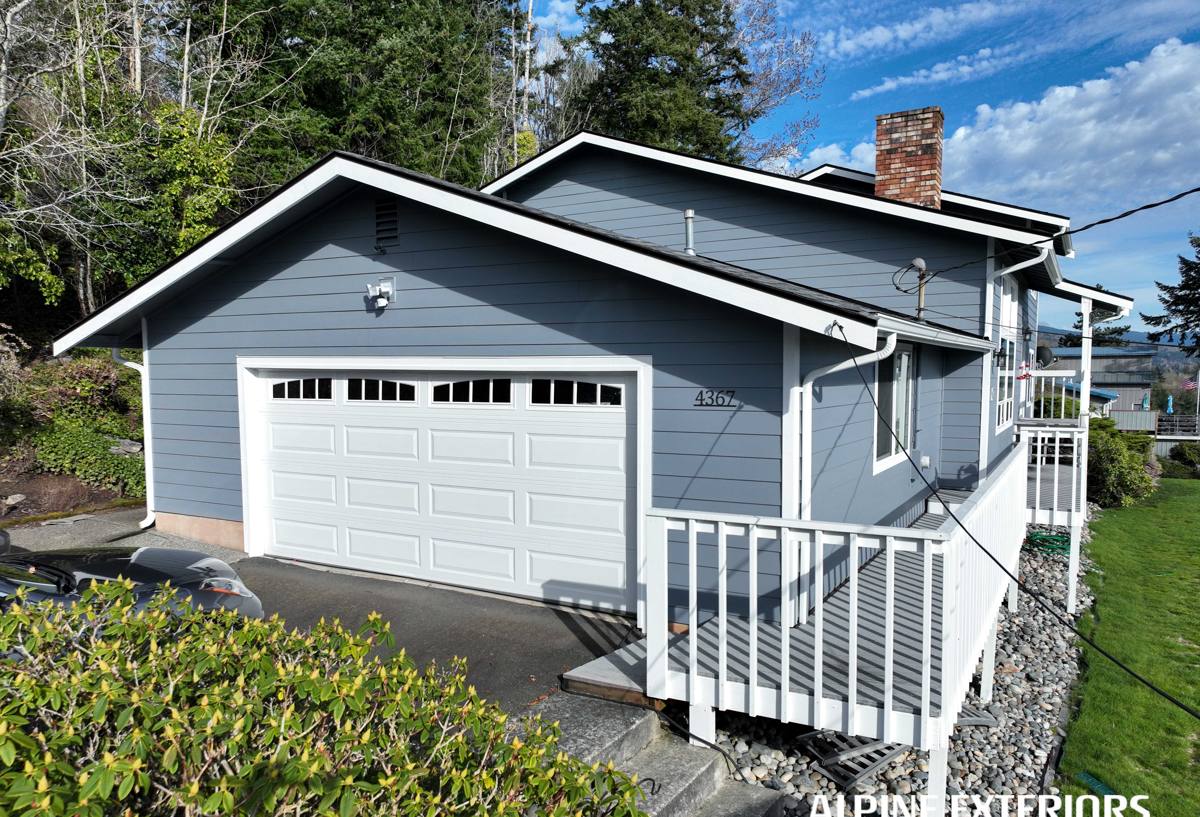
Homes in the Happy Valley area near Sudden Valley sit under heavy tree cover and close to Lake Whatcom, which means decks here deal with more standing moisture, more shade, and more organic debris than decks in drier parts of Whatcom County. Add in the salt air that drifts inland during storms, driving rain for much of the year, and a moss season that can run from October into May, and you have a climate that is hard on any exterior wood surface. Composite decking was built to handle exactly this kind of exposure, but only when it is installed correctly for the conditions it is actually going to live in.
We install composite decking as part of our regular work in Sudden Valley and the surrounding neighborhoods, including Happy Valley. That is not a small detail. A deck built the same way you would build one in eastern Washington or inland California will fight this climate instead of shedding it.
What This Climate Actually Does to a Deck
Moss, Algae, and Shade
Tree cover keeps a deck cooler in summer, but it also keeps boards damp longer after every rain. Moss and algae need moisture and shade to establish, and a shaded deck in this area can hold surface moisture for days after a storm passes. On wood, that moisture works into the grain and starts rot from the inside. On composite boards, it mostly stays on the surface, but how much depends on which product you use and how the boards were installed.
Driving Rain and Water Intrusion
Rain here does not always fall straight down. Wind-driven rain gets pushed sideways into ledger connections, stair stringers, and any gap where water can collect instead of drain. Most deck failures we get called out to inspect are not the decking boards themselves. They are the framing, flashing, or fastener points underneath that were never built to shed water in this direction.
Salt Air and UV Exposure
Whatcom County's proximity to the Sound means fasteners, brackets, and any exposed metal hardware are working against corrosion year-round, not just near the water's edge. Combined with UV exposure during the drier summer stretch, cheap or mismatched hardware is often the first thing to fail on an otherwise sound deck.
What a Correct Composite Decking Installation Involves
Composite boards are only as good as what is underneath them. A correct installation in this climate covers a few things every time, regardless of which composite product a homeowner chooses:
- Pressure-treated or naturally durable framing, spaced and sized for the specific board's span rating. Composite boards typically need tighter joist spacing than wood.
- Proper ledger board flashing where the deck attaches to the house, so water is directed out and away from the wall assembly, not behind the siding.
- Corrosion-resistant fasteners and hidden clip systems rated for coastal and high-moisture exposure.
- Consistent gapping between boards for drainage and seasonal expansion. Composite expands and contracts with temperature more than most homeowners expect.
- Ventilation underneath the deck so trapped humidity has somewhere to go instead of sitting against the framing.
Skip any one of these and the boards themselves can look fine for a while as the structure underneath quietly fails. We build the substructure first, then let the composite board do the job it was designed for.
Composite vs. Wood vs. PVC Decking: Cost and Maintenance Factors
There is no single best decking material for every budget and every home. Here is how the three most common options actually compare for a property in this climate:
| Factor | Pressure-Treated Wood | Composite | PVC / Capped Polymer |
|---|---|---|---|
| Upfront cost | Lowest | Mid-range | Highest |
| Annual maintenance | Staining and sealing, often yearly | Occasional wash, no sealing | Occasional wash, no sealing |
| Moss and mold resistance on surface | Poor without upkeep | Good to very good | Very good |
| Moisture absorption | High, drives rot | Low, capped boards better than uncapped | Essentially none |
| Typical lifespan | 10-15 years with upkeep | 25-30 years | 25-30+ years |
| Feel underfoot and appearance | Natural wood grain | Wood-look, wide color range | More uniform, less wood-like |
For most Happy Valley homeowners, capped composite hits the balance point. It costs less than PVC, resists moss and moisture far better than uncapped wood or older composite formulations, and it is what most manufacturers now build their better warranties around.
Our Process for a Happy Valley Composite Decking Project
- On-site assessment. We look at existing framing if replacing an old deck, drainage around the foundation, tree cover and shade patterns, and how the deck ties into the house.
- Product selection. We walk through board options and grades based on your budget, sun and shade exposure, and how much upkeep you actually want to do.
- Framing and flashing. This is where most of the long-term performance is decided. Ledger flashing, joist spacing, and fastener selection happen before a single composite board goes down.
- Installation. Boards are laid with manufacturer-specified gapping and hidden fastener systems, checked for square and drainage slope as we go.
- Walkthrough. We go over basic care, what to expect from the material in year one versus year five, and warranty registration if applicable.
Problems We Commonly Find on Existing Decks in This Area
When we are called out to look at a failing deck in Sudden Valley or Happy Valley, it is rarely the same story twice, but a few patterns show up often enough to be worth mentioning:
- Ledger boards with no flashing, or flashing installed behind rather than over the house wrap, letting water track into the wall assembly for years before anyone notices.
- Undersized joists for composite board spans, causing boards to bounce or sag between supports.
- Standard exterior screws instead of corrosion-rated fasteners, leaving rust streaks and loosened hardware within a few seasons.
- No airflow underneath low-clearance decks, trapping humidity against framing that never fully dries between rains.
- Boards butted tight with no expansion gap, which buckles or bows as the material moves with temperature swings.
Every one of these is preventable at the framing stage. None of them are things you can fix by simply choosing a better board.
What We Look for in a Composite Decking Product
We are not tied to one brand, because no single product is right for every budget or every home. What we do insist on, regardless of which line a homeowner chooses:
- A fully capped board on at least the top and sides. Uncapped or partially capped boards absorb more moisture over time and are more prone to surface mold in shaded, damp settings like this one.
- A manufacturer warranty that explicitly covers fade, stain, and mold and mildew, not just structural failure.
- A hidden fastener or clip system engineered specifically for that board profile, rather than a generic clip forced to fit.
- Published span tables and installation guidelines we can follow exactly. Deviating from manufacturer spec is one of the fastest ways to void a warranty.
We would rather install a mid-tier board correctly than a premium board cutting corners on the framing underneath it. The framing determines whether the deck is still solid in fifteen years; the board determines how it looks and feels day to day.
Maintenance Checklist for Composite Decks in Whatcom County
Composite decking cuts maintenance significantly compared to wood, but low-maintenance is not no-maintenance, especially under tree cover this wet. A simple seasonal routine keeps a composite deck looking and draining the way it should:
- Sweep off leaves, needles, and debris regularly through fall. Trapped organic matter is what feeds moss and algae growth on any deck surface.
- Rinse or lightly scrub with a soft-bristle brush and mild soap a couple of times a year, more often in heavily shaded spots.
- Check that gaps between boards stay clear so water keeps draining through instead of pooling.
- Inspect fasteners and any visible hardware once a year for rust streaks or loosening.
- Confirm under-deck ventilation is not blocked by stored items, skirting, or overgrown landscaping.
- Avoid pressure washing directly into board grooves or fastener channels. It can drive water where it should not go.
Why Hire a Crew That Already Works in Happy Valley and Sudden Valley
Decking looks straightforward from a distance: boards, joists, screws. What actually separates a deck that holds up for decades from one that needs rework in five years is how well the build accounts for this specific climate: the shade, the moss pressure, the driving rain angle, the salt air working on hardware over time. A crew that only occasionally works in Whatcom County is often building to a generic spec sheet. A crew that works here regularly has already seen which details matter in this environment and builds them in from the start, not as an afterthought after a callback.
We are a siding contractor first, which means we spend most of our time thinking about how water moves around a house: flashing, drainage, ventilation, moisture behavior in humid, tree-covered conditions. That is the same thinking that goes into a deck that ties into your house correctly instead of becoming the place water finds its way in.
If you are weighing options for a deck project in Happy Valley or elsewhere around Sudden Valley, we are happy to take a look and walk through what your specific site needs: the shade, the slope, the existing structure if you are replacing an old deck. Reach out for a free, no-pressure estimate using the form below.