 Sudden Valley Siding
 What Bellingham Homes Are Actually Up Against
Bellingham sits where marine air off the Salish Sea meets the wet, mossy climate of the North Cascades foothills, and that combination is harder on exterior siding than most homeowners realize. It isn't one dramatic weather event that wears a house down here — it's the cumulative grind of hundreds of damp, gray days a year, salt-laden air drifting in off the water, wind-driven rain that hits siding sideways instead of straight down, and a moss and algae season that can run nine months or longer in shaded, north-facing spots. Any siding product installed in Bellingham has to survive that grind for decades, not just look good on installation day.
We install and service siding throughout Whatcom County, and Bellingham-area homes show us the same failure patterns over and over: swollen bottom edges near grade, delaminating panels on the north and west walls, paint that's chalked and faded years ahead of schedule, and moss creeping up from the soil line into lap seams. Almost all of it traces back to a siding material or installation detail that wasn't built for this specific climate.
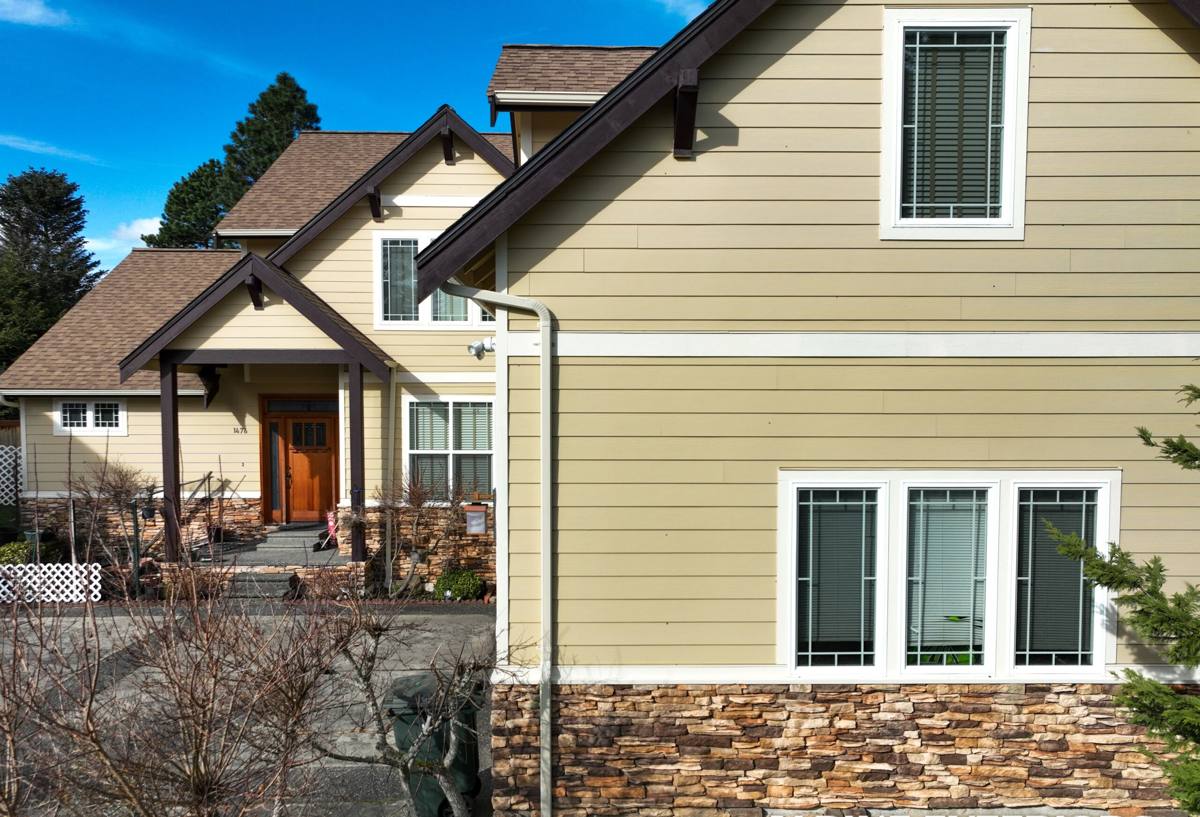
Why Siding Installation Is a Different Job Here Than in Drier Climates
In a dry inland climate, siding installation is mostly about appearance and wind resistance. In Bellingham, the installation itself has to actively manage moisture, because moisture is the constant. That changes several things about how the job should be done:
- Every horizontal seam and butt joint needs to shed water outward, not trap it against the wall sheathing
- Flashing at windows, doors, and roof-to-wall transitions has to be layered correctly with the water-resistive barrier — not just caulked and hoped for
- Bottom clearance from grade, decks, and roof lines has to meet minimum standards so splash-back and standing moisture don't sit against the siding
- Fastener placement and spacing matter more, since panels that shift slightly open hairline gaps that trap moisture
- Ventilation behind the siding (a rainscreen gap) helps panels dry out between storms instead of staying damp for days
None of this is exotic. It's standard best practice for wet-climate siding work. But it only gets applied consistently when the crew doing the installation actually treats it as job-critical, not optional extra steps.
Why We Only Install James Hardie Fiber Cement
We made a decision as a company to install only James Hardie fiber cement siding, and we don't install vinyl, LP SmartSide, Cemplank, Allura, or primed wood products like spruce or cedar lap. That's not a marketing position — it's a practical one, based on what actually holds up in Whatcom County's weather.
Fiber cement is dimensionally stable in a way wood-based and engineered-wood products aren't. It doesn't absorb moisture into its core the way an OSB-based product can, so it isn't prone to the swelling, delamination, and edge failure that shows up on damp-climate homes after a few wet seasons. It's also non-combustible, which matters more each year as wildfire smoke and regional fire risk become part of Pacific Northwest summers, even in a wet county like Whatcom.
James Hardie's HZ5 product line is specifically engineered for climates like ours — colder, wetter, higher humidity — with a formulation built to resist moisture-related damage better than the company's standard-climate products. Combined with the factory-applied ColorPlus finish, which is baked on under controlled conditions rather than field-painted, homeowners get a finish that resists the fading, chalking, and peeling that Bellingham's sun-then-rain cycle causes on site-painted siding.
We're not going to tell you other siding materials don't work anywhere — vinyl and engineered wood have their place. But we've standardized on one product system so we can install it correctly every time, warranty it with confidence, and stand behind the result on a Bellingham roofline for the long haul.
What a Correct Hardie Installation Involves
Installing James Hardie siding correctly is more involved than nailing panels to a wall, and the difference between a correct install and a rushed one shows up in five to ten years, not on day one.
- Confirming the water-resistive barrier is intact and properly lapped before any siding goes up
- Installing flashing at every penetration — windows, doors, hose bibs, light fixtures, vents — integrated with the barrier, not just sealed over the top
- Maintaining Hardie's specified clearances from grade, roofing, and decks
- Using the correct fastener type, length, and spacing for the specific HZ product and substrate
- Priming and painting or caulking cut edges per Hardie's published installation instructions, since factory finish doesn't extend to field cuts
- Following manufacturer-specified gaps at butt joints and inside corners to allow for thermal movement
James Hardie's warranty coverage assumes the product was installed to their written specifications. A crew that skips steps to save time isn't just risking a callback — they're putting the homeowner's warranty coverage at risk without the homeowner ever knowing it.
Our Installation Process for Bellingham Homes
1. On-Site Assessment
We walk the property and look at more than square footage. Sun exposure, prevailing wind and rain direction, roofline drainage, grade slope near the foundation, and existing moisture damage all factor into how we plan the job.
2. Substrate and Barrier Check
Before any new siding goes up, we evaluate the sheathing and water-resistive barrier underneath the existing siding. If there's rot, soft sheathing, or a compromised barrier, that gets addressed first — covering a moisture problem with new siding just hides it for a few more years.
3. Flashing and Drainage Detailing
This is the step that separates a durable installation from a good-looking one. We integrate flashing at every window, door, and roof transition, and we plan drainage paths so water moves away from the wall assembly instead of pooling behind it.
4. Panel Installation to Manufacturer Spec
Fastening, clearances, joint gaps, and cut-edge treatment all follow James Hardie's published requirements for the specific HZ product being installed, so the manufacturer warranty stays fully intact.
5. Final Walkthrough
We review the finished exterior with the homeowner, point out anything worth knowing for long-term maintenance, and make sure the work matches what was scoped.
Comparing Siding Approaches in a Bellingham Climate
| Factor | Vinyl / Engineered Wood | James Hardie Fiber Cement (Our Standard) |
|---|---|---|
| Moisture absorption | Can swell, warp, or delaminate with sustained damp exposure | Dimensionally stable; formulated to resist moisture damage |
| Combustibility | Vinyl softens/melts under heat; engineered wood is combustible | Non-combustible material |
| Finish durability | Field-applied or standard finishes can fade or chalk faster | Factory-baked ColorPlus finish resists fading and chalking |
| Moss and algae resistance | Textured or wood-grain surfaces can hold moisture and organic growth | Smoother, stable surface sheds moisture more consistently |
| Climate-specific engineering | Typically one general-purpose formulation | HZ5 line engineered for cold, wet, high-humidity regions |
Why Local Installation Experience Matters
Siding installation instructions read the same whether the job is in Bellingham or a dry inland town, but applying them well takes judgment that comes from working this specific climate repeatedly. Knowing how far wind-driven rain travels up a wall on an exposed Sudden Valley or Bellingham-facing elevation, how much moss pressure a shaded north wall will see, and where salt air does the most damage near the water isn't something a crew learns from a manual — it's learned from doing the work here, season after season.
A crew that primarily works drier or milder climates may build to code minimums and still leave a Bellingham home under-protected against the specific combination of salt, rain, and moss it will actually face. Hiring locally isn't about hometown loyalty — it's about hiring people who already know what this climate does to a wall assembly and build accordingly.
Questions to Ask Before Hiring Anyone for Siding Installation
- Are you a certified or trained installer for the specific siding product you're proposing?
- Will you inspect the sheathing and water-resistive barrier before installing new siding, or just cover what's there?
- How do you handle flashing at windows, doors, and roof transitions?
- What clearance from grade and other surfaces will the siding maintain?
- Does your installation keep the manufacturer's warranty fully intact, and can you explain what would void it?
- Can you walk me through your process for cut-edge treatment and joint gaps?
Any contractor who can't answer these clearly, or brushes past them, is a warning sign worth taking seriously before signing anything.
Maintenance After Installation
Correctly installed James Hardie siding is low-maintenance, but "low" isn't "zero" in a climate like Bellingham's. A rinse-down once or twice a year knocks back the pollen, dust, and early moss growth before it takes hold. Keeping gutters clear and functioning prevents overflow from running down the wall face. Trimming back vegetation that shades or touches the siding reduces the damp, low-airflow conditions moss and algae need to establish. None of this is heavy work, but skipping it lets Bellingham's climate do more damage than it would otherwise.
If you're weighing a siding installation for a Bellingham-area home, we're happy to walk the property, look at what your current siding is telling us, and give you a straightforward assessment — no pressure, no exaggerated claims. Reach out for a free estimate and we'll talk through what your home actually needs.